
5 Ways AI Is Transforming Natural Stone (2026)
From spectral color matching (1,440x faster than human experts) to AI visualization that eliminates €2,000-5,000 renders, here are 5 AI capabilities reshaping natural stone operations right now.
The industry that time forgot
Natural stone is one of the oldest material industries on earth. Marble has been quarried for over 3,000 years. The tools have improved -- diamond wire saws replaced hand chisels, forklifts replaced ox carts -- but the intelligence layer has remained stubbornly analog. Most quarries still grade by eye, match by memory, allocate by spreadsheet, and sell by phone.
In 2026, that is changing. Not incrementally, but categorically. AI is creating capabilities that did not exist before -- capabilities that no human expert, regardless of experience, can replicate at the speed and accuracy that AI delivers.
1. Spectral color matching: 2 hours to 5 seconds
A client orders 200 square meters of Calacatta for a luxury hotel lobby. The material must be visually consistent across every slab. Traditionally, a senior grading expert visually inspects each slab, comparing it against a reference sample. For 40+ slabs, that is 2 hours of expert time -- and the result depends entirely on the individual's color perception, lighting conditions, and fatigue level.
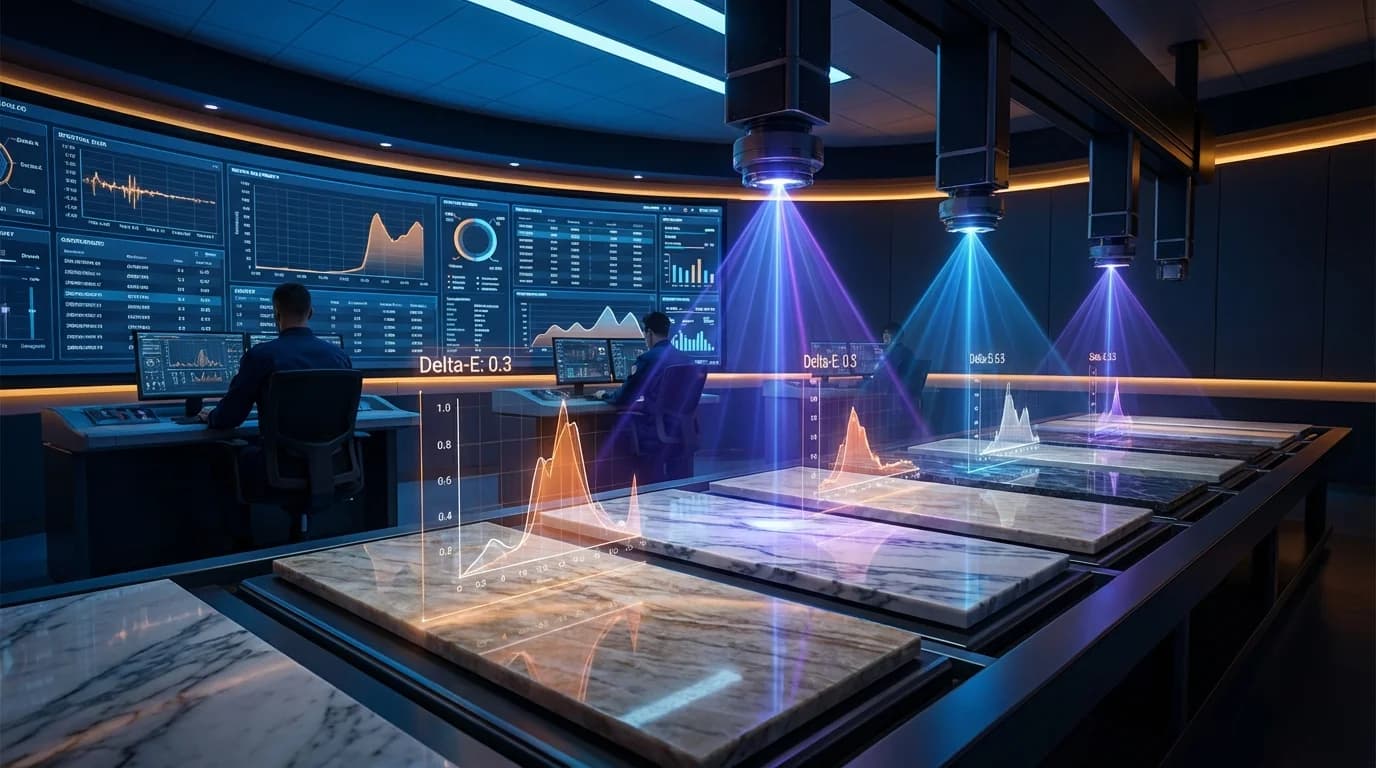
Spectral color analysis captures the precise wavelength signature of each slab's surface. The AI compares these signatures mathematically, calculating Delta-E values with >95% accuracy.
| Metric | Human Expert | AI Spectral |
|---|---|---|
| Time for 40-slab match | ~2 hours | ~5 seconds |
| Speed improvement | -- | 1,440x faster |
| Detectable Delta-E threshold | > 3.0 | < 0.5 |
| Accuracy | Subjective, variable | >95% consistent |
| Affected by fatigue | Yes | No |
The 1,440x speed improvement is not a typo. The expert is freed to make judgment calls that actually require human experience -- assessing veining aesthetics, client preferences, creative matching -- while the AI handles the objective, measurable matching that humans were never well-suited for.
2. AI-powered visualization: €2,000-5,000 renders eliminated
An architect in Milan wants to see your Calacatta Oro in his client's kitchen before committing to a €85,000 order. The traditional answer: hire a 3D visualization studio. Wait two weeks. Pay €2,000-5,000 for a single render. If the client wants to see a different stone, start over.
AI visualization generates photorealistic renders of your actual stone in any space -- from a photograph uploaded by the client. Three modes cover the full specification workflow:
- Generative mode: Upload a room photo, select a stone, see it rendered into the space. Three minutes.
- Inpainting mode: Replace specific surfaces with your stone material while everything else remains untouched.
- Blueprint mode: Generate visualization from architectural drawings before construction begins.
The cost per render: €0. The time per render: three minutes, not two weeks. Every order previously too small to justify a €2,000 render is now viable.
3. Petrographic intelligence: reading a stone's DNA
A block of marble is not a uniform commodity. Its commercial value is determined by internal composition -- pattern type, vein direction, oxidation risk, grain size, mineral inclusions. Traditional analysis requires a trained petrographer examining thin sections under a microscope. Slow, expensive, and rarely performed in commercial operations.
AI petrographic analysis decodes the internal character of a stone from its visual data:
- Pattern type: Book-matched, cross-cut, vein-cut, random classification
- Vein direction and density: Mapped in three dimensions
- Oxidation risk: Iron content assessment, flagging blocks likely to discolor
- Grain size and structure: Affecting polishing behavior and surface durability
No microscope. No thin sections. No human specialist required. The analysis runs on photographs taken during standard block documentation at extraction.
4. Conversational business intelligence: ask your quarry anything
Your quarry generates data constantly -- extraction volumes, inventory levels, sales figures, quality distributions, margin analysis. Getting answers requires someone who knows which dashboard to open, which filters to apply, and how to interpret the results.
Conversational BI lets any team member ask business questions in natural language and receive answers with charts, tables, and context. In any of 12 supported languages.
"What is my yield on Drama blocks this quarter?" -- answered in 5 seconds with a bar chart.
"Show me blocks sitting in inventory longer than 90 days." -- answered with a list, sorted by age, with depreciation estimates.
The AI queries your actual operational data -- 191 database tables covering inventory, sales, clients, logistics, finances, and operations -- and returns deterministic, data-backed answers. Business intelligence is no longer a specialized skill. It is a conversation.
5. Intelligent allocation: 6 strategies, O(1) conflict detection
Every allocation decision involves a tradeoff. Maximize margin? Maximize velocity? Maximize container efficiency? Maximize visual consistency? Human allocators optimize for one variable at a time. They cannot simultaneously evaluate six strategies across an entire inventory.
The intelligent allocator evaluates six optimization strategies simultaneously:
- Margin Leader: Maximizes profit by matching premium slabs to premium clients
- Inventory Flush: Prioritizes aging inventory to reduce storage costs
- Load Optimized: Selects blocks that maximize container fill rate (94% vs. industry average 75-85%)
- Velocity Track: Fulfills urgent orders from nearest high-velocity warehouse
- Visual Harmony: Ensures spectral consistency across every slab in a shipment
- Premium Reserve: Protects top-tier material for VIP clients automatically
Behind every allocation, O(1) conflict detection checks all existing reservations in constant time. Detection time is under one millisecond regardless of inventory size. This protects €420,600 per year for a €20M exporter -- a 32:1 ROI with payback in 11 days.
The industry inflection point
The natural stone industry is the last major construction material sector to be digitized. Concrete has ERP systems. Steel supply chains are fully digital. Even lumber has sophisticated grading and tracking technology.
AI changes the equation because it handles variability natively. It does not need every block to be identical to process them efficiently. It can grade, match, analyze, and allocate blocks that are each unique -- at machine speed, with machine consistency, in any language, across any timezone.
The companies adopting these capabilities in 2026 are not replacing their expertise. They are amplifying it. The senior grader reviews AI-generated matches in seconds. The sales rep manages a global portfolio from a single interface. The quarry owner asks a question and gets an answer in five seconds.
The stone industry has not changed in decades. AI is changing it in months.