
The Science of Spectral Color Matching
Traditional color matching takes 2 hours per set with subjective results. Spectral matching does it in 5 seconds with >95% accuracy. Learn the science behind Delta-E measurement and the 1,440x speed improvement.
The €80,000 rejection
An architect in Milan rejects 40 slabs of Calacatta Borghini. The reason: "the color does not match the sample we approved." The quarry disagrees. The sales rep swears the slabs look identical. The architect holds firm. Forty slabs return to the warehouse. The shipping costs alone exceed €12,000. The material sits in inventory for months before another buyer is found at a discounted price. Total cost of the dispute: approximately €80,000.
This is not unusual. According to the International Institute of Marble, Stone and Restoration (IIMSR, 2023), 7.3% of international natural stone shipments involve color-related disputes. For a mid-sized quarry exporting 200 containers per year, that translates to roughly 14 disputed shipments -- each one a potential five-figure loss and a damaged client relationship.
The root cause is straightforward: human eyes are unreliable instruments for color measurement.
What is Delta-E, and why should you care
Delta-E is a metric that quantifies the perceived difference between two colors. The "E" stands for "Empfindung," the German word for sensation. The current standard, CIEDE2000, accounts for how the human visual system perceives color differences across the full visible spectrum.
The scale is intuitive:
- Delta-E < 1.0 -- Imperceptible to the human eye. Two slabs with this difference are visually identical under any lighting condition.
- Delta-E 1.0 to 2.0 -- Perceptible only through careful side-by-side comparison under controlled lighting.
- Delta-E 2.0 to 3.0 -- Perceptible at a glance. This is roughly where a trained expert begins to flag a mismatch.
- Delta-E > 3.0 -- Clearly different colors. Visible to anyone. This is where disputes start.
The critical gap is between 1.0 and 3.0. This is the range where human experts disagree with each other, where two inspectors in the same warehouse reach different conclusions, and where subjective judgment generates expensive conflict.
Why human eyes fail at color matching
A human color-matching session in a typical quarry warehouse looks like this: a senior inspector examines two slabs under whatever lighting happens to be available. He compares them to his memory of the approved sample, which he may have last seen three weeks ago.
Lighting conditions. The same slab looks different under warehouse fluorescents, daylight, and LED showroom lighting. Metamerism -- where two samples match under one light source but diverge under another -- is particularly common in natural stone with complex mineral compositions.
Fatigue. Color perception degrades over a working day. An inspector making reliable judgments at 8 AM is measurably less accurate by 3 PM.
Subjective standards. Ask five experts to evaluate the same pair of slabs. You will get three different answers.
No documentation. When the inspector says "it matches," there is no record of what he measured, under what conditions, or against what reference.
How spectral color matching works
Spectral color matching replaces subjective assessment with physics.
High-resolution sensors capture the full visible light spectrum reflected by the slab surface -- not just three-channel RGB data, but a dense spectral profile across thousands of data points.
This data is converted into a mathematical color model using the CIE Lab color space, designed specifically to correspond to human color perception. The L axis represents lightness. The a axis runs from green to red. The b axis runs from blue to yellow.
To compare two slabs, the system computes the Delta-E value between their spectral profiles using the CIEDE2000 formula. This formula applies weighting functions that account for known quirks in human vision: we are more sensitive to color differences in certain hue ranges, and our perception of chroma and lightness differences is non-linear.
The entire computation takes approximately 5 seconds. Not 5 seconds per slab. Five seconds to search the entire inventory and rank every slab by color proximity to a reference.
The speed revolution: 1,440x faster
The traditional process: 2 hours per matching set. That is 7,200 seconds of an expert's time, examining slabs one by one, under variable conditions, producing subjective results.
The spectral process: 5 seconds. One scan. Every slab in inventory ranked by measured color distance. Objective. Repeatable. Documented.
That is a 1,440x speed improvement.
A sales representative responding to a client request for "12 slabs of Arabescato that match the Dubai project reference" runs a spectral search from her desk, retrieves every slab with Delta-E < 1.0, and sends results with color certificates attached -- within minutes.
The inspector is not replaced. He verifies loads before they ship. But he starts from a pre-filtered, scientifically validated shortlist instead of scanning the entire warehouse from memory.
Cross-slab consistency: the hidden value
Single-slab matching is useful. Cross-slab consistency across an entire project order is transformative.
Consider a hotel lobby requiring 120 slabs of Thassos White. The architect specifies Delta-E < 1.0 across all 120. With human inspection, this means comparing every slab against every other slab -- a combinatorial explosion no manual process can accomplish.
With spectral matching, the system computes a pairwise consistency matrix for any group of slabs in seconds. It flags the one slab in 120 that deviates by Delta-E 1.3 before the container is loaded, before the shipment crosses a border, before anyone discovers the problem 4,000 kilometers away.
This is quality assurance at the point of selection, not quality control at the point of dispute.
The business impact
Fewer returns. Reducing color disputes by 85%+ from the 7.3% baseline. For a quarry shipping 200 containers per year, that is 12 fewer disputed shipments at an average cost of €25,000 each -- €300,000 in annual savings.
Faster decisions. When matching takes 5 seconds instead of 2 hours, the sales cycle compresses. Faster responses win more deals.
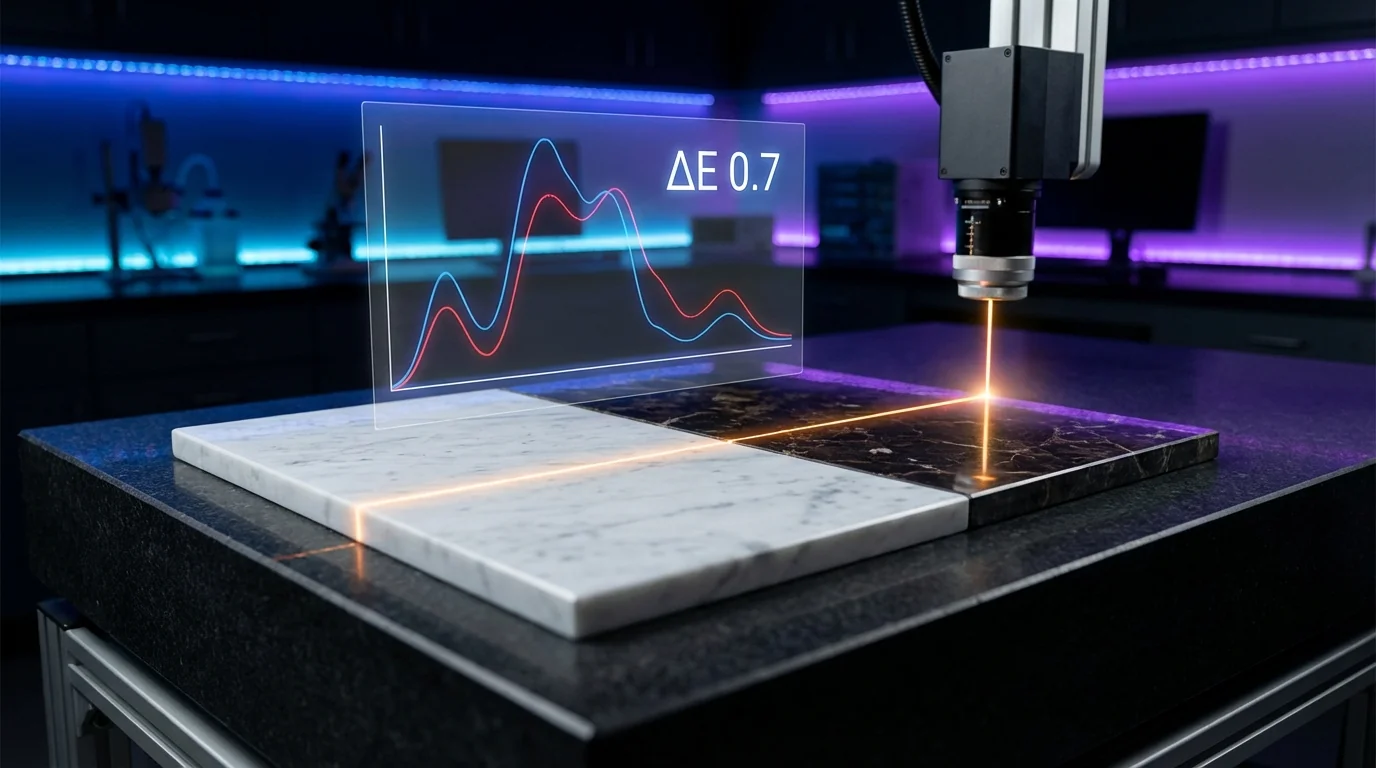
Objective documentation. A color certificate with a measured Delta-E value is not an opinion. It is evidence. When the client's on-site team questions a color match six months after installation, you produce the certificate. Delta-E 0.7. Below 1.0. Imperceptible. The conversation ends.
The stone industry has operated on "trust me" for centuries. Spectral color matching replaces trust with proof -- and proof is better for everyone.