
Pasaporte Digital de Producto para Piedra Natural (2026)
El Reglamento de Productos de Construcción de la UE 2024/3110 entró en vigor el 7 de enero de 2025 y se aplica de forma progresiva. La piedra natural es candidata firme para la primera oleada de actos delegados del Pasaporte Digital de Producto. Esto es lo que las empresas del sector deben preparar ya a mediados de 2026, qué está en fase de implantación y una hoja de ruta de cumplimiento por tipo de empresa.
TL;DR para empresas de piedra a mediados de 2026
Esto es lo que las empresas de piedra deben hacer ya a mediados de 2026, no lo que deben planificar de cara a 2030. Para el planteamiento estratégico de empezar con antelación, véase nuestra guía estratégica de Pasaportes Digitales de Producto 2030; este artículo es el estado táctico a mediados de 2026.
El Reglamento de Productos de Construcción (RPC) de la UE 2024/3110 entró en vigor el 7 de enero de 2025 y se aplica por etapas. La piedra natural, como producto de construcción comercializado en el mercado de la UE, está plenamente incluida en su ámbito de aplicación.
Lo que es obligatorio hoy (mediados de 2026):
- Marcado CE bajo normas europeas armonizadas (requisito de larga data)
- Declaración de Prestaciones (DoP) para productos con marcado CE
- Declaraciones Ambientales de Producto (DAP) -- voluntarias a nivel de la UE, pero cada vez más exigidas por grandes compradores y pliegos de licitación
Lo que está en fase de implantación:
- El propio Pasaporte Digital de Producto, mediante actos delegados bajo el RPC 2024/3110 y el Reglamento de Diseño Ecológico para Productos Sostenibles (ESPR). Los productos de construcción figuran en la lista de prioridades para la implantación temprana.
- El informe de carbono embebido (PCG) a través de normativas de los Estados miembros y reglas de contratación -- ya vinculante en Francia (RE2020), Países Bajos (MPG), Suecia (Klimatdeklaration) y Dinamarca (límites ACV de BR18); en expansión por toda la UE.
Lo que las empresas de piedra deben tratar como presión operativa inmediata: cada bloque, losa o pieza terminada que comercialicen en el mercado de la UE, una vez que se apliquen los actos delegados, deberá llevar un identificador de Pasaporte Digital de Producto y un registro de datos estructurado. Esos datos tienen que provenir de algún sitio. Si empiezan a capturarlos ahora, llegarán al plazo con un registro limpio. Si esperan, llegarán con un retraso acumulado.
¿Qué es un Pasaporte Digital de Producto para piedra natural?
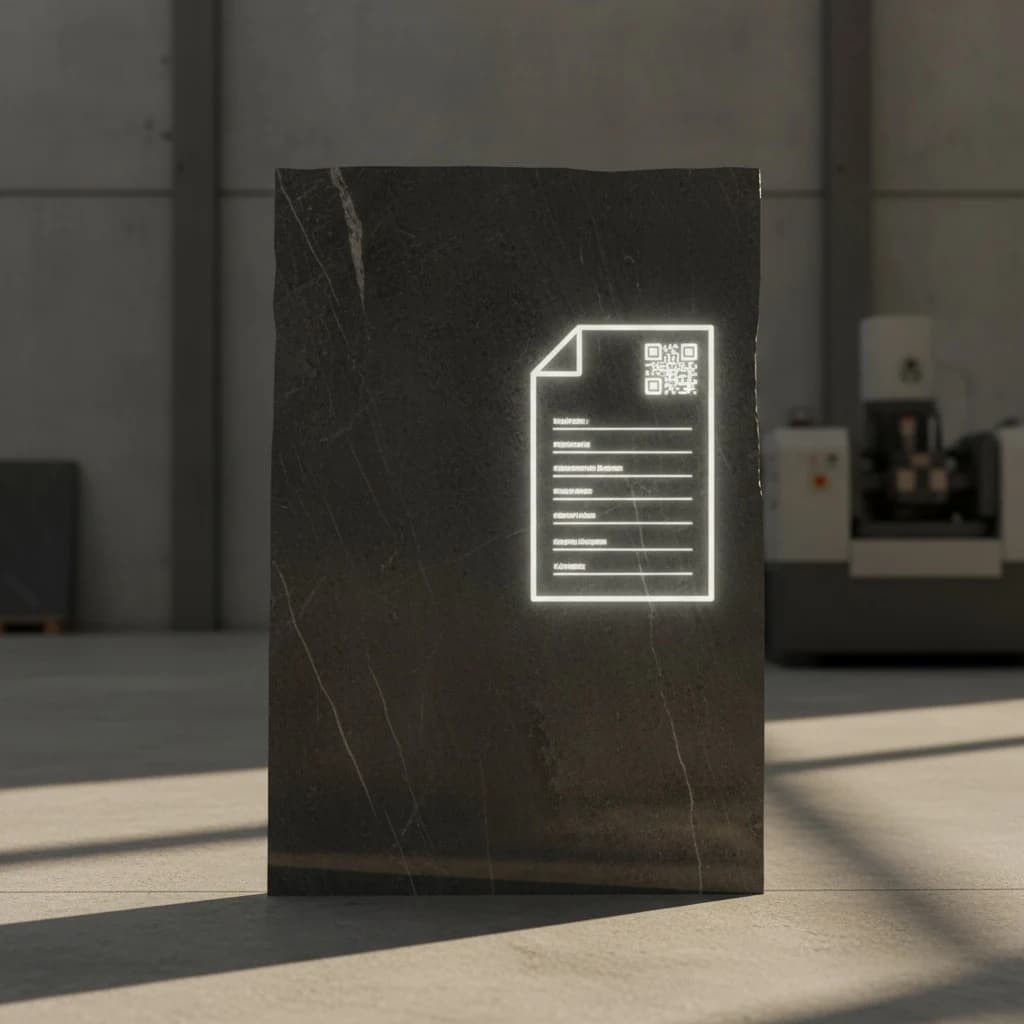
Un Pasaporte Digital de Producto (PDP) es un registro digital estructurado, accesible mediante un identificador único (habitualmente un código QR o RFID), que acompaña al producto a lo largo de todo su ciclo de vida, desde la extracción hasta el fin de vida. Para una introducción al marco regulatorio más amplio y a las categorías de datos, véase nuestra guía estratégica de Pasaportes Digitales de Producto 2030.
Para la planificación del cumplimiento a mediados de 2026, la forma práctica de un PDP para piedra es:
- Un identificador único adherido físicamente al producto o referenciado desde él (bloque, losa o pieza terminada)
- Un registro estructurado legible por máquina almacenado en una base de datos que la UE puede resolver a través de ese identificador
- Campos de datos estandarizados que cubren origen, composición, prestaciones, impacto ambiental y cadena de custodia
- Control de acceso que permite a distintos actores (reguladores, compradores, usuarios finales, recicladores) consultar distintos niveles de detalle
El identificador y el registro de datos son inseparables. Un código QR en una losa sin un sistema de datos de respaldo no es un PDP. Un sistema de datos de respaldo sin un identificador físico tampoco lo es. Ambos son necesarios.
Qué debe proporcionarse ya a mediados de 2026
Incluso antes de que los actos delegados del PDP estén plenamente en vigor, las empresas de piedra que comercializan productos en el mercado de la UE ya están obligadas a proporcionar:
Marcado CE + Declaración de Prestaciones
Obligatorio bajo el RPC vigente para cualquier producto de piedra natural cubierto por una norma europea armonizada (EN 1469 para revestimientos de fachada en losa, EN 12057 para baldosas modulares, EN 12058 para losas para pavimentos y escaleras, EN 12059 para trabajos en piedra natural de talla, y otras).
La DoP debe declarar:
- Tipo de producto, uso previsto, fabricante
- Valores de prestación para las características esenciales conforme a la norma EN pertinente
- Referencia a la especificación técnica armonizada
Documentación de origen
Compradores y reguladores exigen cada vez más un origen trazable: cantera específica, formación geológica, zona de extracción o frente. Aún no está uniformemente impuesto como requisito regulatorio, pero los pliegos de licitación y los contratos de compra de grandes compradores lo exigen con firmeza.
Declaraciones Ambientales de Producto (DAP)
Todavía no son uniformemente obligatorias a nivel de la UE, pero:
- La RE2020 de Francia exige en la práctica DAP (FDES vía INIES) para productos de construcción utilizados en edificios regulados
- El MPG (Milieuprestatie Gebouwen) de los Países Bajos fija umbrales de impacto ambiental que requieren datos de nivel DAP
- La Klimatdeklaration de Suecia (obligatoria desde 2022) y los límites ACV de BR18 de Dinamarca (desde 2023) apuntan en la misma dirección
- Los esquemas de sostenibilidad QNG y BNB de Alemania exigen cada vez más DAP en grandes proyectos
- Los grandes compradores privados en construcción comercial siguen la misma tendencia
Para los exportadores de piedra con clientes en la UE, estar preparados para las DAP es ya un requisito comercial, aunque no sea aún un requisito legal en todos los casos.
Qué está en fase de implantación en los próximos 18 meses
| Fecha | Qué cambia |
|---|---|
| 2026 (en curso) | Aplicación progresiva del RPC 2024/3110: transición de las especificaciones técnicas armonizadas al nuevo marco; estandarización de los formatos de intercambio de datos. |
| 2026-2027 | Actos delegados bajo el ESPR que especifican los requisitos del PDP por categoría de producto. Primeras oleadas previstas para textiles, baterías y electrónica; los productos de construcción figuran en la lista de prioridades pero no en el primer grupo. |
| 2027-2029 | Primera oleada de actos delegados del PDP para categorías de productos de construcción. La piedra natural es candidata firme, pero la secuenciación por categoría aún no ha sido publicada. |
| 2028-2030 | Aplicación progresiva en productos de construcción. Los productos no conformes no podrán comercializarse en el mercado de la UE una vez que los actos delegados sean de aplicación por categoría. |
Las fechas exactas por categoría de producto de piedra se fijarán mediante actos delegados, que aún están siendo elaborados. La dirección está fijada; los hitos precisos están todavía siendo redactados.
«Ya no estamos en una situación de "quizás algún día". El reglamento está en vigor. El marco está establecido. La única variable abierta es si su sistema de datos estará listo cuando llegue el acto delegado para la piedra, o si tendrá que construirse bajo presión de plazo.»
Dimitris Poupouliadis, CEO de Noria Strata
Los cuatro campos de datos más difíciles para el PDP de piedra
La mayoría de los productos de piedra con marcado CE ya cuentan con datos dimensionales y de prestaciones razonablemente completos. La parte difícil del cumplimiento del PDP para la piedra son los cuatro campos para los que los flujos de trabajo tradicionales no están concebidos.
1. Origen a nivel de frente de cantera
No «Grecia» o «Drama». La cantera específica, la zona de extracción o frente concreto, las coordenadas GPS y la fecha de extracción. Una cantera que produce desde cuatro frentes distintos puede tener perfiles de calidad y composición química significativamente diferentes entre esos frentes.
Por qué es difícil: la mayoría de los flujos de trabajo en cantera registran la procedencia a nivel de bloque en papel o en hojas de cálculo básicas, sin resolución a nivel de zona. Reconstruir retroactivamente datos a nivel de zona a partir de años de inventario mezclado es, en la mayoría de los casos, imposible.
Qué funciona: capturar los datos de zona o frente en el momento de la extracción, en un sistema digital, a partir de ahora. Los bloques futuros se convierten en los fáciles.
2. Carbono embebido / PCG
Potencial de Calentamiento Global por unidad funcional declarada (kg CO₂-eq por m² o por tonelada de piedra, según la categoría de producto y la metodología de la norma EN).
Por qué es difícil: el PCG de la piedra depende de la combinación energética en cantera, la distancia y el modo de transporte, la energía de procesado, el consumo de agua y la gestión de residuos. La mayoría de las operaciones con piedra nunca han medido estos factores como una serie temporal estructurada.
Qué funciona: los datos de referencia a nivel de instalación (facturas eléctricas, consumo de combustible, facturas de transporte) asignados al volumen de producción proporcionan un primer PCG por tonelada creíble. Las DAP verificadas por terceros lo elevan al nivel regulatorio. Para el análisis técnico detallado de los módulos de EN 15804, el proceso de DAP y los valores de referencia de PCG por tipo de piedra, véase nuestra guía práctica de declaraciones de PCG.
3. Cadena de custodia
Cada transferencia de custodia física y de titularidad registrada digitalmente. Cantera a transformador, a exportador, a mayorista, a fabricador, a obra. Un identificador compartido que acompaña a la losa en cada traspaso es el mecanismo práctico -- y es exactamente la columna vertebral de datos en torno a la que está construido el módulo de inventario de losas.
Por qué es difícil: la piedra pasa por muchas manos en el comercio. Cada transferencia es un punto de captura de datos. Cada transferencia no documentada es una laguna.
Qué funciona: un identificador compartido (el propio ID del PDP) que acompaña a la losa en cada traspaso, con cada parte registrando su evento de manipulación contra ese ID. Las plataformas en la nube con permisos por actor son la arquitectura natural.
4. Datos de fin de vida y reciclabilidad
Información sobre desmontaje, potencial de reutilización y reciclabilidad del producto de piedra al final de su vida útil.
Por qué es difícil: los datos aún no existen para la mayoría de los productos en el mercado. Las declaraciones genéricas («la piedra natural es reutilizable y reciclable como árido») ya no son suficientes a medida que la regulación se endurece.
Qué funciona: fichas técnicas por producto elaboradas durante el diseño del producto que describen las vías de desmontaje y reutilización. Para la piedra, esto significa en muchos casos sistemas de anclaje y juntas sencillos, duraderos y bien documentados que permiten retirar la piedra intacta al final de la vida útil del edificio.
Hoja de ruta de cumplimiento por tipo de empresa
| Tipo de empresa | Trabajo PDP más urgente en 2026 | Opciones de financiación |
|---|---|---|
| Operador de cantera | Captura de datos de extracción a nivel de zona; sistema de identificación de bloques; medición de referencia de PCG | Subvenciones de transformación digital de la UE (ESPA, Kit Digital, Transizione 5.0) cubren el 50-60% del coste de la infraestructura digital |
| Transformador / fabricador de piedra | Captura de cadena de custodia en la recepción; datos de etapas de procesado con marcas de tiempo; integración del identificador a nivel de losa con la fuente de la cantera | Los mismos programas de la UE, más los esquemas nacionales de digitalización de productos de construcción |
| Exportador / mayorista | Agregación de datos de múltiples proveedores; preparación de DAP para los principales SKU; flujo de documentación de cumplimiento | Los organismos de promoción del comercio en varios Estados miembros cofinancian el desarrollo de DAP |
| Arquitecto / prescriptor | Integrar los requisitos del PDP en los pliegos de compra; elaborar listas cortas de proveedores por nivel de preparación para el PDP | Generalmente no elegible para subvenciones del lado de la producción; palanca de diferenciación comercial |
Pasos prácticos de cumplimiento a acometer este trimestre
No se necesita un sistema PDP completo a mediados de 2026. Es necesario empezar a generar los datos que ese sistema requerirá.
Paso 1: Designar un responsable del PDP. Una persona responsable del seguimiento regulatorio y del programa interno de datos. Sin esto, el trabajo se fragmenta y nunca llega a buen puerto.
Paso 2: Inventariar los datos actuales. ¿Qué se captura ya? ¿En qué formato? ¿Dónde? La mayoría de las operaciones con piedra se sorprenden de cuántos datos están registrados en algún lugar -- y de cuán pocos están en formato digital estructurado.
Paso 3: Elegir un esquema de identificación único. Un código QR impreso en la losa, vinculado a un registro en la nube, es el patrón dominante. Seleccionar un formato que sobreviva a la manipulación habitual y una base de datos que emita identificadores de forma fiable.
Paso 4: Capturar los datos de extracción digitalmente a partir de ahora. Zona o frente, GPS, fecha de extracción, dimensiones (el escaneado LiDAR es ya lo suficientemente asequible como para que no haya excusa de hardware).
Paso 5: Establecer una referencia de PCG a nivel de instalación. Electricidad, combustible, agua, transporte. Asignar al volumen de producción. Este es el punto de partida que se refinará posteriormente en una DAP verificada.
Paso 6: Mapear los traspasos de la cadena de suministro. Para cada traspaso, definir el punto de captura de datos y la parte responsable. Así es como los datos de cadena de custodia se acumulan sin convertirse en un paso manual adicional.
Paso 7: Planificar el desarrollo de DAP para los principales SKU. Las DAP tardan entre 3 y 6 meses en desarrollarse y certificarse. Primero los 3 a 5 SKU de mayor volumen de exportación.
El objetivo para finales de 2026: cada nuevo bloque extraído, cada losa procesada y cada envío despachado genera datos de calidad PDP, aunque el propio marco del PDP no esté aún plenamente activo. El momento de cumplimiento en 2027 o 2028 se convierte entonces en un paso de configuración, no en una crisis documental.
Preguntas frecuentes
¿El Pasaporte Digital de Producto ya es legalmente obligatorio para la piedra hoy?
El marco del PDP está adoptado legalmente bajo el RPC 2024/3110 y el ESPR, y el RPC se aplica progresivamente desde 2025. La obligación específica de emitir un PDP para la piedra natural entra en vigor mediante actos delegados bajo el ESPR, previstos a partir de 2027. A mediados de 2026, el PDP en sí no es aún obligatorio para la piedra, pero los requisitos de base (marcado CE, DoP, y cada vez más las DAP) sí lo son.
¿Aplica esto a los exportadores de piedra no pertenecientes a la UE?
Sí. El RPC se aplica a los productos comercializados en el mercado de la UE independientemente del lugar de producción. Un exportador de piedra brasileño, turco o indio que venda en Europa está obligado a cumplir los mismos requisitos de PDP que un productor de la UE. El exportador o el importador de registro es el responsable de los datos.
¿Cuál es la diferencia entre un PDP y una DAP?
Una Declaración Ambiental de Producto (DAP) es un documento verificado que cubre el comportamiento ambiental (PCG, energía, agua, etc.) de un producto, calculado según la metodología ISO 14025 / EN 15804. Un Pasaporte Digital de Producto es un registro estructurado más amplio que cubre identidad, prestaciones, datos ambientales, cadena de custodia e información de fin de vida. Los datos de la DAP son uno de los elementos del PDP; el PDP es el contenedor.
¿Cuánto cuesta el cumplimiento del PDP para una operación de piedra típica?
El coste está dominado por la infraestructura de datos (registros digitales de extracción, base de datos en la nube, sistema de identificación de losas) y el desarrollo de DAP. Orden de magnitud aproximado: EUR 10K a EUR 40K para la infraestructura de datos de una operación pequeña o mediana, más EUR 4K a EUR 8K por DAP para los principales SKU (dependiendo del organismo de verificación y la complejidad del producto). Las subvenciones de transformación digital de la UE suelen cubrir entre el 45 y el 60% del coste de la infraestructura.
¿Qué ocurre si un producto llega al mercado de la UE sin un PDP válido después del plazo?
Una vez que el PDP sea obligatorio para una categoría de producto, los productos comercializados en el mercado de la UE sin un PDP válido serán no conformes. Los Estados miembros podrán denegar el acceso al mercado, exigir la retirada e imponer sanciones. El modelo de ejecución exacto está siendo finalizado mediante reglamentos de aplicación, pero la base jurídica para la denegación está establecida.
¿Debo esperar a que los actos delegados sean definitivos antes de actuar?
No. El trabajo de captura de datos -- registros de extracción, referencias de PCG, cadena de custodia -- tarda entre 12 y 24 meses en configurarse correctamente, y más tiempo aún en acumular el historial suficiente para ser útil. Para cuando los actos delegados cristalicen el esquema técnico exacto, las empresas que no hayan empezado llevarán entre 18 y 24 meses de retraso. El esquema cambiará en los detalles; las categorías de datos subyacentes no lo harán.
Qué ofrecemos en NoriaStrata
El módulo PDP de NoriaStrata está diseñado conforme al modelo de datos del RPC 2024/3110 y del ESPR. Aborda las partes del problema del PDP que resultan más difíciles para los flujos de trabajo tradicionales de piedra:
- Captura de datos de extracción a nivel de zona con GPS, fecha de extracción y atribución por frente de cantera, transferidos a lo largo del ciclo de vida de la losa.
- Registro de cadena de custodia con cada traspaso firmado por la parte responsable contra el mismo identificador de losa.
- Referencia de PCG a nivel de instalación integrada con datos de extracción y procesado, diseñada para alimentar cálculos de DAP e informes de PDP.
- Identificadores digitales estandarizados (códigos QR por losa, persistentes a lo largo del procesado y el comercio), con acceso a datos por actor resuelto en la nube.
Tres principios que guían la plataforma:
- Datos capturados en la fuente. PCG, origen, dimensiones -- registrados en la extracción y el procesado, no reconstruidos años después.
- Un solo identificador en toda la cadena. El identificador del PDP emitido en la cantera viaja con la piedra a través de cada transferencia.
- Diseñado conforme a los esquemas borradores actuales. La plataforma sigue la evolución de los actos delegados del RPC para que la estructura de datos subyacente se mantenga alineada con lo que los reguladores acabarán exigiendo.
Para las operaciones de piedra que se preparan para la oleada de PDP de 2027 a 2029, el módulo PDP y de cantera de NoriaStrata es la plataforma que ofrecemos. El complementario módulo de inventario de losas basado en iPhone gestiona los datos a nivel de losa aguas abajo de la extracción.