
How to Choose Quarry Management Software
A practical framework for natural stone businesses evaluating quarry and slab management software — covering must-have capabilities, mobile LiDAR measurement, an 11-language client portal, EU Digital Product Passport readiness, and pricing.
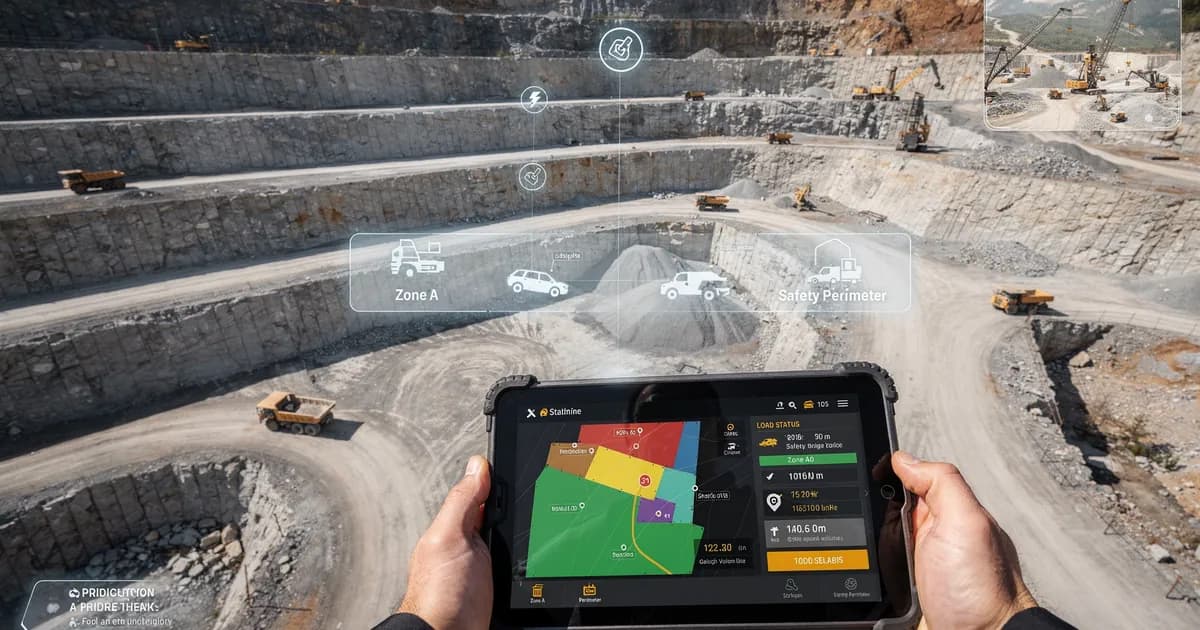
How to Choose Quarry Management Software for Natural Stone
Choosing the wrong software for your stone operation is not just an efficiency problem — it is a competitive disadvantage that compounds quietly over time. Mismatched slabs, manual inventory errors, and fragmented client communication all trace back to the same root cause: a platform that was never designed for natural stone.
This guide gives you a decision framework to evaluate your options honestly, whether you are replacing spreadsheets, migrating from a generic ERP, or consolidating point tools that no longer scale.
---
Why Generic ERP and Inventory Tools Break Down in Stone
Standard ERP and warehouse management systems operate on the assumption that every unit of a product is identical. They are built for SKUs: a product code that represents a repeatable, uniform item. Natural stone is the opposite of that.
Every block pulled from a quarry is unique — different dimensions, weight, colour tone, veining intensity, and geological origin. Every slab cut from that block inherits those characteristics in a different way. No two slabs are the same, yet most generic systems assign them the same product code and manage them identically.
The consequences are predictable: clients receive slabs that do not match their project selections, orders are allocated incorrectly, and your team spends hours reconciling physical stock against digital records that were never accurate to begin with.
The fundamental requirement for natural stone software is individual-item traceability — from block extraction through cutting to client delivery. Systems that cannot support this are not a compromise; they are a liability.
---
Must-Have Capabilities When You Evaluate Quarry Management Software
When you assess any platform claiming to handle natural stone operations, measure it against this capability set.
1. Block-to-slab traceability. Can the system track the lineage of every slab back to its parent block, including cut sequence, dimensions, and quarry lot? This is the foundation of everything else.
2. Accurate 3D measurement. Manual measurement is slow and error-prone. Look for integrated measurement tools that capture real dimensions and link them automatically to inventory records.
3. AI stone classification. The system should identify stone type, colour family, and veining pattern automatically, reducing manual cataloguing time and improving consistency across your catalogue.
4. Spectral colour matching (Delta-E). For clients matching slabs to an existing installation or a specific project palette, Delta-E colour distance gives an objective, repeatable metric. This matters especially for exports where physical viewing is not possible before purchase.
5. Real-time client portal. Your clients need to browse available stock, view accurate slab images and dimensions, and make selections without waiting for your team to compile a PDF or send an email attachment.
6. Intelligent order allocation. When an order comes in, the system should match it against available inventory based on the actual characteristics of each slab — not just a product code.
A platform that covers all six of these capabilities in an integrated way is qualitatively different from one that covers two or three. The gaps between modules are where errors happen.
---
Mobile-First Measurement: The Case for iPhone and iPad LiDAR
Dedicated 3D scanning hardware — wands, structured-light scanners, laser measurement stations — can be accurate, but carries a significant cost barrier: the equipment itself, the training required, and the workflow friction of maintaining separate devices for field teams.
NoriaStrata uses the LiDAR sensor built into iPhone and iPad Pro to achieve +/- 2 cm accuracy on block and slab measurement with no additional hardware required. Your team uses the same devices they already carry. Scanning becomes part of the daily workflow rather than a specialist task.
For operations evaluating quarry management software on a budget, this distinction matters considerably. The measurement capability does not require a capital investment beyond the mobile devices most operations already own. It also means the system scales without proportional hardware cost as your team or yard expands.
---
Integrated Platform vs. Point Tools: Why 16 Modules in One System Changes the Equation
It is tempting to assemble a best-of-breed stack: one tool for inventory, another for client-facing catalogues, a third for order management, and spreadsheets to connect them all. In practice, this approach creates data silos that require constant manual reconciliation.
NoriaStrata's 16 integrated modules cover the full operational lifecycle — from quarry block registration and quarry inventory management, through slab inventory and order allocation, to client portal access and DPP documentation. Because all modules share a single data layer, a dimension captured during scanning is immediately available in the client portal, in order allocation, and in reporting — with no re-entry and no synchronisation lag. The same platform is packaged per vertical — see the dedicated solutions for stone processors and stone distributors.
The comparison is worth making explicit:
| Capability | Spreadsheets + Point Tools | NoriaStrata |
|---|---|---|
| Block-to-slab traceability | Manual, error-prone | Automated, linked to scan data |
| 3D measurement | Dedicated scanner or tape measure | iPhone / iPad LiDAR, +/- 2 cm |
| AI classification | Not available | Stone type, colour, veining |
| Client portal | Static PDF or email | Real-time, 11 languages |
| Order allocation | Manual matching | Intelligent, characteristic-based |
| DPP readiness | Not available | Built-in, EU regulation ready |
Each row represents a workflow your team currently handles somehow. The question is whether the current approach scales with your volume, your export ambitions, and the regulatory environment ahead.
---
Multilingual Client Portal: A Real Differentiator for Exporters
Natural stone is a global trade. Quarries in Greece, Turkey, Spain, and Italy sell to distributors and specifiers across Europe, the Middle East, Asia, and the Americas. A client portal in a single language is a friction point in every market where that language is not the working language.
NoriaStrata's client portal is available in 11 languages, meaning your international clients browse and select in their own language without requiring your team to localise content manually. For exporters managing relationships across multiple regions, this is not a cosmetic feature — it reduces the support overhead and the miscommunication risk that slows cross-border sales.
---
Digital Product Passport Readiness: Why It Belongs in Your Selection Criteria Now
The EU's Digital Product Passport regulation will require product-level digital documentation — provenance, composition, environmental data — for a range of industries. Natural stone is among the priority sectors, with mandatory compliance expected around 2027.
Operators who wait until the regulation arrives to evaluate their software options will face a rushed migration under time pressure. Operators who choose a DPP-ready platform now build compliance into their workflow incrementally, at their own pace.
When you evaluate any quarry management software today, ask explicitly: is this platform designed to generate and export DPP-compatible records? This is a forward-looking selection criterion that will determine whether your software choice remains fit for purpose in three years.
---
Pricing and ROI Framing
NoriaStrata is priced at EUR 499 / month (Essentials) and EUR 999 / month (Professional), with custom Enterprise plans for larger operations.
The ROI framing is straightforward: calculate the current cost of inventory errors, manual reconciliation time, client disputes over slab matching, and the hardware cost of dedicated scanning equipment. In most operations, the combined cost of those inefficiencies — in labour, in returns, in lost repeat business — exceeds the platform fee within the first year.
View full pricing and plan details to compare what each tier includes for your operation size.
---
Selection Checklist
Before signing a contract with any quarry management software vendor, work through this list:
- Does it support individual-item traceability from block to slab delivery?
- Does it include integrated 3D measurement, or does measurement require third-party hardware?
- Does it offer AI classification for stone type and colour?
- Does it include Delta-E colour matching for client-facing selection?
- Is there a real-time client portal, and in how many languages?
- Does the platform cover order allocation based on slab characteristics?
- Is DPP documentation supported or on the roadmap with a credible timeline?
- What is the total cost of ownership, including hardware, integrations, and training?
- How many modules are included versus sold separately?
- Is there a live demo available before you commit?
---
Frequently Asked Questions
What makes natural stone software different from standard inventory management? Standard inventory systems are designed for identical, repeatable units. Every natural stone slab is unique in dimensions, colour, and veining, so the system must track individual items rather than product codes. Without this, matching and allocation errors are structurally inevitable.
Do I need dedicated scanning hardware to use NoriaStrata? No. NoriaStrata uses the LiDAR sensor built into iPhone and iPad Pro for block and slab measurement at +/- 2 cm accuracy. No additional hardware is required, which significantly lowers the cost of entry compared to dedicated 3D scanners.
When will Digital Product Passports be mandatory for natural stone? The EU's DPP regulation is expected to cover natural stone as a priority sector around 2027. Choosing a DPP-ready platform now means you build compliance into your daily workflow incrementally, rather than facing a forced migration under a regulatory deadline.
Is NoriaStrata suitable for operations that export internationally? Yes. The client portal is available in 11 languages, which reduces the friction and support overhead of managing client relationships across multiple regions without manual localisation effort.