
At a glance
- A study of travertine from seven Turkish quarries defines the vein cut as the cut in which the stone's "waterway structure appears", and the cross cut as the one in which it "is not visible"1.
- In the same study, capillary water absorption and compressive strength were both higher parallel to the waterway structure than perpendicular to it1.
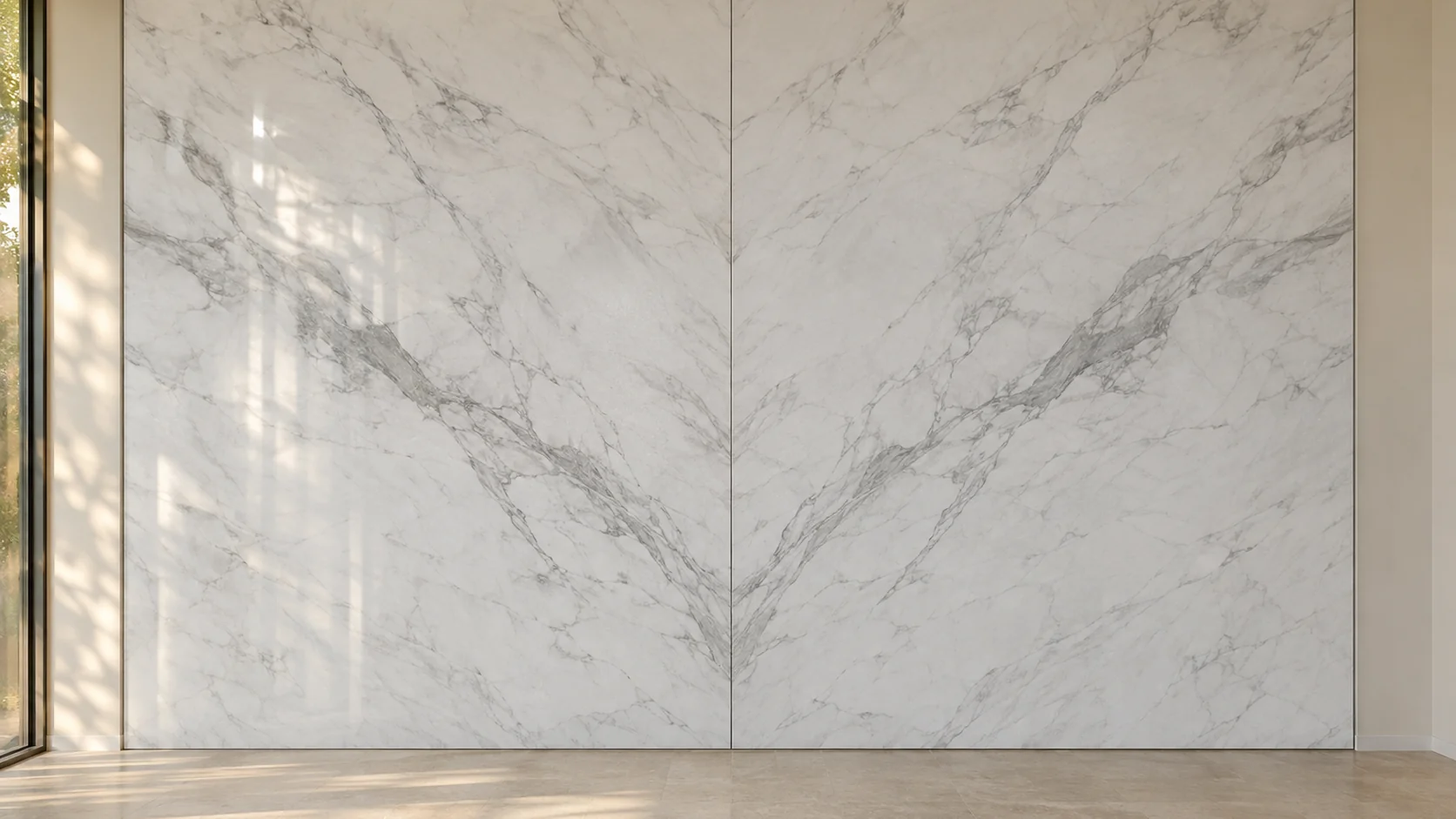
- Bookmatched slabs are neighbours from one block, polished on the faces that touched, so that "they will be mirror images of each other"5.
- Between two neighbouring slabs only the saw's kerf is lost, about 6.5–9 mm on a gang saw and about 7 mm on a multi-wire saw in makers' 2006 figures6.
Same block, two faces
Vein cut and cross cut are two ways of sawing the same block of a layered stone, and the difference is plain on the slab. A vein-cut slab shows the stone's layers as long parallel bands. A cross-cut slab, also sold as fleuri, shows a cloudy, mottled surface with no clear direction. A study of travertine from seven quarries near Denizli, in Turkey, defines the two by what the factory sees: the cut in which the stone's "waterway structure appears" is the vein cut, and the cut in which it "is not visible" is the cross cut1.
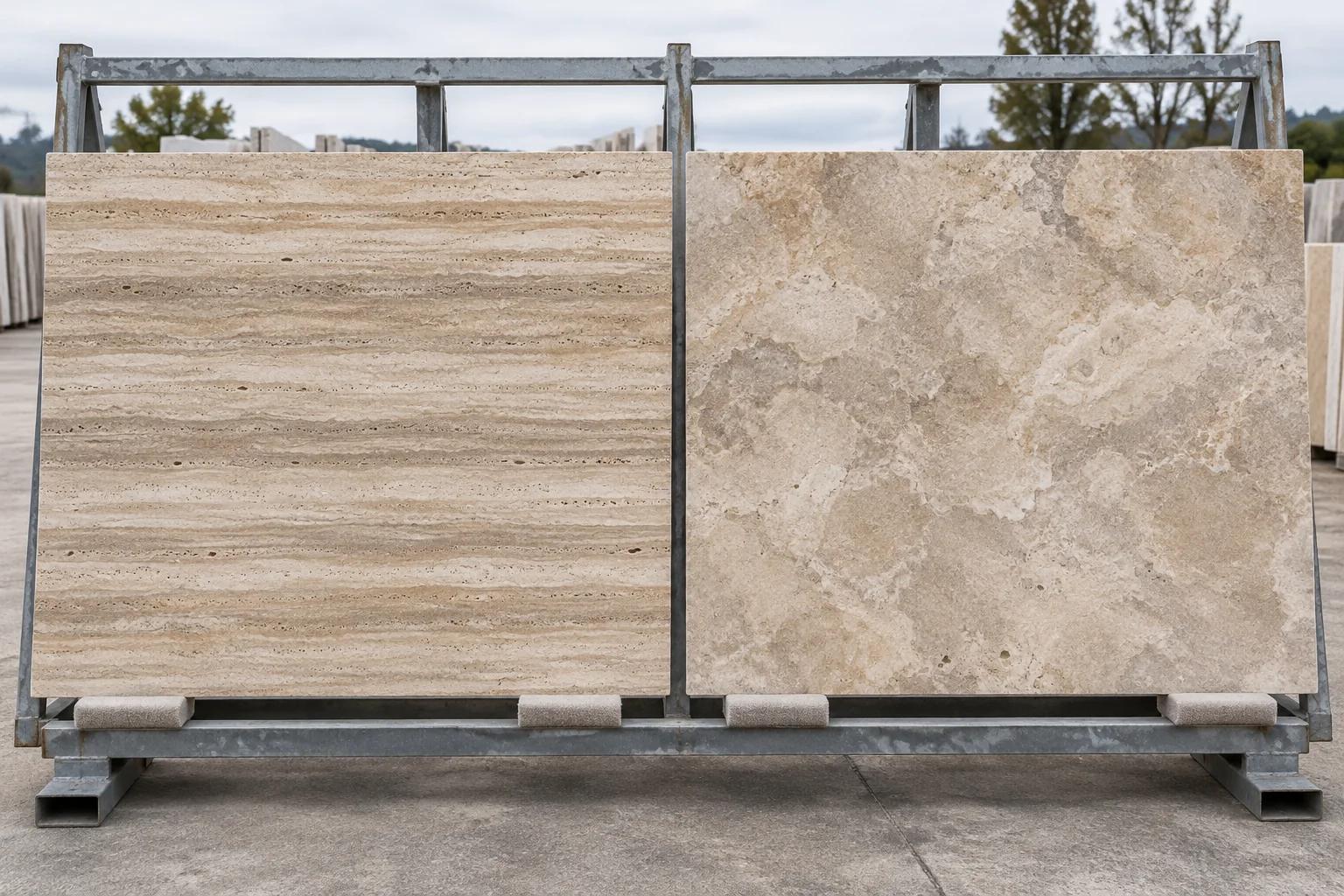
Why one block gives both comes down to geometry. Travertine and other banded stones are built of layers laid down one on top of another. A saw plane that crosses the layers cuts through every one of them, so each shows on the face as a line: stripes. A saw plane that runs along the layers stays inside one of them, so the face shows that layer's own texture: cloud. Turn the block a quarter turn on the saw and every slab it gives changes.
The block
The slab face it gives · Vein cut
Drawn from a model of layered stone, not a photograph
Cross cut (fleuri) · Along the layers
Vein cut · Across the layers
Saw plane at 90° to the layers
The saw crosses every layer, so each one shows on the face as a line: stripes.
Not every travertine is equally layered. A classification by García-del-Cura and colleagues, cited in a 2026 review, sorts travertines by the thickness of their layers into massive, banded, laminated and crypto-laminated types2. The stronger the banding, the more the direction of the cut decides the look.
The names are muddled; the face is not
Written explanations of the two cuts do not agree on how to describe the saw. One producer's guide, for example, describes the vein cut as sawn "against the vein" and yet "parallel to the natural bedding plane"3, which does not fit the geometry above. Italian producers sell travertine «in falda»4. Falda is the bed, or layer: read literally, a cut «in falda» runs in the bed and gives the cloudy face, and a cut «controfalda» runs against it and gives the stripes.
When the words disagree, the slab settles it. Ask for photographs of the slabs you will actually receive: stripes mean vein cut, cloud means cross cut.
Which stones it applies to
Travertine is the classic case, and it is where buyers meet the terms most often. The same logic applies to any stone with strong banding, and the terms are used for marble slabs too3.
Granite rarely has layers to show, but quarrymen have long read direction in it as well. The U.S. Geological Survey's early granite bulletins, as quoted in a glossary of quarrying terms, call the rift "an obscure microscopic cleavage in granite which greatly facilitates quarrying" and the grain the direction in which the stone splits "next easiest". The hard way runs at right angles to both, the direction "in which granite does not split readily"7.
The cut changes more than the look
Layered stone does not behave the same in every direction. In the Denizli study, both capillary water absorption and uniaxial compressive strength were higher in the position parallel to the waterway structure than perpendicular to it, and the author concludes that "travertines are natural stones exhibiting anisotropic properties"1. A 2026 review summarises the same study as finding vein-cut samples about 1.45 times as strong as cross-cut ones2. It also cites work on banded travertines in which, at low porosity, strength was highest perpendicular to the layering2.
These are results for particular stones, not rules for every travertine. For floors, stairs and façades, ask the supplier for test results that match the direction in which the stone will be used.
Neighbouring slabs are near twins
A gang saw or a multi-wire saw turns a block into a stack of slabs separated only by the width of each cut. In 2006 machine makers gave gang-saw kerfs of 6.5 to 9 mm, and about 7 mm for a multi-wire saw, the diameter of its diamond beads6. So the pattern on one slab carries on, a few millimetres later, on the next. That is what makes matching possible, and it is why the order of the slabs is worth keeping from the moment they leave the saw. How the block itself came out of the quarry is in our article on how marble and granite are quarried.
Bookmatching: two neighbours, opened like a book
Bookmatching takes two neighbouring slabs and opens them like the pages of a book. The faces that touched each other in the block are polished, so that, in the words of the Natural Stone Institute, "the pattern on each stone will be virtually identical, except they will be mirror images of each other"5.
This has to be planned where the slabs are cut. The Institute notes that the facing surfaces are polished at that stage and that it "is not commonly done at a fabricator's shop"5. When every slab of a block is polished on the same side, the trade calls it consecutive or sequential polishing; such slabs "are usually numbered so you can purchase neighboring slabs if needed"5. A sequential pair can sometimes be turned into a bookmatched one by polishing the back of one slab, but slabs processed with bookmatching in mind are "less hassle and more reliable"5.
Two practical points follow. The edges that will meet "have to be in near-perfect condition", and any chip or crack trimmed off one slab must also be taken off its mate5. And the mirror is never perfect: "such perfection is not attainable in actual stone fabrication due to variation within the stone"5. Because a bookmatch always needs two slabs, even for a small area, it "tends to be more expensive than a standard layout"5.
The block on the saw: slabs in cutting order
Between neighbours only the kerf is lost: 6.5–9 mm on a gang saw, about 7 mm on a multi-wire saw (makers' figures, 2006)

Bookmatch Slabs 4 and 5, neighbours in the block. The faces that touched are polished, and the pair opens like a book into mirror images.
Quad or diamond match Four pieces from neighbouring slabs, mirrored left to right and top to bottom.
Slip match Slabs side by side in cutting order, the same face up, so the pattern runs on from one slab to the next instead of mirroring.
Bookmatch
Slabs 4 and 5, neighbours in the block. The faces that touched are polished, and the pair opens like a book into mirror images.
What it needs: Mirror polishing planned where the slabs are cut; edges in near-perfect condition. · Slabs used: 4, 5
Three ways to lay a sequence
| Pattern | How the slabs are laid | What it needs | Source |
|---|---|---|---|
| Bookmatch | Two neighbouring slabs, facing sides polished, opened like a book | Mirror polishing planned where the slabs are cut; edges in near-perfect condition | 5 |
| Quad or diamond match | Four pieces, mirrored left to right and top to bottom | Four pieces from neighbouring slabs | 5 |
| Slip or vein match | Slabs side by side, same face up, so the veins run on across the joints | Slabs polished on the same side, kept in their numbered order | 5 |
Keeping a set together
A bookmatched or sequence-matched set is worth most as a set. Split it, and each half loses the thing that made it special. For a yard, that means keeping the bundle together and visible as one: the slab numbers in cutting order, which face was polished, the block it came from, and a hold on all the slabs as soon as a buyer reserves one of them. Selling the same slab twice is a risk in any yard, and a matched set makes it costlier; we covered the wider problem in the double-selling problem.
For a project, write the choice down before anything is cut: vein cut or cross cut, the match, the slab numbers and which face is up. Then lay the slabs out together and look at them in that order.
Frequently Asked Questions
What is the difference between vein cut and cross cut?
Both come from the same kind of block, sawn in two directions. A vein cut runs across the stone's layers, so the slab shows them as long parallel bands. A cross cut, also called fleuri, runs along them, so the face is cloudy. A study of Turkish travertine defines the two by whether the stone's "waterway structure" shows on the face1.
Is vein cut stronger than cross cut?
In tests on travertine from seven quarries near Denizli, Turkey, compressive strength and capillary water absorption were both higher parallel to the waterway structure than perpendicular to it1. A 2026 review summarises the study as finding vein-cut samples about 1.45 times as strong as cross-cut ones2. It is one stone and one study, so ask for test results for the stone you buy.
What does bookmatched marble mean?
Can any two slabs be bookmatched?
Only neighbours from the same block, and it works best if they were polished for it where they were cut. Slabs polished on the same side can sometimes be converted by polishing the back of one, but the Natural Stone Institute calls slabs processed for bookmatching from the start "less hassle and more reliable"5.
What is a slip match?
Slabs laid side by side with the same face up, in cutting order, so that the veins run on across the joints instead of mirroring. The Natural Stone Institute calls it vein-matching or slip-matching5.
How Noria Strata handles this
In Noria Strata a bundle opens into numbered slabs, each with its sizes, a photo and a status, and the order for bookmatch is kept (slabs). Every slab keeps its block, so a set can be traced back to the block it came from. Holds stop the same slab being sold twice. In the client portal, buyers can mirror and rotate slabs to preview a bookmatch before they choose.
Sources
- Çobanoğlu, İ. (2020). Anisotropic changes of capillary water absorption and compressive strength parameters in "vein cut" and "cross cut" shaped travertines (Su yollu yapıya dik ve paralel kesilmiş travertenlerde kapiler su emme ve basınç dayanımı özelliklerinin anizotropik değişimlerinin incelenmesi). Journal of Scientific Reports-B 2: 55–67 dergipark.org.tr/en/pub/jsrb/article/1111878
- İnce, İ., Balcı, M. C., Bozdağ, A. & Tosunlar, M. B. (2026). Evaluation of anisotropy in rocks using non-destructive testing methods. Acta Geodynamica et Geomaterialia 23(2): 223–234. DOI 10.13168/AGG.2026.0014 irsm.cas.cz/materialy/acta_content/2026_doi/Ince_AGG_2026_0014.pdf
- Elite Stone S.r.l. (2023). What are Vein Cut (VC) and Cross Cut (CC)? 27 July 2023 (a producer's guide) elitestone.it/advices/what-are-vein-cut-vc-and-cross-cut-cc
- Moruzzi. Travertine Travertino Romano Classico in falda (a producer's product page) moruzzi.com/travertine-travertino-romano-classico-in-falda
- Kirk, K. (2018). Bookmatching: Geology Meets Geometry. Use Natural Stone (Natural Stone Institute), 21 December 2018 usenaturalstone.org/bookmatching
- Daniel, P. (2006). Multi-wire saws gains ground. Stone Business, 6 December 2006 (trade press) stonebusiness.us/?p=416
- Quarries and Beyond. Glossary: granite (terms quoted from T. Nelson Dale, U.S. Geological Survey Bulletins 354, 1908, and 738, 1923) quarriesandbeyond.org/articles_and_books/glossary-granite.html
How to cite this article
Poupouliadis, D. (2026). Vein cut, cross cut and bookmatching: how the saw decides the look. Noria Strata. https://www.noriastrata.com/en/blog/vein-cut-cross-cut-bookmatching
The author
Dimitris PoupouliadisCo-founder & Customer Success Manager, Noria Strata