
At a glance
- The U.S. Geological Survey defines dimension stone as rock quarried to obtain blocks or slabs of specified size and shape; colour, pattern and finish are normal requirements too1.
- Commercial blocks are sound, box-shaped blocks "usually weighing 5 to 15 t", often cut step by step from primary slices of thousands of cubic metres2.
- A quarry diamond wire carries beads of 10–11 mm, 35–43 per metre2; at one Iranian travertine quarry it cut about 5.5 to 7 m² of face an hour at a wire speed of 30 m/s9.
- Carrara cut marble with a steel helical wire and quartz sand from 1895 to about 19783; the diamond wire reached its quarries at the end of the 1970s5.
Quarried, not mined
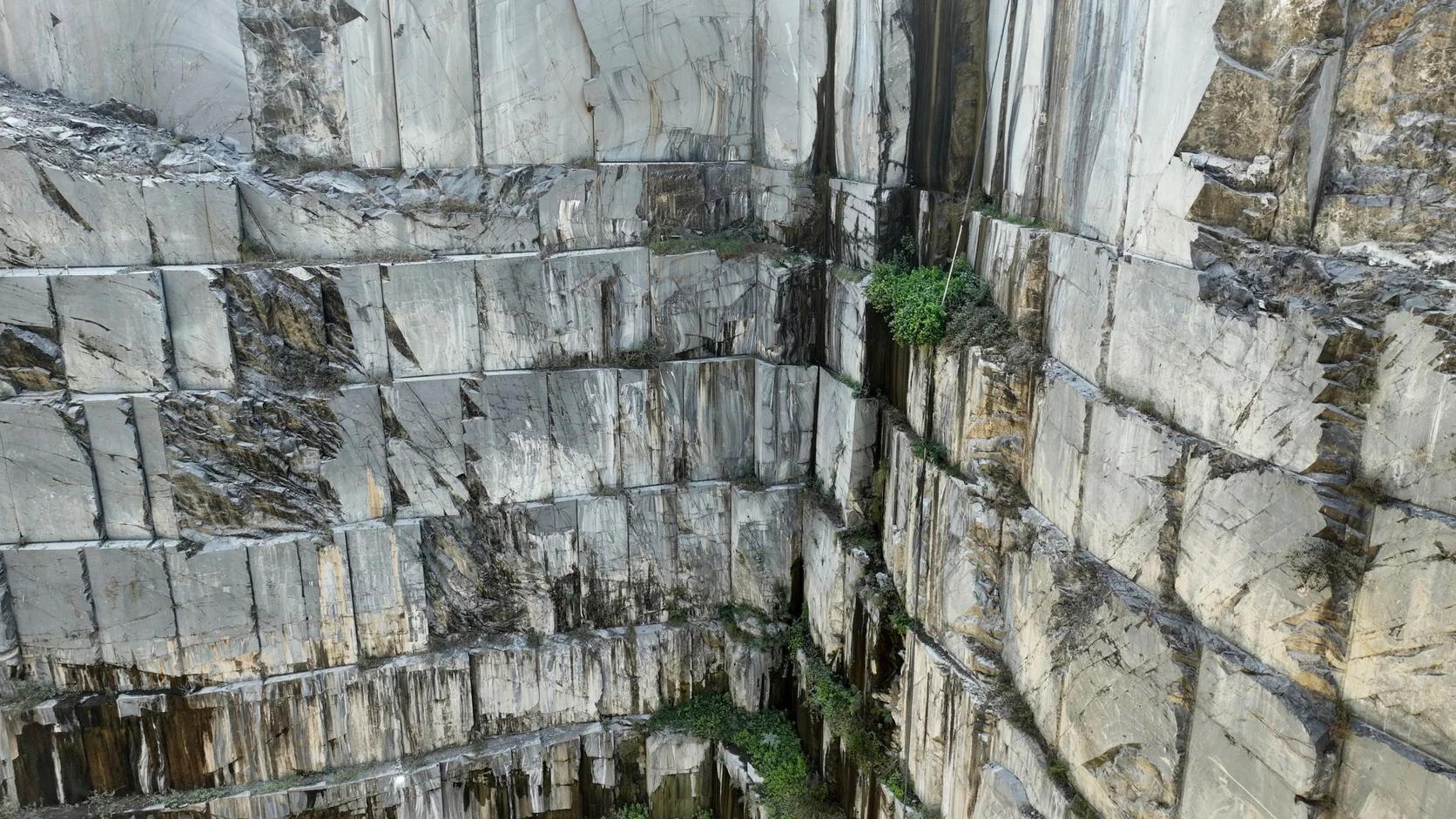
Marble and granite for building leave the mountain as large, sound blocks, not as blasted rubble. The U.S. Geological Survey defines dimension stone as "natural rock material quarried for the purpose of obtaining blocks or slabs that meet specifications as to size (width, length, and thickness) and shape", and adds that colour, grain texture and pattern, and surface finish are normal requirements too1. People often search for «marble mining»; in the trade the work is called quarrying, and its whole aim is to get the stone out without cracking it.
What a quarry sells is the commercial block. A survey of Italian quarries by the Politecnico di Torino describes it as a sound block "of parallelepiped shape usually weighing 5 to 15 t, suitable for further processing and for the production of slabs or other architectural items"2. The same survey describes two ways of getting there2:
- Large slices first. "Large volumes of rock, usually in the range of thousands of m3, are removed by primary cuts from the rock body and, subsequently, stepwise, divided into commercial blocks"; unsuitable material is discarded along the way.
- Blocks straight from the rock. Commercial blocks are cut directly from the rock body, a method "mostly applied to very regular and homogeneous deposits and especially to underground operations".
Most open quarries work the first way, in steps called benches. The rest of this article follows one bench from the face to the factory.
From the face to the block, in six steps
The order and the tools change with the stone and the quarry. The sequence below is the common pattern in an open marble quarry such as those of Carrara, drawn from Italian sources2,6,7.
- Plan the cut. The quarry first studies the face: the layout of the cut, its direction and the points where holes will be drilled. Then the area is marked out6.
- Drill. Holes are drilled into the rock so that a wire can be threaded through it and closed into a loop around the section to be cut6.
- Cut the bench free. In a worked example of the Turin survey, a primary block of 512 m³ needs three cuts when one vertical side is already open and no natural parting, an "easy way", helps2. Italian accident reports on marble benches describe the first cut made at the base of the whole bench with a chain-cutting machine, then a vertical cut at the back7.
- Push it over. Flat hydraulic cushions, two thin steel sheets welded together and filled with water under pressure by an electric pump, are slid into the cuts. As they swell, the bench tips over onto the quarry floor7.
- Cushion the fall. Where it lands, the quarry lays a bed of earth mixed with stone chips to soften the impact7.
- Square it into blocks. On the ground, the bench is squared into blocks of commercial size7. Each block is then measured. EN 1467:2022 defines a rough block's gross, net and commercial sizes13; how that is done, and how far the three can differ, is in our article on how a quarry block is measured.
Step 6 of 6
Square it into blocks
On the ground the bench is squared into commercial blocks, usually 5 to 15 tonnes each. Each block is then measured.
1. Plan the cutThe quarry studies the face: the layout of the cut, its direction and where the holes will go. Then the area is marked out.
2. DrillHoles are drilled into the rock so that they meet. A wire is threaded through them and closed into a loop around the section to be cut.
3. Cut the bench freeCuts free the bench at the base, at the back and at the side; here one end is already open. In the Italian reports, a chain-cutting machine makes the base cut first.
4. Push it overFlat hydraulic cushions, two thin steel sheets welded together, go into the back cut. A pump fills them with water under pressure, and as they swell the bench starts to tip.
5. Cushion the fallWhere it will land, the quarry lays a bed of earth mixed with stone chips. The bench tips over onto it, and the bed softens the impact.
6. Square it into blocksOn the ground the bench is squared into commercial blocks, usually 5 to 15 tonnes each. Each block is then measured.
The diamond wire saw
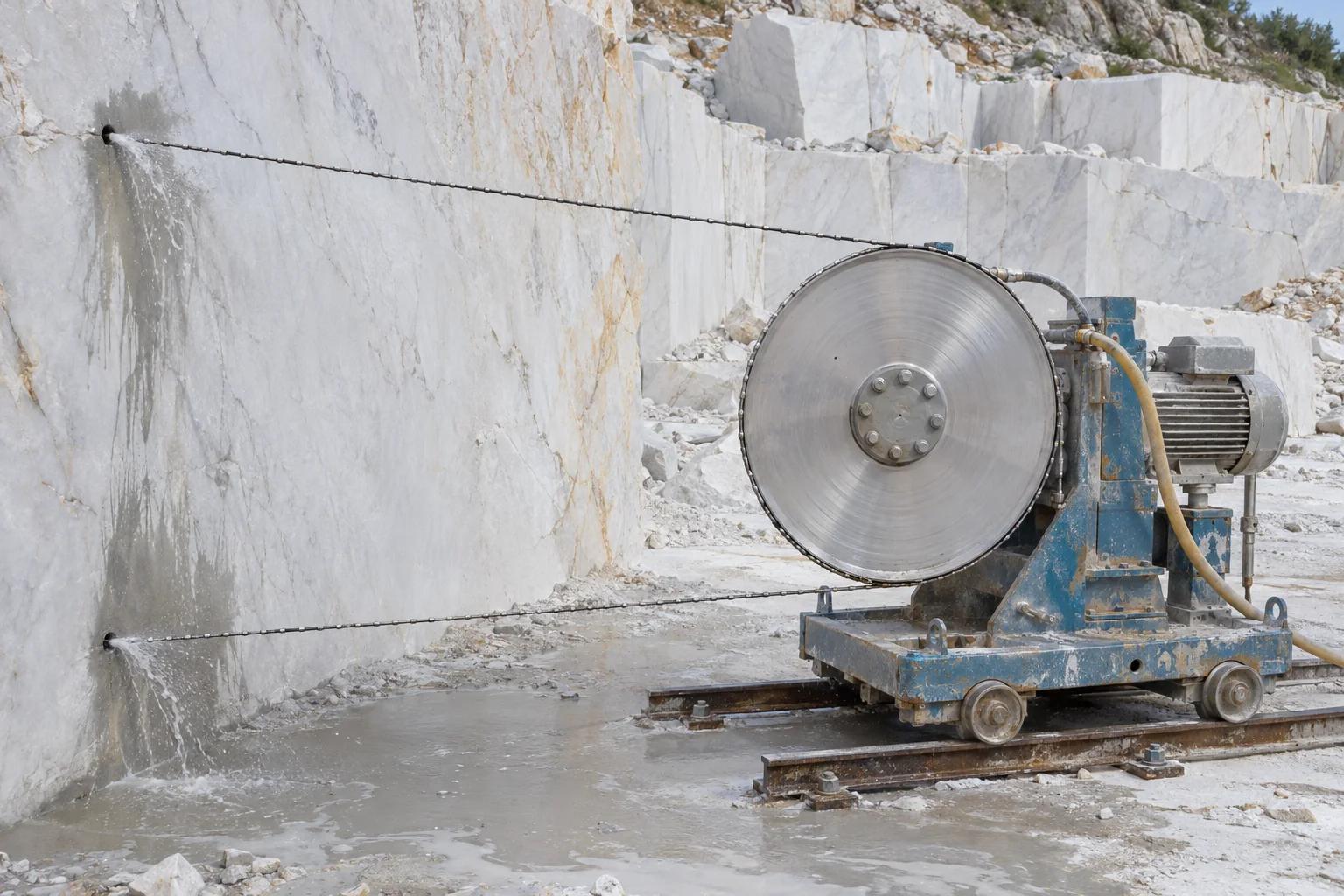
The machine that changed quarrying is a loop of steel cable threaded with diamond beads. The Turin survey describes the beads: they "are always impregnated with synthetic diamonds; their diameter is 10-11 mm and there are 35-43 beads per meter of wire"2. The loop runs through the drilled holes and around the section to be cut, and it is sprayed with water as it cuts6. A drive wheel pulls it round while the machine keeps it under tension. In a field study at the Targh travertine quarry in Iran, a 45 kW machine ran the wire at 30 m/s over a 600 mm pulley, with a pull-back force of 930 N9.
- 1 Drilled holes, meeting inside the rock
- 2 Cut so far
- 3 Drive wheel of the machine
- 4 Water sprayed at the cut
- 5 Direction of travel
- ◦ Diamond wire loop: steel cable threaded with diamond beads 10–11 mm across, 35–43 per metre
How fast it cuts depends on the stone and on the wire. In the Targh study, the wires cut between about 5.5 and 7 m² of face an hour over their working life. The best assembly carried 31 beads per metre, and the beads cut best in the middle third of their life9. A 2023 review of extraction methods calls diamond wire cutting "a highly efficient technique that reduces waste and ensures quality", and lists high costs and wire breakage as its remaining problems10.
A wire is not thrown away when its first beads wear. It is reconditioned: worn beads are replaced and the wire is reassembled, "up to 5 times, usually 1-2 times for hard rocks"2. In hard stone it is often run "to death", until its cutting tools are completely worn out2.
Before the diamond: the helical wire
Carrara was cutting marble with wire long before diamonds. The helical wire was three steel wires twisted into a helix. Its grooves carried a mixture of water and quartz sand along the cut, and the sand, pressed by the wire, wore a groove 8–10 mm wide into the marble3. The Carrara marble museum's catalogue names the firm of Adolfo Corsi as the first to use it in the quarries, in 1895, and dates its use to about 1895–19783. The wire ran over long circuits of pulleys carried on iron posts, a system the quarrymen called the «poteaux»4. The museum's records credit the invention to a patent by Eugène Chevallier in Belgium, dated 18543.
The gain was large. A popular-science account of Carrara's techniques says a cut that had taken one to two months could be made in three to four days6. The diamond wire reached Carrara's quarries at the end of the 1970s, after experiments in the previous decade5.
Chain saws, splitting and explosives
Chain saws. A chain-cutting machine drives a toothed chain round an arm, like a very large chainsaw. In dimension-stone quarries it is used "as the main or auxiliary" machine8. The Turin survey lists chain cutting among Italy's three established methods, "for soft rocks only"2. In the Italian reports on marble benches, it makes the base cut7.
Splitting. The oldest method is still in use in newer forms. Carrara's quarrymen forced cracks open with iron wedges, or drove in wooden wedges and wetted them, so that the swelling wood split the stone5. Today a row of drilled holes can be split with plugs and feathers or with expanding materials, which swell in the holes without a blast11.
Explosives. In hard granite, the Turin survey of quarries in Piedmont and Sardinia found that "the most economical production system, at least for primary cuts, is still splitting by explosives"2. This is not blasting rock to pieces. "Very thin linear charges" of detonating cord are placed in parallel, closely spaced holes, stemmed with water and fired together; in well-run operations "the half casts of the holes are perfectly observed and no extra cracks occur"2. The authors estimated that 12,000 km of detonating cord a year went into this work in Italy2. Marble has a different history. Carrara used powder mines on a large scale until the beginning of the 20th century, with "a great waste of material", and then moved to more controlled explosions; explosives are still used there today5.
| Method | Mostly used for | How it works | Waste in one comparison | Sources |
|---|---|---|---|---|
| Diamond wire saw | Marble and granite; primary and squaring cuts | A beaded steel loop through drilled holes, cooled with water | Seldom | 2,6,11 |
| Chain saw | Soft stone such as marble | A toothed chain on an arm cuts a slot | Not rated | 2,7,8 |
| Detonating cord in holes | Primary cuts in granite | Thin charges in close, parallel holes, fired together | High for blasting in general | 2,11 |
| Plug and feather, wedges | Splitting blocks along a line of holes | Wedges driven into the holes | High | 5,11 |
| Expanding materials | Splitting without a blast | A material swells in the holes | Low to medium | 11 |
The waste classes come from a 2018 comparison that the EU's Joint Research Centre reproduces in its background report on the Ecolabel for hard coverings11. They are general classes, not measurements at one quarry. They do not separate a carefully controlled cord split, which aims at no extra cracks2, from blasting in general.
Open pit and underground
Most quarries work in the open, on benches. Some go into the mountain, where blocks can be cut directly from the rock body; the Turin survey ties that approach to very regular, homogeneous deposits and to underground work2. Vermont's Danby quarry, which its operator calls "the largest underground marble quarry in the world", runs about 1½ miles (2.4 km) into the mountain, and the operator says two gang saws and a monowire saw work inside it12. That is the operator's own description.
How much of the mountain becomes blocks
Only part of what is cut leaves the quarry as blocks. Preparing the EU Ecolabel criteria for hard coverings, the Joint Research Centre put "a typical extraction efficiency" for a quarry producing dimension-stone blocks at 0.20 to 0.40, and noted that it can be much lower for slate11. For the Carrara basin, it cites a 2017 study estimating that about 3.0 million m³ of waste is generated each year, of which only about 0.5 million m³ is sold or converted11. The rest of the stone still has uses: monoliths for artistic work, irregular blocks for vehicle barriers, crushed aggregate and fine powder for agglomerated stone products11.
How recovery is defined, and the figures published for real quarries, are in our article on block recovery in dimension-stone quarries.
From the quarry floor to the factory
The blocks leave the quarry for the saw. A factory cuts them into slabs on a gang saw, a frame of parallel steel blades, or on a multi-wire saw, many diamond wires side by side. Each cut turns a strip of stone into dust: in 2006 machine makers gave gang-saw kerfs of 6.5 to 9 mm, and about 7 mm for a multi-wire saw, the diameter of its beads14.
How the block lies on the saw decides what every slab will look like. Saw a layered stone across its layers and the slabs show stripes; saw it along them and they show cloud. That choice, and how neighbouring slabs become bookmatched pairs, is the subject of our article on vein cut, cross cut and bookmatching. Slab sizes follow from block sizes and the saw: see standard slab sizes.
Frequently Asked Questions
Is marble mined or quarried?
Quarried. Marble and granite for building are dimension stone, rock taken out "for the purpose of obtaining blocks or slabs" of a specified size and shape1. Quarries cut or split the stone free so that it stays whole, in commercial blocks that usually weigh 5 to 15 tonnes2. «Marble mining» is a common search phrase for the same work.
How is a marble block cut out of the mountain?
Holes are drilled so that a diamond wire can be looped around the section to be cut6. Wire saws and chain saws free a large slice, the bench, with cuts at the base, the back and the side2,7. Hydraulic cushions then tip it onto a bed of earth and stone chips, and on the ground it is squared into commercial blocks7.
How heavy is a quarry block?
A survey of Italian quarries describes commercial blocks as "usually weighing 5 to 15 t"2. The weight of a given block follows from its volume and the stone's density. Our density table gives density by stone, and the block weight calculator does the arithmetic.
Do quarries use explosives on marble and granite?
Yes, but not to shatter rock. In granite, thin detonating cord in closely spaced holes was still the cheapest primary cut in a 2001 survey of Italian quarries, and well-run splits leave no extra cracks2. Carrara used powder mines into the early 20th century, with great waste, and later moved to more controlled explosions; explosives are still used there5.
How fast does a diamond wire cut stone?
It depends on the stone and the wire. In a field study at a travertine quarry in Iran, wires cut about 5.5 to 7 m² of face an hour at a wire speed of 30 m/s, and the best assembly carried 31 diamond beads per metre9. In hard granite, wire costs more than splitting with detonating cord, so many quarries combine the two2.
Why are some marble quarries underground?
How Noria Strata handles this
In Noria Strata a block gets its record at the face. Its sizes and 3D are taken with one phone, with photos, its tag and the face it came out of (blocks). The record stays with the block in the yard and in the factory. Every slab keeps its block and every block its slabs, so from any slab you can get back to the face and the quarry. For the quarry's own work, from the face to the invoice, see quarry management.
Sources
- U.S. Geological Survey, National Minerals Information Center. Dimension stone statistics and information usgs.gov/centers/national-minerals-information-center/dimension-stone-statistics-and-information
- Mancini, R., Cardu, M., Fornaro, M. & Lovera, E. (2001). Technological and economic evolution of diamond wire use in granite or similar stone quarries. Proceedings of the 17th International Mining Congress and Exhibition of Turkey (IMCET 2001) api.maden.org.tr/uploads/portal/resimler/ekler/01627aa14e37bd1_ek.pdf
- Museo Civico del Marmo, Carrara. Catalogue record «Tesa di filo elicoidale» (NCTN 09 00555892, inv. 11132). Catalogo generale dei Beni Culturali, Italian Ministry of Culture; compiled 2004, updated 2006 sigecweb.beniculturali.it/sigec/item/print/ICCD5634338
- Museo Civico del Marmo, Carrara. Catalogue record «Puleggia di rinvio» (NCTN 09 00555083, inv. 11114). Catalogo generale dei Beni Culturali, Italian Ministry of Culture sigecweb.beniculturali.it/sigec/item/print/ICCD5634324
- Carrara Marble Tour (Dbm S.r.l.) (2018). Marble: the quarrying techniques. 22 February 2018 carraramarbletour.it/en/culture/il-marmo-le-tecniche-di-escavazione
- Grimaldi, F. (2023). Come si estrae il marmo dalle cave: tecniche di escavazione e taglio dall'antichità a oggi. Geopop, 16 April 2023 geopop.it/come-si-estrae-il-marmo-dalle-cave-tecniche-di-escavazione-e-taglio-dallantichita-a-oggi
- Menduto, T. (2023). Imparare dagli errori: taglio e ribaltamento di bancate nelle cave di marmo. PuntoSicuro, 4 May 2023 (based on INAIL, Illustrazioni delle dinamiche infortunistiche in cava, 2019) puntosicuro.it/infortuni-sul-lavoro-C-138/imparare-dagli-errori-taglio-ribaltamento-di-bancate-nelle-cave-di-marmo-AR-23286
- Korman, T., Kujundžić, T., Lukačić, H. & Martinić, M. (2016). The impact of area and shape of tool cut on chain saw performance. Rudarsko-geološko-naftni zbornik 31(3). DOI 10.17794/rgn.2016.3.1 hrcak.srce.hr/file/246327
- Bagherpour, R., Khademian, A., Almasi, S. N. & Aalaei, M. (2014). Optimum cutting wire assembly in dimension stone quarries. Journal of Mining and Metallurgy 50A(1): 1–8 jmma.tfbor.bg.ac.rs/Volumes/2014/01.pdf
- Samarakoon, K. G. A. U., Chaminda, S. P., Jayawardena, C. L., Dassanayake, A. B. N., Kondage, Y. S. & Kannangara, K. A. T. T. (2023). A review of dimension stone extraction methods. Mining 3(3): 516–531. DOI 10.3390/mining3030029 (abstract) api.crossref.org/works/10.3390/mining3030029
- Donatello, S., Garbarino, E., Sanfelix, J., Fernandez Carretero, A. & Wolf, O. (2021). EU Ecolabel criteria for hard covering products. Final Technical Report: criteria and supporting rationale. European Commission, Joint Research Centre susproc.jrc.ec.europa.eu/product-bureau/sites/default/files/2021-04/Final_TR_PUBSY-submit-x.pdf
- Vermont Quarries Corp. Danby Quarry (operator website; the operator's own claim) vermontdanbymarble.com/?p=963
- CEN (2022). EN 1467:2022 Natural stone – Rough blocks – Requirements. Preview pages of SIST EN 1467:2022 cdn.standards.iteh.ai/samples/72591/b25b7404e3cb4139b24cb91ca3cfd48c/SIST-EN-1467-2022.pdf
- Daniel, P. (2006). Multi-wire saws gains ground. Stone Business, 6 December 2006 (trade press) stonebusiness.us/?p=416
How to cite this article
Poupouliadis, D. (2026). How marble and granite are quarried: from the mountain to the block. Noria Strata. https://www.noriastrata.com/en/blog/how-marble-and-granite-are-quarried
The author
Dimitris PoupouliadisCo-founder & Customer Success Manager, Noria Strata