
At a glance
- No standard fixes a granite slab's size: one North American quarry company gives an average of 9 × 5 ft (about 274 × 152 cm) for its stone slabs, granite and marble among them14, and one Indian exporter lists large gang-saw slabs of granite and other stone at 240–370 × 134–211 cm (about 94–146 × 53–83 in)16.
- The Natural Stone Institute lists 20 mm and 30 mm (with the nominal trade equivalents 3/4 in and 1 1/4 in) among standard granite thicknesses, and says size "may become a limiting factor" for a given stone1.
- EN 1469:2015 allows ±10% on cladding slabs over 12 up to 30 mm thick, and ±3 mm above 30 up to 80 mm6.
- The three quartz brands listed here publish jumbo formats of about 325–335 by 159–166 cm, and standard formats of about 305–310 by 140–144 cm7,8,9.
The short answer
No standard fixes a granite slab's size: one North American quarry company gives an average of 9 × 5 ft (about 274 × 152 cm) for its stone slabs, granite and marble among them14, and one Indian exporter lists large gang-saw slabs of granite and other stone at 240–370 × 134–211 cm (about 94–146 × 53–83 in)16. Those are sellers' figures, so you buy the measured dimensions of the slab supplied. The Natural Stone Institute (NSI) says size "may become a limiting factor" and advises checking available sizes with the supplier1. For engineered quartz, formats are fixed by each maker: Caesarstone US lists 144 × 305 cm standard and 164 × 327 cm jumbo7. Thickness is mostly 2 or 3 cm, with other standard thicknesses available1.
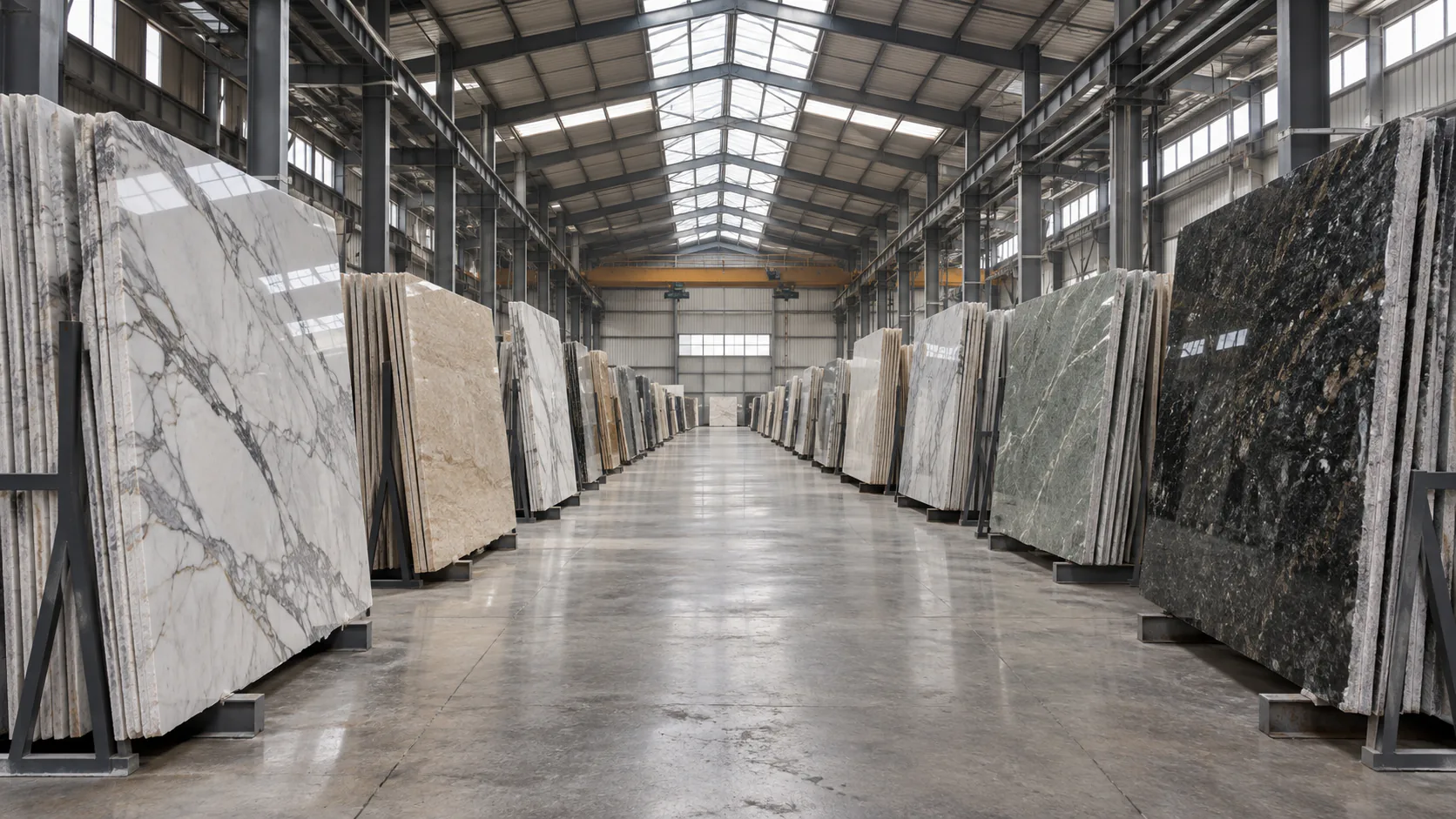
Natural stone (granite, marble, quartzite, limestone): a slab is as big as the block it was sawn from, less trimming, and the block must fit the saw. For example, Breton lists a maximum block length of about 3.7 m and a block height of 2.2 m for its Paragon multi-wire machine2, so a full slab from that machine cannot exceed roughly 3.7 × 2.2 m. Other machines have other limits. In a 2013 study of Palestinian stone plants, the block cutters described produced strips up to about 60 cm wide3.
Thickness: the NSI's list of standard nominal thicknesses for granite runs from 10 mm (3/8 in) through 20 mm (3/4 in) and 30 mm (1 1/4 in) up to 200 mm1. The inch figures are nominal trade equivalents, not equal dimensions.
Engineered quartz: the three brands listed below publish standard formats of about 305–310 by 140–144 cm and jumbo formats of about 325–335 by 159–166 cm7,8,9.
Slab sizes that producers, sellers and a trade body state
For granite slab size and marble slab size, no standard sets a length and height, so every figure below is a seller's statement, a saw's capacity or a trade body's guide, and the table says which. Use them to plan; buy from the measured slab.
| Stone or material | Length × height, cm | Length × height, in | Common thicknesses | What the figure is | Source |
|---|---|---|---|---|---|
| Natural stone, granite and marble among it, quarried in North America | about 274 × 152 (average) | 108 × 60 (9 × 5 ft) | 1, 2, 3 and 5 cm | One quarry company's stated average for its slabs | 14 |
| Danby marble, Vermont | up to about 394 × 198 (the quarry's wire saw) | up to 155 × 78 | mostly 3 cm; some 2 and 5 cm | What one quarry's wire saw could cut, as reported by trade press in 2015: a ceiling, not a slab size | 15 |
| Granite and other stone from India, large gang-saw slabs | 240–370 × 134–211 | about 94–146 × 53–83 | 2 and 3 cm | One exporter's stated range | 16 |
| The same exporter's cutter slabs | 180–360 × 60–105 | about 71–142 × 24–41 | 1.6, 1.8, 2 and 3 cm | One exporter's stated range | 16 |
| Slate panels for cladding | standard up to 200 × 120; no piece over 300 × 150 recommended | 78 × 48 (6 ft 6 in × 4 ft); 114 × 60 (9 ft 6 in × 5 ft) | 25, 30 and 40 mm | A trade body's design guide (its metric figures are rounded) | 13 |
| Engineered quartz, three brands | standard 305–310 × 140–144; jumbo 325–335 × 159–166 | standard about 120–122 × 55–57; jumbo about 128–132 × 63–65.5 | 1 to 3 cm | The makers' named formats, the only fixed sizes in this table | 7,8,9 |
Read each row for what it is. The quarry company's 9 × 5 ft is an average across its own production, not a size every slab meets14. The exporter's ranges are for its large gang-saw and its cutter formats (it also lists mini gang-saw slabs of 240–360 × 107–134 cm), without separating granite from other stone, and it warns of "shade and size differences" between lots16. The Vermont figure is what one quarry's wire saw could cut in 2015, so a slab from it can be smaller but not larger15. The slate figures are the NSI's recommendation for spandrels, panels and wall facings, with larger sizes available "only under special conditions and limited production"13. None of these sources gives a size that a natural slab must meet.
Why granite and marble slab sizes vary: the block decides
A slab is a slice of a block, so its length and height are the block's length and height, less the trimming of rough edges. Blocks differ from quarry to quarry, and natural fractures limit both the size of block that can be extracted and what is recovered from it10. In a simulation on one fractured Italian limestone block, the best recovery across 37 slab sizes was 44.91%10. The same research found that the slab size giving the best recovery was not the one giving the best revenue10,11.
As a result, two bundles of the same stone can arrive with slabs of different sizes, which is why the slab record should carry each slab's own measured dimensions rather than a catalogue figure.
Why natural slabs vary: the saw decides
Three relevant kinds of machine turn blocks into slabs or strips, and each leaves its mark on the size.
| Machine | How it cuts | What it produces | Size limit in the cited source | Sources |
|---|---|---|---|---|
| Gang saw | Parallel steel blades in a frame moving back and forth, fed a cutting abrasive in water (steel shot in the granite example), or diamond-tipped blades | Full slabs, the whole block at once | The block that fits the frame | 1,4 |
| Multi-wire saw | Many diamond wires cutting the whole block | Full slabs of 20 mm, 30 mm or more | Breton Paragon: blocks up to about 3.7 m long, 2.2 m wide and 2.2 m high | 2,4 |
| Block cutter | A two-way cutting machine that cuts the block into strips | Strips of a set thickness | About 60 cm wide in the 2013 Palestinian study | 3 |
The NSI describes the gang saw as "a series of steel blades set parallel in a frame that moves forward and backward"1. A 2006 trade report gives one plant's comparison: a 50-wire machine sawed about 20,000 m² of 2 cm granite a month, against about 6,000 m² on a steel-shot gang saw4. That is one plant at one date, not a current benchmark. In the Palestinian study, the two-way block cutting machine produced strips "with certain thickness and maximum width of about 60cm"3.
So a "slab size" printed on a natural-stone offer is best read as the size of that bundle, not a property of the stone.
Thickness: 2 cm and 3 cm, and their tolerances
The conventions
The NSI's standard nominal thicknesses are1:
- Granite: 10, 20, 30, 40, 50, 75, 100, 150 and 200 mm (3/8 in to 8 in).
- Marble veneer: 20, 22, 30, 38 and 50 mm (3/4 in to 2 in). Marble thicker than 50 mm is "usually regarded as cubic stock".
- Limestone: 10, 20, 30, 38, 50, 60, 75, 90 and 100 mm (3/8 in to 4 in).
In the 2013 Palestinian study, 2 cm and 3 cm were "the most used thicknesses in stone factories" and known locally as the standard thicknesses3. The Breton Paragon is built to saw slabs of "20 mm, 30 mm, or more"2, and the 2006 trade report describes 4 cm granite slabs cut on a multi-wire machine4.
The NSI pairs 20 mm with 3/4 in and 30 mm with 1 1/4 in1. These are nominal trade equivalents, not equal dimensions: 20 mm is 0.787 in and 30 mm is 1.181 in, while 3/4 in is 19.05 mm and 1 1/4 in is 31.75 mm (conversion arithmetic). Keep one system in a cutting list.
Why thinner slabs cost more of the block
Every cut removes a kerf, the width of the cut. In the 2006 trade report, machine makers gave gang-saw kerfs of 6.5 to 9 mm (6.5 mm from a 5 mm steel blade) and a multi-wire kerf of about 7 mm4. With the same kerf, the loss is a larger share of the block when slabs are thin.
Example. A 1 × 1 × 1 m block, a 6.5 mm kerf, no trimming:
- Continuous loss: 6.5 ÷ (20 + 6.5) = 24.5% of the block for 20 mm slabs; 6.5 ÷ (30 + 6.5) = 17.8% for 30 mm slabs (our calculation).
- Continuous area yield: 1 ÷ (0.020 + 0.0065) = 37.7 m² of 20 mm slab per m³; 1 ÷ (0.030 + 0.0065) = 27.4 m² of 30 mm slab per m³.
- Whole slabs from that cube: 37 slabs of 20 mm (0.74 m³ of slab) and 27 of 30 mm (0.81 m³), so the waste is 26% and 19%. These are the "ideal" values the Palestinian study reports for a 6.5 mm blade thickness, which its formula counts as the width of each cut3; the difference from the continuous figures is the part-slab left at the end of the cube.
None of these are measured factory yields. A separate study of 19 plants in Bilecik, Turkey, reported waste of 28% in block cutting and 20% in gang sawing12; those are different operations and assumptions, so they are not directly comparable with the ideal figures.
Tolerances in European standards
Two European standards set how far a slab may deviate from its nominal thickness. EN 1468 covers rough slabs, the semi-finished slabs "with unfinished edges obtained by sawing or splitting from a rough block"5. EN 1469 covers slabs for cladding internal and external walls and ceilings6. The EN 1468 figures below are from its 2012 edition, since superseded by EN 1468:2022, whose text may differ.
On a 20 mm slab, ±10% means anything from 18 to 22 mm is within tolerance. Both texts also cap flatness: the deviation may not exceed 0.2% of the slab length and may not exceed 3 mm, whichever is smaller5,6; on any slab longer than 1.5 m, that cap is 3 mm. Manufacturers may declare stricter tolerances, and EN 1469 says this is "particularly important when the edges of the slabs will be visible after installation"6. EN 1468:2012 also defines the commercial size of a rough slab as its net length and width each reduced by 0.03 m, with length and width given in metres to two decimals5. Neither text prescribes one universal slab format: they govern accuracy and declaration, not size.
Engineered quartz slab sizes: named formats
Quartz manufacturers publish fixed formats, and the three brands below use "jumbo" for different larger formats7,8,9. The makers are named here as facts, from their own sheets.
| Manufacturer | Format | Size as published | Thicknesses | Source |
|---|---|---|---|---|
| Caesarstone (US) | Standard | 144 × 305 cm | 2 cm, 3 cm | 7 |
| Caesarstone (US) | Jumbo | 164 × 327 cm, each ±1.5% | 2 cm, 3 cm | 7 |
| Cambria | Standard | approx. 122 × 55.5 in (310 × 141 cm) | 1, 2, 3 cm nominal | 8 |
| Cambria | Jumbo | approx. 132 × 65.5 in (335 × 166 cm) | 1, 2, 3 cm nominal | 8 |
| Silestone (Cosentino, NZ 2023) | Standard | up to 306 × 140 cm | 1.2, 2, 3 cm | 9 |
| Silestone (Cosentino, NZ 2023) | Jumbo | up to 325 × 159 cm | 1.2, 2, 3 cm | 9 |
Three cautions. Not every colour is made in every format and thickness; Cambria tells buyers to check availability "per design"8. Published sizes carry tolerances (±1.5% on Caesarstone's jumbo7), and Cambria distinguishes the slab size listed from the "largest slab size able to be fabricated"8. And the figures here are for the markets named; check the page for your own market.
Caesarstone USstandard 305 × 144 cmjumbo 327 × 164 cm
Cambriastandard 310 × 141 cmjumbo 335 × 166 cm
Silestone NZ, 2023standard 306 × 140 cmjumbo 325 × 159 cm
- Standard slab
- Jumbo slab
- Breton Paragon block envelope, 3.7 × 2.2 m: one machine's block limit, not a slab format
How slab size drives yield in a kitchen
A bigger slab is not only more stone. It decides where the seams go and how much is left over.
Example. Assumptions: two worktop runs, 300 × 62 cm and 240 × 62 cm, and an island top of 310 × 100 cm; at most one seam in the island; rectangular pieces only; no allowance for kerf, edge profiles or vein matching. Slab sizes are Caesarstone US's published standard (305 × 144 cm, 4.39 m²) and jumbo (327 × 164 cm, 5.36 m²)7.
- With jumbo slabs: slab 1 takes the island (310 × 100 cm) in one piece; slab 2 takes both runs side by side (62 + 62 = 124 cm of the slab's height; 300 and 240 cm of its length). Two slabs, 10.73 m² bought, no island seam. This layout still fits at the −1.5% tolerance (about 322 × 162 cm). Putting the 300 cm run beside the island on slab 1 would work only at the nominal size: at −1.5% the strip left beside the island is about 61.5 cm, less than 62 cm.
- With standard slabs: the island is longer than the slab (310 against 305 cm), so it takes its one permitted seam. Slab 1 takes both runs side by side. The two island halves, 155 × 100 cm each, do not fit end to end on one slab (310 cm), so they need slabs 2 and 3. Three slabs, 13.18 m² bought, one island seam. With two seams allowed, the island could be cut into three pieces of about 103 × 100 cm that fit on one standard slab, so two standard slabs would do; the one-seam rule is what forces the third.
- Countertop area is 6.45 m² in both cases, so the share of bought stone that ends up installed is about 60% with jumbo slabs and 49% with standard slabs under the one-seam rule.
The numbers change with every kitchen, and a real layout can depend on the veining, not only the rectangles. The point is the mechanism: one piece longer than the slab adds a seam and can add a slab. With natural stone the same logic applies to the actual slabs in the bundle. Try your own dimensions in the slab yield calculator, and see how much a stone slab weighs before planning the lift.
Frequently Asked Questions
What is the standard size of a granite slab?
There is no standard size for granite or marble: a slab is as large as its block and the saw allow, and the Natural Stone Institute advises checking sizes with the supplier1. Sellers' figures give the order of size: an average of 9 × 5 ft (about 274 × 152 cm) at one North American quarry company14, and large gang-saw slabs of 240–370 × 134–211 cm at one Indian exporter16. In 2015, trade press reported that one Vermont marble quarry's wire saw could cut up to 155 × 78 in (about 394 × 198 cm)15.
What size is a quartz slab?
It depends on the brand and format. Standard slabs are 144 × 305 cm at Caesarstone US7, about 310 × 141 cm at Cambria8 and up to 306 × 140 cm at Silestone in New Zealand9. Jumbo slabs are 164 × 327 cm (±1.5%)7, about 335 × 166 cm8 and up to 325 × 159 cm9 respectively. Check the colour you want, since not every colour comes in every format.
What does a jumbo slab mean?
"Jumbo" is the name these manufacturers use for their larger format, and each uses it for a different size7,8,9. For the three quartz brands listed here, jumbo slabs are about 325–335 cm long and 159–166 cm high. A longer slab can let a long piece, such as an island top over 3 m, be cut without a seam, if the slab's usable area allows.
How thick are stone slabs?
The Natural Stone Institute lists standard thicknesses from 10 mm to 200 mm for granite and from 20 mm to 50 mm for marble veneer, including 20 mm and 30 mm1. In North America these two are sold under the nominal names 3/4 in and 1 1/4 in, which are close to, not equal to, 20 and 30 mm1. Quartz brands also list 1 or 1.2 cm8,9.
What thickness tolerance is allowed on a stone slab?
Under EN 1469:2015, cladding slabs over 12 up to 30 mm may deviate by ±10% from their nominal thickness, and slabs above 30 up to 80 mm by ±3 mm6. The superseded EN 1468:2012 allowed ±1.5 mm on rough slabs up to 15 mm and ±10% above 15 up to 30 mm5; it has been superseded by the 2022 edition. Flatness: at most 0.2% of the length and at most 3 mm5,6.
Why do 2 cm slabs waste more of the block than 3 cm slabs?
Each cut removes the same kerf, so thin slabs lose a larger share of the block. With a 6.5 mm kerf, the continuous loss is about 24.5% for 20 mm slabs and 17.8% for 30 mm (our calculation); counting whole slabs from a 1 m cube gives the 26% and 19% reported in a 2013 study3. A block still yields more 2 cm slab: about 37.7 against 27.4 m² per m³, ideally.
How Noria Strata handles this
Because natural slabs have no universal size, Noria Strata keeps one record per slab with its own measured dimensions, thickness and photos, linked to the bundle and the block it came from. Slabs can be captured with an iPhone or iPad, so a yard or fabricator works from the slab that is actually in the rack, not from a catalogue size. See slab inventory management, or test a layout in the slab yield calculator.
Sources
- Natural Stone Institute (2022). Dimension Stone Design Manual. Granite chapter, 5.1 and 6.1; Marble and Onyx chapter, 5.1, 6.1 and 9.1; Limestone chapter, 5.1 (copy hosted by a member company) lurveys.com/wp-content/uploads/NSI-Dimension-Stone-Design-Catalog.pdf
- Breton S.p.A. (n.d.). Breton Paragon multiwire machine, technical data (machine maker's page) breton.it/products/machines-and-lines/breton-paragon
- Alhaj, J. (2013). Effects of the thickness of block cutting machine gang saw on waste percentages and productivity. Third International Conference on Energy and Environmental Protection in Sustainable Development (ICEEP III), Palestine Polytechnic University, Hebron, paper ENV114 psmc.ppu.edu/sites/default/files/ENV114-GANG%20SAW-FINAL%20PAPER.pdf
- Daniel, P. (2006, 6 December). Multi-Wire Saws Gains Ground. Stone Business (trade press; figures from machine makers) stonebusiness.us/?p=416
- CEN (2012). EN 1468:2012 Natural stone – Rough slabs – Requirements, clauses 3.1, 3.2, 3.5, 4.1.2, 4.1.3 (preview pages of SIST EN 1468:2012; superseded by EN 1468:2022, not verified) cdn.standards.iteh.ai/samples/36918/c518933aa82a4384a379e46e46be16c9/SIST-EN-1468-2012.pdf
- CEN (2015). EN 1469:2015 Natural stone products – Slabs for cladding – Requirements, clauses 1, 4.1.2, 4.1.3 (preview pages of SIST EN 1469:2015) cdn.standards.iteh.ai/samples/34684/02005aadbe8a4ef4b70c107b6d0f12cc/SIST-EN-1469-2015.pdf
- Caesarstone US (n.d.). Design: slab sizes (manufacturer's own page)
- Cambria (2024). Slab Product Information (manufacturer's sheet)
- Cosentino New Zealand (2023). Silestone brochure insert (manufacturer's brochure)
- Elkarmoty, M. (2018). Rock Mass Fracture Detection and Modelling Using GPR for Evaluation and Production Optimization of Ornamental Stone Deposits. PhD thesis, University of Bologna amsdottorato.unibo.it/id/eprint/8370/1/Thesis_Mohamed%20Elkarmoty_PhD%20UNIBO.pdf
- Elkarmoty, M., Bonduà, S. & Bruno, R. (2020). A 3D optimization algorithm for sustainable cutting of slabs from ornamental stone blocks. Resources Policy 65: 101533. DOI 10.1016/j.resourpol.2019.101533 ideas.repec.org/a/eee/jrpoli/v65y2020ics0301420719305720.html
- Yurdakul, M. (2020). Natural stone waste generation from the perspective of natural stone processing plants: an industrial-scale case study in the province of Bilecik, Turkey. Journal of Cleaner Production 276: 123339. DOI 10.1016/j.jclepro.2020.123339 acikkaynak.bilecik.edu.tr/items/b6e42353-16d0-46fa-8f2a-c826b3295151/full
- Natural Stone Institute (2022). Dimension Stone Design Manual. Slate chapter, 3.1.1 Dimensional Limitations, page 10-3 (same hosted copy as [1]) lurveys.com/wp-content/uploads/NSI-Dimension-Stone-Design-Catalog.pdf
- Polycor (n.d.). Countertops: slabs and tiles (quarry company's own page; a seller's statement) polycor.com/applications/countertops
- Richinelli, J. (2015, 2 February). Meeting the demand for white marble. Stone World (trade press, on the Danby quarry of Vermont Quarries Corp.) stoneworld.com/articles/88269-meeting-the-demand-for-white-marble
- Stone Galleria LLP (n.d.). Slab size charts: granite, quartzite and other natural stone (exporter's page, Kishangarh, India; a seller's statement) stonegalleria.in/slab-size-guide
How to cite this article
Theodorakis, N. (2026). Standard granite, marble and quartz slab sizes, and why they vary. Noria Strata. https://www.noriastrata.com/en/blog/standard-slab-sizes
The author
Nikos TheodorakisCOO, Noria Strata