At a glance
- On four Spanish granites, a stable colour mean needed 6 to 17 readings per 36 cm², depending on aperture, stone and finish2.
- In a dental-ceramics viewing-booth study, half of observers rejected a match at ΔE00 1.84; that is a dental-ceramics threshold, not a stone tolerance.
- EN 1469:2015 compares production with a reference sample at about two metres in daylight and says natural variations may always occur1.
- We found no stone-specific ΔE acceptance limit in the EN, ISO or ASTM standards reviewed; any limit is a contract term the parties agree1.
Colour consistency: the question a yard actually faces
For example: a buyer orders 40 slabs for a lobby and wants them to look like one surface. Six months later the same buyer orders 12 more and wants them to match the first 40. A distributor has two lots of the same material from different blocks and has to decide whether they can go into one project.
Each of these is a question about colour consistency: between slabs in one lot, between lots, and between a delivery and the sample the buyer approved. Instrument readings taken the same way make the slabs comparable as numbers, and show which slab differs and in which direction: lighter or darker, redder or yellower. The answer has four parts: what the standard expects, how to take readings that mean something on veined stone, how to compute a ΔE, and how to agree a tolerance with the buyer. For the science behind the numbers (CIELAB, CIEDE2000, metamerism, gloss), see the science of spectral colour matching.
What the contract standard says
In Europe, the product standard for cladding slabs is EN 1469:2015. It does not use instruments for appearance. Its rules, in clause 4.2.3, are these1:
- Colour, veining and texture are identified visually, typically by a reference sample of the same stone, supplied by the manufacturer.
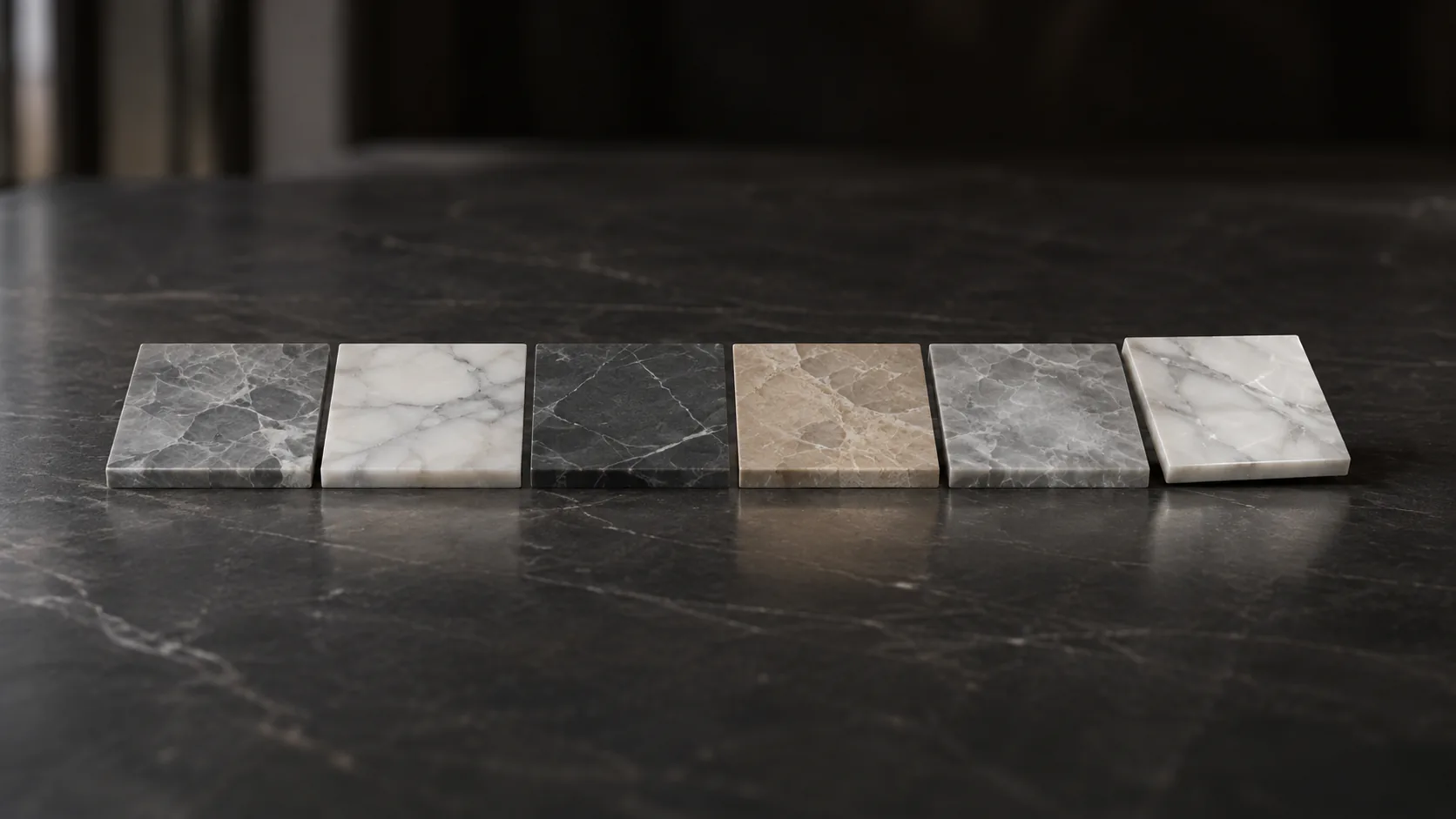
- The reference sample is an adequate number of pieces, each at least 0.01 m² (typically 0.01 to 0.25 m²), and must show the range of colouring, vein pattern, structure and finish, including typical holes, spots and veins.
- If the stone is patched or filled, the sample must show that too.
- Production is compared by placing the reference sample against the production samples and viewing them at about two metres under normal daylight, recording any visible differences.
- Features shown on the sample are typical of the stone, not flaws, and are not a reason for rejection unless their concentration becomes excessive and the stone loses its typical character.
And one sentence that matters in every dispute: "The reference sample does not imply strict uniformity between the sample itself and the actual supply; natural variations may always occur."1
What "natural variations may always occur" means in a contract
It does not mean anything goes. Read with the rest of the clause, it means three practical things:
- The sample shows the expected range, not a single colour. Use reference pieces to show the expected range of appearance, including typical features. A sample of one small piece invites a dispute; a sample that shows the lightest and darkest acceptable pieces, and typical veining, gives both sides the same reference1.
- Typical features are not defects. Features shown on the sample are treated as typical of the stone, unless their concentration becomes excessive and the stone loses its typical character1.
- The test is visual and recorded. Two metres, daylight, differences written down1. A contract that adds instrument readings adds a second test on top of this one; it should say which test decides if they disagree.
A specification such as "ΔE < 1" is a term the parties have chosen. A useful contract specification states both the ΔE limit and the measurement method, and identifies which test prevails.
How to take readings that mean something
Instrument and settings
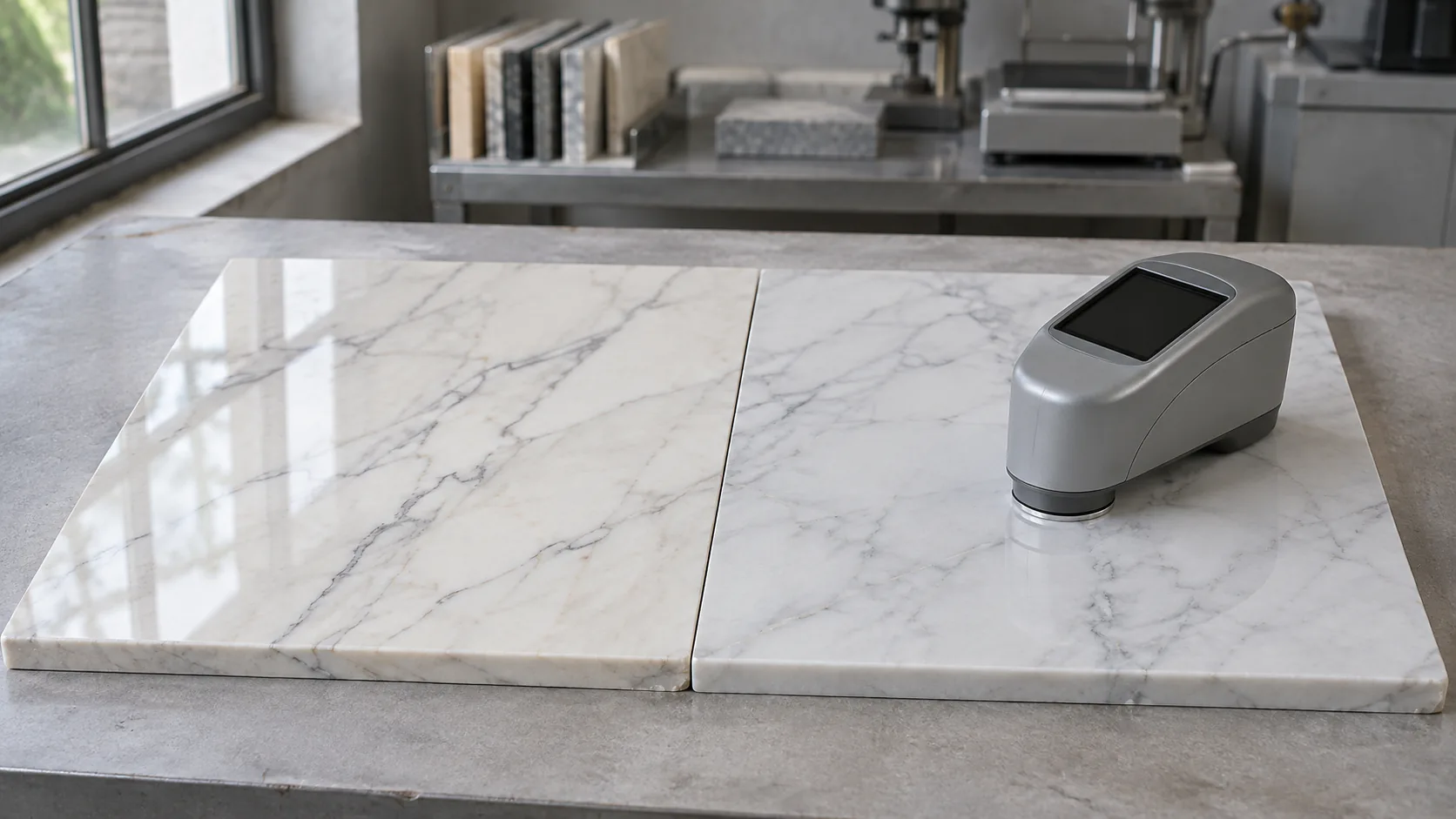
If you use a portable spectrophotometer, fix its settings and write them down, because every number depends on them:
- Illuminant and observer, for example D65 and the 10° or 2° observer. Prieto and colleagues used D65 and the 2° observer for granite2.
- Geometry: diffuse/8° with the specular component included (di:8°) or excluded (de:8°), or 45°:0°3. On polished stone the choice changes the result; never compare readings taken in different modes.
- Aperture (the size of the measured spot): it decides how many readings you need2.
- Formula: CIEDE2000 (ΔE00) is the CIE's preferred colour-difference formula3.
Follow the manufacturer's calibration and verification procedure, and record the check.
How many points
A spot reading on veined stone measures a few crystals. On four Spanish granites with four finishes, the number of readings needed for a stable mean was2:
Use these granite results as a starting point for a sampling study on your own stone2.
For a full slab, one practical approach is a fixed grid: for example, a 3 × 4 grid of measuring zones across the face, each zone measured with the number of readings you settled on, avoiding the edges. Use the same grid for every slab so the means are comparable. (This is a suggested practice, not a published protocol.)
Conditions (suggested practice)
- Same finish. Finish changes colour, mainly lightness, and most in dark stones5. Compare polished with polished.
- Clean, dry surface, with no film of water, dust or polishing residue.
- Same instrument, or instruments checked against each other. In the granite study, results from different apertures differed significantly unless the recommended number of readings and area were used2.
- Record the slab ID, the date and the operator with every set of readings.
Worked example: a ΔE between two readings
Example. The mean of the readings on the buyer's reference sample, and on one production slab (illustrative values, D65/10°, di:8°, same instrument):
- Reference: L\ 82.4, a\ 0.6, b\* 3.2
- Slab: L\ 81.1, a\ 0.9, b\* 4.1
Step 1, the differences. ΔL\ = 81.1 − 82.4 = −1.3 (the slab is darker). Δa\ = +0.3 (slightly redder). Δb\* = +0.9 (yellower).
Step 2, the simple formula (CIE76). ΔE\*ab = √(1.3² + 0.3² + 0.9²) = √2.59 = 1.61.
Step 3, CIEDE2000. The formula is normally computed in software; it reweights lightness, chroma and hue differences6. With all parametric factors set to 1, it gives ΔE00 = 1.23. (We used an implementation checked against the published test data of Sharma, Wu and Dalal7; any software you use should pass that check.)
Reading the result. The same pair gives 1.61 or 1.23 depending on the formula, which is why a tolerance must name its formula. The components tell you more than the total: this slab is darker and yellower than the reference. For context only, 1.23 lies between the 50:50% perceptibility (0.8) and acceptability (1.8) thresholds measured on dental ceramic samples in a viewing booth4.
Checking a lot
The same calculation, done for each slab's mean against the reference, shows the spread of a lot at a glance.
Example. Six slabs against the reference above (illustrative values):
| Slab | ΔL\* | Δa\* | Δb\* | ΔE\*ab | ΔE00 |
|---|---|---|---|---|---|
| S1 | −0.3 | +0.1 | +0.2 | 0.37 | 0.30 |
| S2 | −0.8 | +0.2 | +0.4 | 0.92 | 0.70 |
| S3 | +0.5 | −0.1 | −0.3 | 0.59 | 0.45 |
| S4 | −1.5 | +0.3 | +1.0 | 1.83 | 1.38 |
| S5 | −0.1 | 0.0 | +0.7 | 0.71 | 0.61 |
| S6 | −0.5 | +0.1 | +0.1 | 0.52 | 0.38 |
Illustrative readings. No tolerance is drawn: a stone tolerance must be agreed with the buyer.
In this illustrative lot (chart drawn without any tolerance line), five slabs sit within ΔE00 0.7 of the reference; S4 stands apart, darker and yellower. Before anyone decides, S4 goes next to the reference sample at two metres in daylight, as EN 1469 asks1. The numbers decide which slab to look at; the agreed test decides whether it is accepted.
How to agree a tolerance with a buyer
The tolerance has to be agreed between the parties. A workable sequence:
- Agree the method first. Illuminant, observer, geometry, aperture, number of readings, grid, formula and parametric factors. Without these, a number means nothing.
- Agree the reference. A physical reference sample that shows the range, as EN 1469 requires1, measured with that method. Keep a counter-sample at both ends.
- Calibrate the number by eye, together. Measure a set of slabs, view them against the reference under the EN 1469 conditions, and note which the buyer accepts and which not. Check whether accepted and rejected stones separate under the proposed metric; if they do, set the limit between them; if they overlap, keep visual approval or add pattern or lightness criteria. A limit set this way reflects the buyer's judgement on this stone, which a threshold measured on dental ceramics cannot do4.
- Use two levels, not one. For example: below the lower limit, accept; between the limits, view and decide; above the upper limit, reject or set aside for another project. This fits the standard's visual test instead of replacing it.
- Consider a separate limit on lightness. Finish affects L\ most5. A separate ΔL\ limit can identify lightness shifts; agree whether that matters to this project.
- Write down which test decides. If the instrument and the visual comparison disagree, the contract should say which prevails.
| Field | Why it matters | Source |
|---|---|---|
| Formula and parametric factors | CIE76 and CIEDE2000 give different numbers | 3,6 |
| Illuminant and observer | Colour values exist only for a stated light and observer | 3 |
| Geometry (di:8°, de:8°, 45°:0°) | Gloss changes the reading | 3 |
| Aperture, number of readings, area | Determines whether the mean is stable | 2 |
| Finish | Finish changes colour, mainly L\* | 5 |
| Slab ID, date, operator, instrument | Lets a reading be repeated or checked | practice |
How photos under fixed light help
An instrument gives numbers for spots. A photograph shows the whole face, including veining; a ΔE between slab means does not describe the spatial arrangement of veining. For re-orders and disputes, a good photograph of every slab is a valuable record. To make photos comparable (suggested practice):
- Fix the light: the same lamps, position and intensity, with no daylight from windows changing through the day.
- Fix the camera: same position and distance, manual exposure and white balance, no filters or automatic "enhancement".
- Put a grey card or colour reference chart in a corner of every frame, so colour can be corrected and compared later.
- Photograph the same finish the buyer will receive, and name each file with the slab ID.
A photo taken this way does not replace the reference sample, which is the standard's test1. It lets the yard show, months later, what a slab looked like when it left, and lets a buyer pick a re-order that resembles the first lot before anyone ships stone.
What the research does not cover
We found no stone-specific ΔE acceptance limit in the EN, ISO or ASTM standards reviewed, and no perceptibility or acceptability threshold measured on natural stone in the literature searched. The thresholds used for context above come from dental ceramics4; they say nothing certain about how a buyer will judge a given stone. The sampling counts come from the tested granites and conditions; strongly veined marble was not tested, and the authors only hypothesise that the method extends to other rocks2. We found no equivalent study on veined marble, so the counts are not a minimum validated for it.
Frequently Asked Questions
What Delta E is acceptable for natural stone?
The useful number is the one agreed with the buyer by measuring slabs both sides have viewed. In a dental-ceramics study, half of observers rejected a match at ΔE00 1.84. There is no common number for stone: EN 1469 judges appearance by eye against a reference sample and accepts natural variation1, and we found no stone ΔE limit in the EN, ISO or ASTM standards reviewed.
What does "natural variations may always occur" mean?
It is a sentence from EN 1469:2015: a reference sample "does not imply strict uniformity" with the supply1. Features shown on the sample are typical of the stone, not flaws, unless their concentration becomes excessive1. That is why the sample should show the full range of colour and veining the buyer must accept.
How many readings do I need on a slab?
On granite, a stable mean needed 6 readings per 36 cm² with a 50 mm aperture, 14 with 8–10 mm, and 17 with 5 mm, and at least 72 cm² of measured area with the 50 mm head2. Read together, the 50 mm head needs at least 12 readings, 6 per 36 cm² over at least 72 cm² (our arithmetic). Strongly veined marble was not tested, so treat these as a starting point for your own sampling check. Use a fixed grid across the face and the same number of readings on every slab.
Why do slabs from the same block differ?
Should I use CIE76 or CIEDE2000?
The CIE calls CIEDE2000 the preferred formula3. CIE76 is simpler and can be computed by hand, but it gives different numbers for the same pair: 1.61 against 1.23 in our example. Use one formula throughout and name it in every report and contract.
How Noria Strata handles this
Noria Strata's spectral matching, described in the science of spectral colour matching, converts the light reflected by a slab to CIE L\a\b\*, compares slabs with the CIEDE2000 formula, ranks slabs by colour proximity to a reference and documents matches with colour certificates. Any matching system needs the foundations this article describes: imaging or measurement under controlled lighting, a correct CIEDE2000 implementation, colour profiles of the stock, and tolerance thresholds agreed with the client. See machine vision features and slab inventory.
Sources
- CEN (2015). EN 1469:2015 Natural stone products – Slabs for cladding – Requirements, clause 4.2.3 (preview pages of SIST EN 1469:2015) cdn.standards.iteh.ai/samples/34684/02005aadbe8a4ef4b70c107b6d0f12cc/SIST-EN-1469-2015.pdf
- Prieto, B., Sanmartín, P., Silva, B. & Martínez-Verdú, F. (2010). Measuring the color of granite rocks: a proposed procedure. Color Research & Application 35(5): 368–375. DOI 10.1002/col.20579 (accepted manuscript, USC repository) minerva.usc.gal/bitstreams/ac702761-a321-42ea-9621-6c9fe706c613/download
- CIE (2018). CIE 015:2018 Colorimetry, 4th edition. DOI 10.25039/TR.015.2018 (copy incorporated by reference, law.resource.org) law.resource.org/pub/us/cfr/ibr/inc/ansi/cie.015.2018.pdf
- Paravina, R. D., Ghinea, R., Herrera, L. J. et al. (2015). Color difference thresholds in dentistry. Journal of Esthetic and Restorative Dentistry 27 Suppl 1: S1–S9. DOI 10.1111/jerd.12149 ebi.ac.uk/europepmc/webservices/rest/search?query=DOI:10.1111/jerd.12149&resultType=core&format=json
- Sanmartín, P., Silva, B. M. & Prieto, B. (2011). Effect of surface finish on roughness, color and gloss of ornamental granites. Journal of Materials in Civil Engineering 23(8). DOI 10.1061/(ASCE)MT.1943-5533.0000285 minerva.usc.gal/entities/publication/4492d6f0-dd6e-4824-8987-e63a1080e3ff/full
- Luo, M. R., Cui, G. & Rigg, B. (2001). The development of the CIE 2000 colour-difference formula: CIEDE2000. Color Research & Application 26(5): 340–350. DOI 10.1002/col.1049 doi.org/10.1002/col.1049
- Sharma, G., Wu, W. & Dalal, E. N. (2005). The CIEDE2000 colour-difference formula: implementation notes, supplementary test data, and mathematical observations. Color Research & Application 30(1): 21–30 (author page with test data) hajim.rochester.edu/ece/sites/gsharma/ciede2000
How to cite this article
Poupouliadis, D. (2026). How to check colour consistency between stone slabs and lots. Noria Strata. https://www.noriastrata.com/en/blog/color-matching-natural-stone-delta-e
The author
Dimitris PoupouliadisCo-founder & Customer Success Manager, Noria Strata