
How to Source Marble Directly from a Quarry
The 7-step process for buying marble directly from a quarry: specification, finding producers, samples, negotiating FOB terms, logistics and quality inspection.
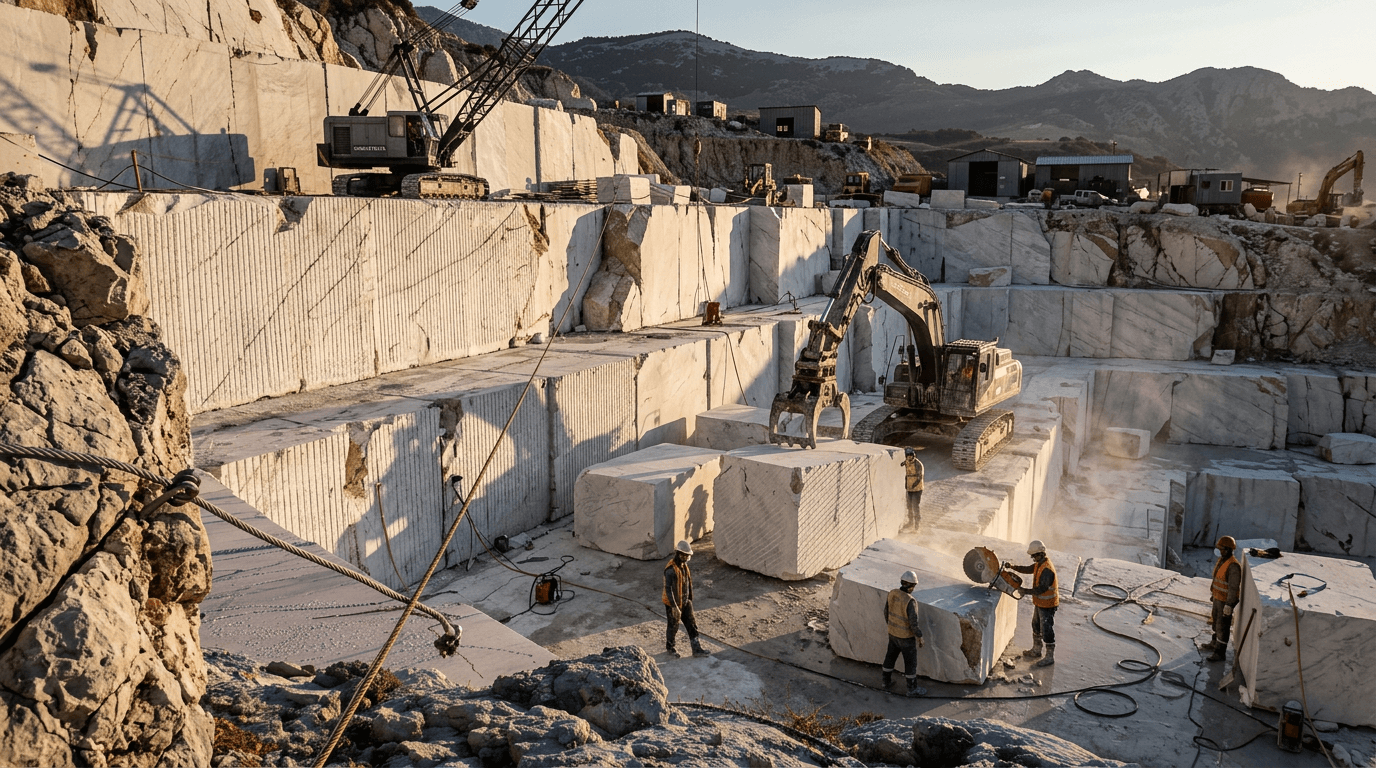
How to Source Marble Directly from a Quarry (Step-by-Step Guide)
Direct quarry sourcing gives buyers access to better material at better prices — but only if you know how to navigate the process. This guide covers the full workflow, from identifying the right quarry to managing the logistics of your first container.
Why source directly from the quarry?
When you buy marble through a distributor or trading company, you are paying for their margin (typically 30-60% above FOB price), their stock selection (not the full quarry output), and their timeline (not yours).
Direct quarry sourcing removes those layers. The advantages:
- Price: Access to FOB quarry pricing, typically 30-60% below distributor retail
- Selection: First access to new extraction batches before they are sold to distributors
- Consistency: Ability to select and reserve entire blocks or bundles for project lot consistency
- Traceability: Direct origin documentation for EU Digital Product Passport compliance and green building certifications
The trade-off: more complexity. You are managing the logistics, quality verification, and commercial relationship yourself.
Step 1: Define your specification precisely
Before contacting any quarry, you need a precise specification. Vague requests ("white marble, good quality") waste everyone's time.
A proper specification includes:
- Stone type and variety: e.g., "Calacatta Oro" or "Bianco Carrara CD" — be specific
- Background colour range: e.g., "Background L* value above 90, minimal grey tint"
- Veining character: Bold/fine, colour range (gold/grey/none), density
- Finish: Polished, honed, brushed, sandblasted
- Thickness: Standard is 2cm or 3cm; specify if different
- Slab dimensions: Minimum size required for your cut pieces
- Grade: Commercial (A/B), First Choice, Extra
- Volume: Minimum order quantity — most quarries will not engage below 1-2 containers (approximately 20-40m2 per bundle, 8-12 bundles per container)
- Timeline: When you need the material on site
Step 2: Identify quarries producing your target material
For Italian marble (Carrara, Calacatta, Statuario, Botticino):
- Confindustria Marmomacchine (Italian marble industry association) maintains quarry directories
- Marmomacc trade fair (Verona, September) is the primary in-person sourcing event
- Google "[stone name] quarry Italy" for direct quarry websites — most major producers have them
For Turkish marble (Afyon White, Mugla, Burdur Beige):
- IMM (Istanbul Marble and Stone Fair) is the primary trade event
- Turkish quarries are generally more accessible to direct buyers than Italian ones
For Greek marble (Volakas, Thassos, Penteli, Drama White):
- Marble exporters' association of Northern Greece
- Direct quarry enquiries for Volakas, Drama, and Kavala producers
For Indian granite:
- CAPEXIL (Chemical and Allied Products Export Promotion Council) maintains exporter directories
- Rajasthan and Andhra Pradesh are the primary granite production regions
Digital platforms: B2B stone trade platforms aggregate quarry listings and allow buyers to filter by material, origin, grade, and price. These are increasingly useful for initial sourcing and price benchmarking.
Step 3: Make first contact
When you contact a quarry directly, your first message sets the tone. Quarries receive many tyre-kicker enquiries — a professional, specific enquiry gets a professional response.
What to include in your first message:
- Your company name and what your business does
- The material specification (from Step 1)
- The volume you need (minimum and ideal)
- Your timeline
- Whether you have imported directly before (if yes, this is credibility)
- Your preferred payment terms (ask, don't assume)
What not to do:
- Ask for a "best price" without giving your specification
- Ask for samples before establishing that you are a serious buyer
- Negotiate price before you have seen material and agreed on terms
Step 4: Request samples and verify quality
For any significant order, request physical samples — not photographs. Photographs are useful for initial screening but cannot substitute for seeing and touching the stone.
Standard sample protocol:
- Request 2-3 representative samples of the specific block or bundle you are considering
- Request samples as "cut from the commercial stock you will supply" — not specially selected pieces
- Inspect for: colour consistency with your specification, finishing quality, hidden fissures, calibration accuracy (thickness tolerance)
For large orders, consider sending a quality inspector to the quarry or factory. Professional stone quality inspectors operate in Italy, Turkey, India, Brazil, and most major producing countries. The cost (typically EUR 500-2,000 per inspection visit) is minimal against the cost of rejecting a container.
Step 5: Negotiate commercial terms
Typical FOB terms for Italian and Turkish marble:
- Payment: 30% deposit on order confirmation, 70% before container loading (or against B/L copy)
- Lead time: 4-12 weeks from order confirmation depending on finish and availability
- Currency: EUR (Italy, Turkey), USD (India, Brazil, China)
- Minimum order: Typically 1 full container (20ft or 40ft depending on weight)
Key negotiation points:
- Price per m2 (not per piece — insist on this)
- Total m2 per container (understand bundle sizes and how many fit)
- Tolerance on dimensions (specify +/-2mm thickness, +/-5mm length/width)
- Replacement policy for damaged pieces (typically 3-5% damage allowance, quarry replaces above this)
Step 6: Manage logistics
Container loading:
- Most quarries load onto flatbed trucks; you arrange the container
- A 20ft container carries approximately 18-22 tonnes of stone
- A 40ft container carries approximately 22-26 tonnes
- Marble is dense — you will usually max out weight before volume on a 40ft
Documentation you need:
- Commercial Invoice
- Packing List
- Certificate of Origin (for EU duty purposes)
- Bill of Lading
- CE marking documentation (for construction use in EU)
- Any quarry-specific certification (ISO, environmental, sustainability)
Freight forwarders: Use a freight forwarder with stone experience. General cargo forwarders sometimes mishandle bundles. Ask specifically for their stone import experience.
Step 7: Incoming quality inspection
When your container arrives, inspect before accepting delivery:
- Document any damage to crating or bundles before signing the delivery note
- Cross-reference pieces against the packing list
- Sample-check dimensions and finish on 10-20% of pieces
- Photograph any issues immediately
Disputes are significantly easier to resolve with documented photographic evidence taken at delivery.
The direct sourcing learning curve
Your first direct import will be slower and more stressful than subsequent ones. That is normal. By the third or fourth direct import, you will have established relationships, a reliable logistics chain, and a calibrated understanding of what to expect from each quarry.
The economics improve significantly at scale: buyers doing 10+ containers per year from a single quarry typically negotiate pricing 15-25% below first-order pricing.
Digital tools for quarry sourcing
Modern B2B stone platforms (like NoriaStrata) connect buyers directly with quarries, provide verified inventory listings, and manage the documentation and traceability chain digitally. For buyers who want direct quarry pricing without managing each relationship manually, these platforms compress the process significantly.
Quarries and exporters who want to receive direct enquiries like these digitally can start with our stone export management software.
Frequently asked questions
What is the minimum order when buying marble directly from a quarry?
Most quarries will not engage below one to two full containers. A bundle runs roughly 20-40m² and a container holds 8-12 bundles; a 20ft container carries approximately 18-22 tonnes of stone, a 40ft around 22-26 tonnes. Below that volume, a distributor or a B2B stone platform is usually the more realistic route.
How much cheaper is direct quarry sourcing?
Distributor retail typically runs 30-60% above FOB quarry pricing, so direct buyers capture most of that margin. The economics improve with volume: buyers importing 10+ containers per year from a single quarry typically negotiate a further 15-25% below first-order pricing.
What are typical payment terms for a direct quarry order?
The standard structure for Italian and Turkish marble is a 30% deposit on order confirmation and 70% before container loading or against the bill of lading copy. Lead times run 4-12 weeks from confirmation depending on finish and availability.
Should I inspect marble before it ships?
For large orders, yes. Request samples cut from the commercial stock you will actually receive, not specially selected pieces, and consider a professional quality inspection at the quarry. Inspections typically cost EUR 500-2,000 per visit, minimal against the cost of rejecting a container.
What documents do I need to import marble into the EU?
Commercial invoice, packing list, certificate of origin, bill of lading, and CE marking documentation for construction use, plus any quarry-specific certifications. Direct origin documentation also supports EU Digital Product Passport compliance and green-building certification.