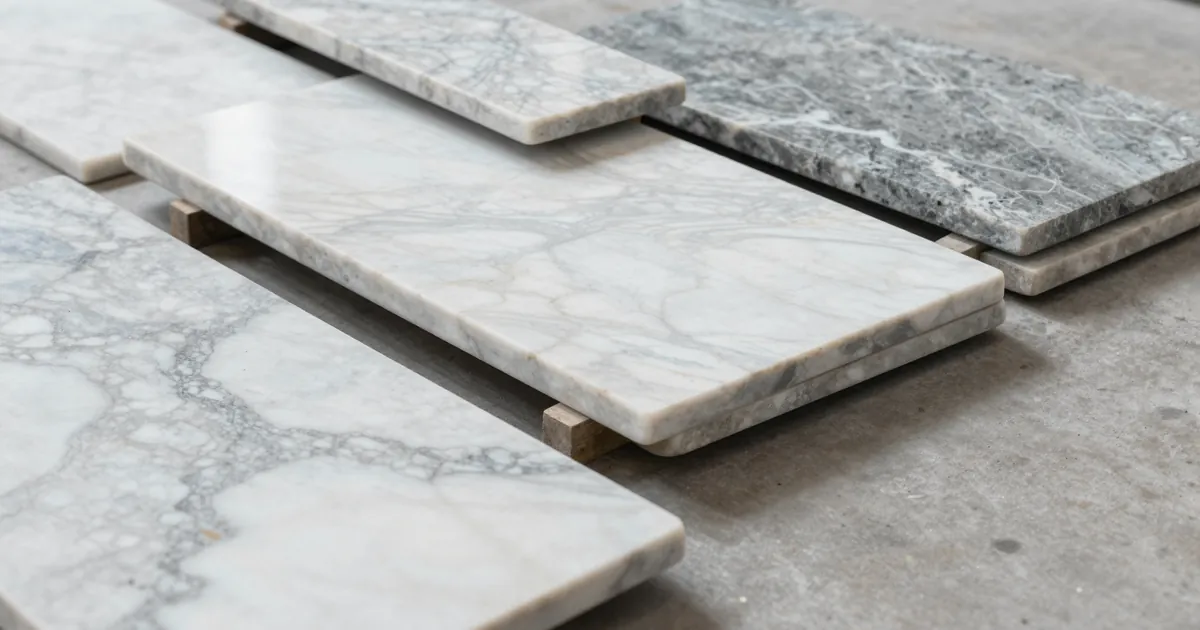
At a glance
- True quartzite is «much harder than marble», in the Natural Stone Institute's words, and household acids do not etch it: it is mostly quartz (Mohs 7), while marble is calcite (Mohs 3) or dolomite (3.5–4), which acids attack1,2,5,6.
- Tested densities overlap: six Brazilian quartzites 2,570–2,660 kg/m³, the cited granites 2,590–2,670 kg/m³, Greek calcitic marbles 2,694–2,714 kg/m³4,14,15,16.
- Two tested calcitic Greek marbles absorbed 0.1% and 0.2% of water by weight3; acid, not water, is what marks marble5,6.
- «Soft quartzite» in most cases means the stone is marble, according to the Natural Stone Institute6.
The short answer
True quartzite is «much harder than marble», in the Natural Stone Institute's words, and household acids do not etch it: it is mostly quartz (Mohs 7), while marble is calcite (Mohs 3) or dolomite (3.5–4), which acids attack1,2,5,6. A steel knife blade (Mohs 5–6.5) can scratch marble1,5. Granite in the geological sense is a mix of quartz and feldspar with other minerals1. Quartz and feldspar are harder than calcite, but actual slabs can contain other minerals or treatments, so test the material supplied rather than infer every response from a trade name. Engineered quartz is a manufactured slab, not a quarried stone7.
Two practical consequences follow. On a kitchen worktop where lemon, wine and vinegar are daily events, marble will etch5,6. On a facade of thin panels, some marbles lose strength and bow with heat cycles9,10; the sources we reviewed do not report the same mechanism for granite or quartzite, which is a limit of those sources, not proof that no thermal problem can occur.
For the shorter, stone-by-stone comparison of the two most confused materials, see our quartzite vs marble page.
What each stone is
Marble
ASTM's specification for marble dimension stone states that «Marbles covered here are classified as either calcite or dolomite»11. In a doctoral study of marbles from Eastern Macedonia, Greece, the dolomitic marbles were denser (2,825–2,848 kg/m³ against 2,694–2,714 kg/m³ for the calcitic ones) and about two to three times stronger in compression4. Those are results for the tested Greek samples, not limits for all marbles.
Quartzite
The British Geological Survey defines quartzite as «a psammite containing more than 80% quartz»2. ASTM C616, the specification for quartz-based dimension stone, has three classes: sandstone (I), quartzitic sandstone (II) and quartzite (III)12. In the trade, «quartzite» is also used as a sales name for stones that are not quartzite: a laboratory report on a stone sold as «Quartzite» gives its petrographic name as «QUARTZ-BEARING MARBLE»17.
Granite
In geology, granite is an igneous rock of quartz and feldspar; its main minerals have Mohs hardness of 6–6.5 (orthoclase and plagioclase feldspar) and 7 (quartz)1. ASTM C615, the granite specification, defines its scope by processing, stone «sawed, cut, split, or otherwise finished or shaped», and excludes «molded, cast, or otherwise artificially aggregated units»13. Test reports often list a stone as a trade «granite» without a petrographic name15; if the exact rock type matters, ask for a petrographic description.
Engineered quartz is not quartzite
A 2023 study of silicosis among engineered stone countertop workers in California describes the material as «manufactured in large facilities via mechanical crushing of quartz with polymer resins, dyes, and glass at high heat»7. A quartzite comes from a quarry and a block; engineered quartz comes from a factory and a production batch. The silica content is discussed under «Fabrication and silica» below.
Marble vs granite vs quartzite: properties side by side
| Property | Calcitic marble | Dolomitic marble | Quartzite | Granite | Source |
|---|---|---|---|---|---|
| Main mineral (Mohs) | Calcite (3) | Dolomite (3.5–4) | Quartz (7), more than 80% | Feldspar (6–6.5), quartz (7) | 1,2 |
| Apparent or bulk density (kg/m³) | 2,694–2,714 (Greek study samples); 2,710 (Thassos and Naxos Crystallina) | 2,825–2,848 (Greek study samples) | 2,570–2,660 (six São Thomé quartzites, Brazil) | 2,590–2,670 (Portuguese granites and Baltic Brown, Finland) | 3,4,14,15,16 |
| Water absorption (% by weight) | 0.2 (Thassos Crystallina); 0.1 (Naxos Crystallina) | Two to three times the calcitic samples (fine-grained Falakro dolomites) | not compiled here | not compiled here | 3,4 |
| Household acid (lemon, vinegar) | Etches | Etches, more slowly | Does not etch | Main minerals do not etch | 5,6 |
| Glass scratch test | Does not scratch glass | Does not scratch glass | Scratches glass | Scratches glass | 6 |
The table gives results for the samples named. Quarry-to-quarry variation inside each family is large; the densities of the cited quartzites and granites overlap almost completely14,15,16. Absorption and strength cannot be read from density; for a quartzite or granite, take them from the stone's own test report.
What the ASTM specifications say
ASTM publishes product specifications for each family: C503 for marble, C615 for granite and C616 for quartz-based stone11,12,13. Their numeric limits are not quoted here, because the current editions could not be checked. Two scope points are confirmed:
- The cited C503-22 catalogue describes calcite and dolomite marbles11.
- C616 and several other specifications «do not include requirements for flexural strength (ASTM C880)»9. C616 does not itself require ASTM C880 flexural testing; a project specification can request additional tests where the design needs them9.
In Europe, the test methods are the EN series: apparent density and porosity (EN 1936), water absorption (EN 13755), flexural strength (EN 12372), compressive strength (EN 1926) and frost resistance (EN 12371)3.
In the kitchen: etching, staining, scratching, heat
Etching. Acid attacks calcite and, more slowly, dolomite: dolomite is «also affected by acids but not as quickly»5. For the household etch marks it describes, the Natural Stone Institute states: «Etches do not affect the structural integrity of a stone, and they can be polished out if need be»5. Sealers do not prevent etching: «Sealers do not protect a stone from interactions with acid»6. A marble worktop will etch; the owner chooses whether that patina is acceptable.
Staining. Staining depends on absorption. The two calcitic Greek marbles tested absorbed 0.1% and 0.2% of water by weight3; that is not a range for all marbles, and the fine-grained Falakro dolomites absorbed two to three times as much as the calcitic marbles in the same study4. A water-drop test can indicate absorption; follow the stone and sealer supplier's instructions on whether and when to reseal.
Scratching. Knife blades «vary between 5 and 6.5» on the Mohs scale1. That is harder than calcite (3) and dolomite (3.5–4) and softer than quartz (7)1. A slab's resistance also depends on its other minerals and structure, so treat this as an indication rather than a guarantee.
Heat. Engineered stone contains polymer resin7, which the natural rock does not (a commercial natural slab may still carry a resin treatment, as noted above); follow the manufacturer's guidance on hot pans for any engineered product. We know of no published test comparing heat resistance across these stones and engineered quartz.
How to test a sample sold as quartzite
The Natural Stone Institute advises: «Your best bet is to rely on the way the stones behave rather than how they look»5. It also states that «There is really no such thing as soft quartzite, and in most cases that term means the stone is marble»6. Run the tests on a sample or offcut, or on a slab only with the owner's permission; the Institute warns «If you don't already own the slab, make sure you get permission before doing this!»6.
| Test | What you do | Quartzite | Marble | Caveat |
|---|---|---|---|---|
| Acid | «Put several large drops of lemon juice or vinegar on the surface of the stone and leave it there for 5-10 minutes»6 | No etch | Etch mark | Dolomite reacts more slowly5 |
| Glass | Press the pointed edge of the stone into a glass tile6 | Scratches glass | Does not scratch glass | Glass varies from 4 to 7 Mohs1; wipe the mark, as powder from a soft stone can look like a scratch |
| Knife | Drag the tip of a pocketknife or awl across the surface6 | Not significantly scratched | Scratched | «When in doubt, check a few different areas of the stone»5 |
Mixed stones are why one test is not enough. The Institute states that «Super White and Calacatta Gold are examples of marble breccia», and that «Some marbles, like Super White or Fantasy Brown, may have isolated pockets of quartz amid an overall composition of marble»5. A sample can scratch glass in one spot and etch in another.
Outdoors and on facades
A 2024 review of stone testing for building professionals notes that «some types of marble are prone to strength loss through hysteresis», and points to EN 16306 as the test for susceptibility to bowing9. Thin Carrara marble facade panels are the documented case: an ASTM paper studies «thin, facade panels that have failed because of out-of-plane distortions»10. Our Calacatta and Carrara guide describes two buildings that were reclad.
For marble facade panels, ask for EN 16306 results and frost resistance (EN 12371) for the specific stone3,9. For granite and quartzite, select the tests and design criteria for the actual rock and application.
Fabrication and silica
OSHA states that «Materials like sand, stone, concrete, and mortar contain crystalline silica», and that respirable dust is created «when cutting, sawing, grinding, drilling, and crushing stone, rock, concrete, brick, block, and mortar»8. Silica content varies substantially among natural stones; the BGS definition of quartzite alone requires more than 80% quartz2.
Engineered stone is where the recent health evidence sits. The California study cited above is a case series of 52 male patients with silicosis associated with engineered stone countertop fabrication, identified by statewide surveillance of the California Department of Public Health from 2019 to 2022; 10 of the cases (19%) were fatal7. In its introduction, the paper states that «engineered stone contains more than 3 times the silica content (90% vs 3%-30%)» of «natural stone products», citing a manufacturer's safety data sheet and a 1999 study of granite countertop fabrication7. That comparison was not measured in the study, and it is not a range for all natural stones: quartzite falls outside it. The authors also note that fabrication «is frequently performed in shops where ventilation, dust control methods, and personal protective equipment are inadequate»7. Follow the occupational-health rules of your own country for dust control when cutting any of these materials.
What to compare when quotes differ
We give no prices. When two quotes for a finished surface differ, compare them line by line:
- The material: the stone, its origin and the test report offered.
- Thickness and slab size.
- Matching: consecutive slabs from one block, or visual matching across several blocks, which are different requirements.
- Fabrication: edges, cut-outs and seams.
- Installation and any tests the project requires.
What we could not find
We did not compile water absorption or strength results for quartzites and granites, could not check the numeric limits in the current ASTM C503, C615 and C616, and found no published test comparing heat resistance across natural stones and engineered quartz. The Carrara vendor values used elsewhere are left out because the same publisher repeats them for another stone.
Frequently Asked Questions
Is quartzite harder than granite?
Generally, slightly. Quartzite is mostly quartz, Mohs 71,2; granite mixes quartz with feldspar at 6–6.51. The Natural Stone Institute says «Quartzite is much harder than marble and slightly harder than granite»5. Both quartzite and granite «will all scratch glass and will not be significantly scratched by a metal tool», in the Institute's tests6.
What is the difference between quartzite and quartz?
Quartzite is a natural rock with more than 80% quartz, quarried as blocks2. «Quartz» worktops are engineered stone, made by crushing quartz with polymer resins, dyes and glass7. A 2023 California case series linked silicosis, including fatal cases, to the fabrication of engineered stone countertops7.
Is quartzite better than marble for countertops?
For acid and scratches, quartzite resists better: it is made mostly of quartz (Mohs 7), which household acids do not etch1,2,6. Marble is calcite or dolomite, which acids attack and a steel knife blade (Mohs 5–6.5) can scratch1,5; on a worktop where lemon, wine and vinegar are daily events, marble will etch5,6. Whether that patina is acceptable is the owner's choice. Test the sample first: «soft quartzite» in most cases means the stone is marble6.
Can marble be used in a kitchen?
Yes, if the owner accepts etching. Lemon juice and vinegar leave etch marks on calcite and, more slowly, on dolomite5,6. Sealers reduce staining but «do not protect a stone from interactions with acid»6. The Natural Stone Institute states that such etches do not affect the stone's structural integrity and can be polished out5.
How often should marble be sealed?
How can I tell if my «quartzite» is really marble?
Test a sample or offcut. Leave lemon juice or vinegar on it for 5–10 minutes, press it into a glass tile, and try to scratch it with a knife tip6. Quartzite scratches glass and resists a metal tool; marble does not scratch glass6. Check several areas, because some marbles contain pockets of quartz5.
Which stone is best for an exterior facade?
It depends on the specific stone's test results, not its family. Some marbles lose strength and bow under heat cycles, and EN 16306 tests marble for this9; thin Carrara panels have failed on facades10. For marble panels, ask for EN 16306 and frost (EN 12371) results3,9; for other rocks, choose tests for the rock and application.
How Noria Strata handles this
Noria Strata is software for natural stone companies: quarries and block traders, factories, slab distributors and showrooms, fabricators and projects. This guide is about the stones themselves, and the choice between marble, granite and quartzite remains a matter of test reports and samples. For the stones we describe, with their origin and type, see the stones pages. For how a slab yard keeps track of the stock it holds, see slab inventory.
Sources
- Geology.com. Mohs Hardness Scale (geology reference site) geology.com/minerals/mohs-hardness-scale.shtml
- British Geological Survey. Rock Classification Scheme, entry QZITE (quartzite) webapps.bgs.ac.uk/bgsrcs/rcs_details.cfm?code=QZITE
- Laskaridis, K., Arapakou, A. & Patronis, M. (2026). The timelessness of Thassos and Naxos heritage ornamental stones. Boletín Geológico y Minero 137(1): 004. DOI 10.21701/bolgeomin/137.1/004 bgm.revistas.csic.es/index.php/bgm/article/download/764/728?inline=1
- Papatrechas, C. (2011). Correlation of physicomechanical properties with grain size and mineralogical composition of the carbonate rocks of Eastern Macedonia (Greece). PhD thesis, Aristotle University of Thessaloniki didaktorika.gr/eadd/handle/10442/26663?locale=en
- Kirk, K. (2020-04-10). Telling White Stones Apart. Natural Stone Institute (UseNaturalStone.org) usenaturalstone.org/?p=7575
- Kirk, K. (2020-02-20). How to Be Your Own Stone Sleuth. Natural Stone Institute (UseNaturalStone.org) usenaturalstone.org/?p=7405
- Fazio, J. C., Gandhi, S. A., Flattery, J., Heinzerling, A., Kamangar, N., Afif, N., Cummings, K. J. & Harrison, R. J. (2023). Silicosis Among Immigrant Engineered Stone (Quartz) Countertop Fabrication Workers in California. JAMA Internal Medicine. DOI 10.1001/jamainternmed.2023.3295 ph.lacounty.gov/silicosis/docs/Fazio_2023.pdf
- US Occupational Safety and Health Administration. Silica, Crystalline osha.gov/silica-crystalline
- Farmer, M. C. (2024). Dimension Stone Testing and Evaluation: The What, Why, When, and Where. IIBEC Interface, October 2024: 10–18 iibec.org/publication-post/dimension-stone
- Erlin, B. (2000). Contribution to a Better Understanding of the Mechanism Causing Dishing Failures of the Carrara Marble When Used for Outside Building Facades. ASTM STP 1394. DOI 10.1520/STP13540S (abstract) store.astm.org/stp13540s.html
- ASTM International. C503/C503M-22 Standard Specification for Marble Dimension Stone (catalogue page) store.astm.org/c0503_c0503m-22.html
- ASTM International. C616/C616M-22 Standard Specification for Quartz-Based Dimension Stone (catalogue page) store.astm.org/c0616_c0616m-22.html
- ASTM International. C615/C615M-23 Standard Specification for Granite Dimension Stone (catalogue page) store.astm.org/c0615_c0615m-23.html
- Carvalho, J., Carvalho, C. & Lisboa, V. (2021). EuroLithos Atlas: Ornamental stone resources in Portugal. LNEG repository.europe-geology.eu/egdidocs/eurolithos/eurolithos+atlas+portugal.pdf
- Centro Tecnológico del Mármol (2023-02-23). Test report 232936PN004A, «Baltic Brown», for LT Granit Oy, hosted by the Finnish Natural Stone Association (KIVI) kivi.info/wp-content/uploads/2023/12/Baltic-Brown-LT-Granit-Oy-2023-EN.pdf
- Fernandes, T. M. G., Godoy, A. M. & Fernandes, N. H. (2003). Aspectos geológicos e tecnológicos dos quartzitos do centro produtor de São Thomé das Letras (MG). Geociências (UNESP) 22(2): 129–141 revistageociencias.com.br/geociencias-arquivos/22_2/3.pdf
- SGS-CSTC Standards Technical Services (Xiamen) (2017-07-18). Test report XMCCM161201715, commercial name «Quartzite», hosted by Groupe Samse medias.groupe-samse.fr/Fiche_technique/Fiche_technique_681369.pdf
How to cite this article
Konstantinou, M. (2026). Marble vs granite vs quartzite (and engineered quartz): a spec guide. Noria Strata. https://www.noriastrata.com/en/blog/marble-vs-granite-vs-quartzite-guide
The author
Maria KonstantinouCTO, Noria Strata