
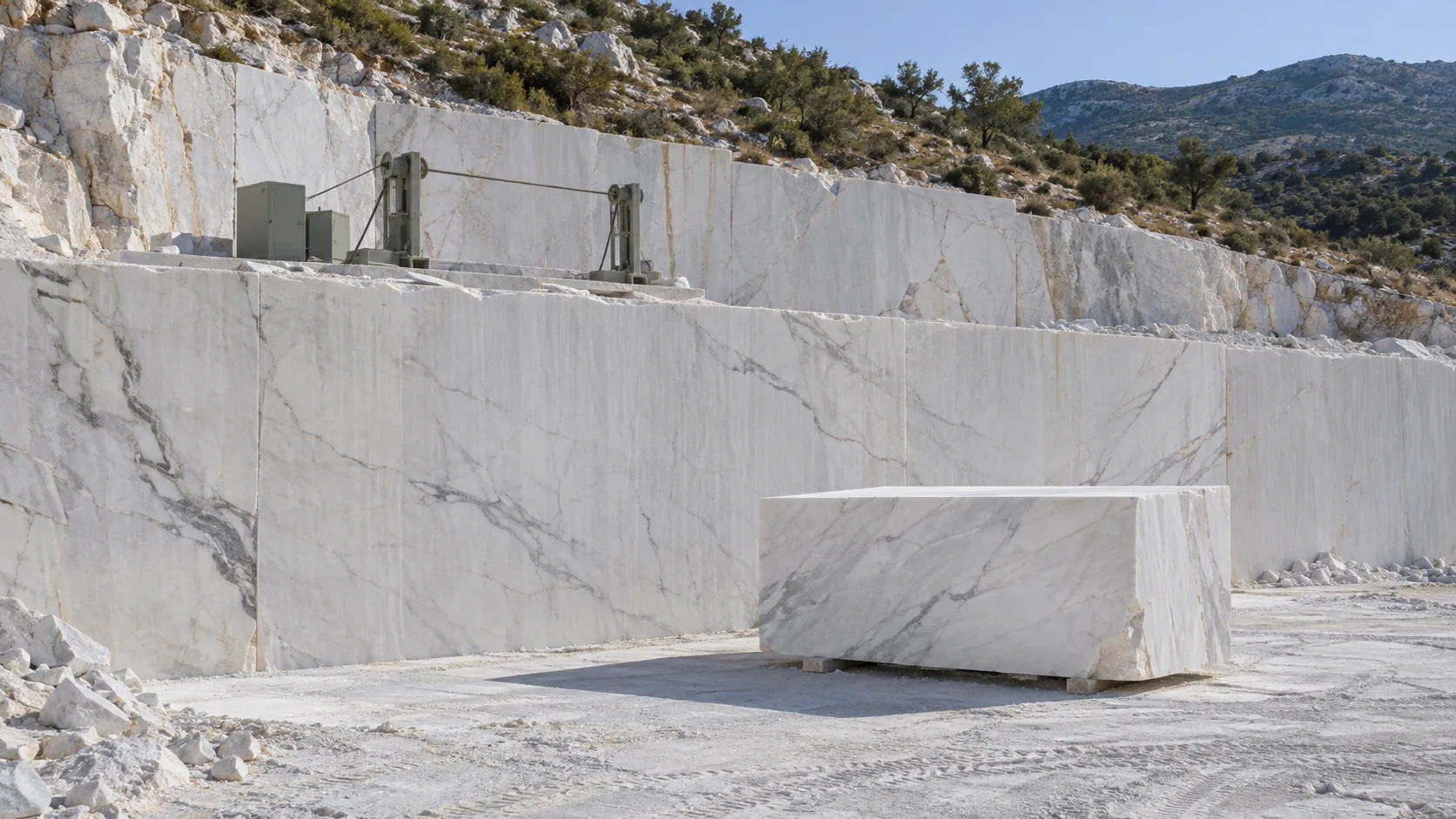
At a glance
- Most of the world's natural stone, the family that includes marble and granite, comes from quarries in China, India and Turkey: more than two-thirds of world production in 2021, in Carlo Montani's estimates4.
- In 2023 Italy (53%) and Greece (27%) accounted for most of the reported export value under HS 251511, marble and travertine, crude or roughly trimmed7.
- In 2023 India accounted for about 60% of the reported export value under HS 251611, granite, crude or roughly trimmed9.
- In Montani's estimate for 2020, about 91.5 million of the 318 million tonnes extracted worldwide ended up in products3.
The short answer
Most of the world's natural stone, the family that includes marble and granite, comes from quarries in China, India and Turkey: more than two-thirds of world production in 2021, in Carlo Montani's estimates4. Montani's list of the five largest producers in 2020 was China, India, Turkey, Brazil and Iran3.
Who exports the most depends on what you count:
- By tonnage, all natural stone, 2021: India (15.5 million tonnes), Turkey (7.76 Mt) and China (6.6 Mt) led, followed by Brazil, Italy, Portugal, Spain and Greece4.
- Raw marble, by export value, 2023: Italy and Greece together accounted for about 80% of the reported export value under HS 251511 (marble and travertine, crude or roughly trimmed)7. Under HS 251512 (marble and travertine merely cut into rectangular blocks or slabs), Turkey accounted for 60%8.
- Raw granite, by export value, 2023: India accounted for about 60% under HS 251611 (granite, crude or roughly trimmed)9. Under HS 251612 (granite cut into rectangular blocks or slabs), India had 34% and Brazil 33%10.
- Worked stone, by export value, 2023: China accounted for 71% under HS 680293 (worked granite) and 41% under HS 680291 (worked marble, travertine and alabaster), ahead of Italy and Turkey for the second code11,12. These two codes do not cover all finished stone: simply sawn granite with a flat surface falls under HS 680223, where India accounted for 73%13.
These customs shares are shares of the exports reported in the cited dataset for each code, not a complete census of every exporting country7–13. A trade-press summary describes China's stone imports as almost all raw blocks and its exports as finished products6.
A caution on world figures. The U.S. Geological Survey estimates dimension stone production only for the United States and lists the world total as "not available"1. Montani's yearbook was the only world series we found, and according to trade press its 2022 edition was the last6. We found no other world production series in the sources consulted, so the world numbers here are Montani's estimates for 2019 to 2021, plus customs data, which count trade and not production3–13.
What a dimension stone quarry is
Dimension stone is stone quarried for blocks and cut to size, sold as rough blocks or as dressed pieces such as ashlar, slabs and flagging1; the glossary entry gives the definition. Its scale is small next to aggregates. In 2025 the United States produced an estimated 2.3 million tonnes of dimension stone, worth $460 million1. Its crushed stone, from about 3,500 quarries, came to an estimated 1.5 billion tonnes, worth $27 billion2. By weight, that is roughly 650 tonnes of crushed stone for every tonne of dimension stone (our arithmetic).
The great quarrying districts for marble, granite and other stone
Selected districts follow, each with one or two sourced facts and a link to our country page.
Apuan Alps, Italy (Carrara)
"Carrara marble" is a collective name for more than two hundred commercial varieties from over a hundred quarries in the Apuan Alps of north-west Tuscany, among them Statuario and Calacatta20. Geologically it is a calcitic marble formed from Triassic to Early Jurassic limestone21. Output in Carrara municipality alone is shrinking: its quarries extracted 600,000 tonnes of marble blocks in 2025, 11% less than in 2024 and the lowest since the 1970s19. The Apuan district accounted for 43% of Italy's raw-stone exports by value in 202419. See Italy and our Calacatta vs Carrara guide.
Drama, Kavala and Thassos, Greece
Eastern Macedonia and Thrace accounts for 73% of Greece's marble quarrying activity, according to the Ministry of Environment and Energy's 2024 report, and the same report places Greece second in the EU for marble, without naming the measure22. The industry association puts about 70% of the country's quarries in Drama, Kavala and Thassos23. The studied Falakro whites near Drama, Volakas among them, are ultra-fine-grained dolomitic marbles, and the commercial Thassos white is mainly coarse dolomite25. The ancient Alykes quarry on Thassos, which produced a grey calcitic marble and is no longer worked, was in operation for over 1,200 years24. In 2023 Greece had 27% of the reported export value under HS 251511, second to Italy7. For 2024 marble exports the sources differ: €338 million (Ministry) and €322 million (industry figures); their coverage has not been reconciled22,47. See Greece and our Greek marble guide.
Afyon and the Marmara Sea, Turkey
Turkey exported natural stone worth about $1.94 billion in 2023, with China and the USA together taking about 42% of the value; the source does not specify code coverage15. Two historic marble districts are Afyon and Marmara. Afyon marble, quarried around İscehisar (ancient Docimium) since at least 300 BC and sold as Afyon white, sugar, grey, Tigerskin and violet, was designated a heritage stone by the IUGS in 202426. Proconnesus, today's Marmara Island, was the largest quarrying district of the Roman world, covering almost 40 km², and remains an important quarrying centre28. Denizli travertine, from the Çürüksu basin, was also designated in 202427. See Turkey.
Macael and O Porriño, Spain
Two contrasting Spanish districts are Macael and O Porriño. Macael in Almería has supplied white marble for more than 5,000 years, including to the Alhambra, and was designated a heritage stone in 201929. O Porriño near Vigo is "one of the main production centres of granite for ornamental use in the world", and a 2017 study states that more than half of Spain's granite is extracted in Galicia30. The same study's reserve-quality assessment of the Rosa Porriño deposit classed 13.9% of it as first-quality and 16.0% as second-quality ornamental stone, and 48.6% as fourth quality, for aggregate30. See Spain.
Estremoz, Portugal
The Estremoz–Borba–Vila Viçosa "marble triangle" in the Évora district has been quarried systematically since the Roman period; the IUGS record places 90% of its quarries in the south-western limb of the Estremoz anticline, in Vila Viçosa municipality31. Estremoz marble was designated a heritage stone in 201731. A 2022 university report (grey literature) says only about 9% of what it calls "picked material" is marketed32. Portugal's stone exports fell 5.4% by value to €470 million in 20246, and in 2023 it had 8% of the reported export value under HS 251612, granite cut into blocks or slabs10. See Portugal.
Rajasthan and south India
India was the world's largest exporter of natural stone by tonnage in 20214. In Rajasthan, Makrana marble, the stone of the Taj Mahal, was designated a heritage stone in 201933. In the south, charnockite, the granite-like rock of the Mahabalipuram monuments, was designated in 202434. India exported about $1.88 billion of natural stone in 2023, about a third of it raw granite16. In 2023 it had about 60% of the reported export value under HS 251611 (crude granite) and 73% under HS 680223 (granite simply cut or sawn with a flat surface)9,13.
Fujian, Guangdong and Shandong, China
China was listed first among the five largest producers in Montani's 2020 ranking3, and in 2023 it led reported export value under HS 680293 and HS 68029111,12. A supplier's page attributes to the China Stone Industry Association a list of ten stone bases that includes Shuitou (Nan'an, Fujian), Yunfu (Guangdong) and Laizhou (Shandong)35; these are processing clusters, and we found no official figure for their shares of national output. In 2024 China was the largest buyer of Italian raw blocks, at €228.8 million14. See China.
Espírito Santo, Brazil
Brazil exported natural stone worth $1.263 billion in 2024, 12.7% more than in 20236. Espírito Santo dominates: the state industry association reports about 82% of national export value and 75% of tonnage from January to October 202417. The United States took 54.7% of Brazil's stone exports in 2023, a year the source totals at $1.11 billion, and the same source names US demand for quartzite as a key factor in early-2024 growth18. In a separate series, Brazil was the leading source of U.S. granite imports, with 41% by value in 2021–241. See Brazil.
Texas, Wisconsin, Vermont, Indiana and Georgia, United States
By tonnage the largest producing states in 2025 were Texas, Wisconsin, Vermont, Indiana and Georgia, together 73% of U.S. dimension stone output1. In 2025 limestone was 46% of U.S. dimension stone by weight, granite 18% and sandstone 17%; the remaining 19% was divided among dolomite, slate, quartzite, marble and other stone1. The country is mainly a market: it imported an estimated $2 billion of dimension stone in 2025, and its leading suppliers by value in 2021–24 were Brazil, Italy, China and India1. See United States.
Larvik, Norway
Larvikite, a monzonite from the Larvik area in south-east Norway, is sold in commercial types such as Blue Pearl and Emerald Pearl and is prized for the blue iridescence of some of its feldspars36. It was designated a heritage stone in 2017 and has been used on buildings from Harrods in London to the Burj Al Arab in Dubai36. Since modern production began, a significant part of it has gone into gravestones and funerary monuments36. See Norway.
Other country pages
Our directory also covers South Africa, with 8% of the reported export value under HS 251611 (crude granite) in 20239; North Macedonia, with 4% under HS 251512 (marble and travertine cut into blocks or slabs) in 20238; Iran, fourth in world extraction in Montani's estimate for 2019, a year earlier than the 2020 list above5; and the United Kingdom, home of Portland limestone, designated a heritage stone in 201646. The remaining pages are Canada, Pakistan, Nigeria, Australia, Germany, France, Belgium, the Netherlands and Sweden.
Countries at a glance
Rows use different years, currencies and measures and are not a country ranking. Customs shares are shares of reported export value under the named code.
| Country | Main stones | Main districts | Selected figure (year) | Source | Our page |
|---|---|---|---|---|---|
| China | Granite, marble (processed) | Shuitou (Fujian), Yunfu, Laizhou | 71% of reported export value, HS 680293 worked granite (2023) | 12 | China |
| India | Granite, marble | Rajasthan (Makrana); south Indian charnockite | $1.88 bn stone exports (2023); 15.5 Mt exported (2021) | 16,4 | — |
| Turkey | Marble, travertine | Afyon, Marmara, Denizli | $1.94 bn stone exports (2023) | 15 | Turkey |
| Italy | Marble | Apuan Alps (Carrara) | €2.18 bn stone exports, €457 m of it raw (2024) | 14 | Italy |
| Brazil | Granite, quartzite | Espírito Santo | $1.263 bn stone exports (2024) | 6 | Brazil |
| Greece | Dolomitic and calcitic marble | Drama, Kavala, Thassos | Marble exports €338 m (Ministry); €322 m (industry) (2024) | 22,47 | Greece |
| Spain | Marble, granite | Macael, O Porriño | 5% of reported export value, HS 251511 crude marble and travertine (2023) | 7 | Spain |
| Portugal | Marble, granite | Estremoz triangle | €470 m stone exports (2024) | 6 | Portugal |
| United States | Limestone, granite, sandstone | Texas, Wisconsin, Vermont, Indiana, Georgia | 2.3 Mt produced, $460 m (2025) | 1 | United States |
| Norway | Larvikite | Larvik | Heritage stone designation (2017); no output figure found | 36 | Norway |
Shares of reported export value within each code, 2023; each code covers a different product.
HS 251511 · marble and travertine, crude
HS 251512 · marble and travertine cut into blocks or slabs
HS 251611 · granite, crude
HS 251612 · granite cut into blocks or slabs
HS 680291 · worked marble, travertine and alabaster
HS 680293 · worked granite
How much of the rock becomes a block
Reported recovery depends strongly on the quarry and on the definition used. Montani's estimates for 2020 imply that about 49% of the 318 million tonnes extracted worldwide went on to processing as raw blocks and about 29% reached products (our arithmetic from3); a 2023 peer-reviewed paper citing Montani gives about 51% quarry waste and about 71% total losses from quarry to product37. These are world mass figures; they do not describe a typical quarry.
Local figures use different measures and are not directly comparable: district waste of about half of the marble extracted in the Carrara basin (2024 conference abstract)39; overall recovery of 16% to 26% in four Indian granite quarries (2016 study)38; about 9% of "picked material", in the report's term, marketed at Estremoz (2022 grey literature)32; and computed recoveries of 49%, 33% and 48% for three cutting grids on one Botticino marble bench (2025)42. Our article on block recovery in dimension stone quarries covers the evidence in detail.
How quarrying is done today
Methods discussed in a 2023 review of dimension stone extraction include diamond wire cutting, which it describes as highly efficient and waste-reducing but costly and prone to wire breakage, circular diamond saws, frame sawing and controlled blasting40. Chain saws are used as the main or auxiliary machines in quarrying dimension stone, with performance governed largely by the rock's compressive strength, hardness and abrasivity41. See the diamond wire saw glossary entry and the recovery article linked above.
Frequently Asked Questions
What is the largest marble quarry in the world?
We found no measured worldwide ranking of individual marble quarries in the sources consulted. Primavori's 2014 account describes more than 100 Apuan quarries producing about 1.5 million tonnes a year20. The Danby quarry in Vermont describes itself as the largest underground marble quarry in the world; that is the operator's claim43. In antiquity, Proconnesus (Marmara Island) was the largest quarrying district of the Roman world28.
Where does Carrara marble come from?
From the Apuan Alps of north-west Tuscany. "Carrara marble" is a collective commercial name for the district's marbles: more than two hundred varieties from over a hundred quarries, including Statuario and Calacatta, all calcitic marble formed from Triassic to Early Jurassic limestone20,21. The 2025 production figure, about 600,000 tonnes of blocks and the lowest since the 1970s, refers only to Carrara municipality19.
Which country produces the most granite?
We found no world production figure for granite alone in the sources consulted. China was listed first among natural stone producers in Montani's 2020 ranking3. In 2023 customs data, India had about 60% of the reported export value under HS 251611 (crude granite) and China 71% under HS 680293 (worked granite)9,12. Brazil was the leading source of U.S. granite imports by value in 2021–241.
Can you visit a marble quarry?
Quarry access depends on the operator; arrange permission before visiting. At Carrara, a tour operator runs jeep tours from a meeting point by the Fantiscritti quarry yard and asks groups of 20 or more to book44. Policies change: Rock of Ages in Barre, Vermont, ended its granite quarry tours in February 2025, citing site regulations and operational needs45.
Where is marble quarried in the United States?
In four states, for marble cut as blocks and slabs, in the latest U.S. Geological Survey yearbook we found: in 2019, five companies quarried dimension marble at five quarries in Vermont, Colorado, Tennessee and Georgia, in that order by tonnage48. The leading producers were Colorado Stone Quarries and Vermont Quarries Corp.48. The Colorado quarry, about 3 miles (5 km) south of the town of Marble, works the Yule marble used in the Lincoln Memorial49; Vermont's Danby quarry calls itself the world's largest underground marble quarry43. US dimension-marble output was 47,100 tonnes in 2019, partly estimated by the USGS48.
How much of a quarry becomes saleable block?
It depends on the quarry and on how recovery is defined. For the world as a whole, Montani-based figures put quarry waste at about 51% of gross extraction and total losses to finished product at about 71%37. Local figures use other measures: about half of extracted marble wasted in the Carrara basin (2024)39, 16–26% overall recovery in four Indian granite quarries (2016)38, and about 9% of "picked material", in the report's term, marketed at Estremoz (2022)32.
How Noria Strata handles this
Noria Strata records each block when it leaves the quarry face: a LiDAR scan with the phone, photographs of each face, GPS coordinates for origin, and a weight calculated from the material's density. Each block gets one record with timestamped measurements and photographic evidence, which buyer and seller can both check when a question arises. The same record follows the material downstream to the slab yard. See quarry management for the workflow and extraction for the quarry tools.
Sources
- U.S. Geological Survey (2026). Mineral Commodity Summaries 2026: Stone (Dimension). J. C. Willett pubs.usgs.gov/periodicals/mcs2026/mcs2026-stone-dimension.pdf
- U.S. Geological Survey (2026). Mineral Commodity Summaries 2026: Stone (Crushed) pubs.usgs.gov/periodicals/mcs2026/mcs2026-stone-crushed.pdf
- Stone-Ideas.com (2021). Dr. Carlo Montani: statistics world stone market 2020 (trade press summarising Montani's XXXII report) stone-ideas.com/90089/dr-carlo-montani-statistics-world-stone-market-2020
- Stone-Ideas.com (2022). Dr. Carlo Montani: 2021 statistics for stone (trade press summarising Montani's XXXIII report) stone-ideas.com/96389/dr-carlo-montani-2021-statistics-for-stone
- Stone-Ideas.com (2020). Dr. Carlo Montani: natural stone statistics 2019 (trade press summarising Montani's XXXI report) stone-ideas.com/82698/dr-carlo-montani-natural-stone-statistics-2019
- Stone-Ideas.com (2025). Stone producing countries: import and export 2024 (editorial compilation of national association data) stone-ideas.com/114921/stone-producing-countries-import-export-2024
- TrendEconomy, world exports of HS 251511, marble and travertine, crude or roughly trimmed, 2023 (UN Comtrade-based) trendeconomy.com/data/commodity_h2/251511
- TrendEconomy, world exports of HS 251512, marble and travertine, merely cut into rectangular blocks or slabs, 2023 (UN Comtrade-based) trendeconomy.com/data/commodity_h2/251512
- TrendEconomy, world exports of HS 251611, granite, crude or roughly trimmed, 2023 (UN Comtrade-based) trendeconomy.com/data/commodity_h2/251611
- TrendEconomy, world exports of HS 251612, granite, merely cut into rectangular blocks or slabs, 2023 (UN Comtrade-based) trendeconomy.com/data/commodity_h2/251612
- TrendEconomy, world exports of HS 680291, worked marble, travertine and alabaster, 2023 (UN Comtrade-based) trendeconomy.com/data/commodity_h2/680291
- TrendEconomy, world exports of HS 680293, worked granite, 2023 (UN Comtrade-based) trendeconomy.com/data/commodity_h2/680293
- TrendEconomy, world exports of HS 680223, granite simply cut or sawn with a flat surface, 2023 (UN Comtrade-based) trendeconomy.com/data/commodity_h2/680223
- StoneNews.eu (2025). Italian natural stone exports grow in 2024, driven by raw materials and finished products (data: Confindustria Marmomacchine) stonenews.eu/?p=64672
- StoneNews.eu (2024). Turkey's natural stone exports in 2023 (data: IMIB and Confindustria Marmomacchine) stonenews.eu/turkey-s-natural-stone-exports-in-2023
- StoneNews.eu (2024). Indian natural stone exports in 2023 (trade press; data source not named) stonenews.eu/indian-natural-stone-exports-in-2023
- ES Brasil (2025). Rochas naturais no Espírito Santo: recorde e otimismo para 2025 (Sindirochas figures) esbrasil.com.br/rochas-naturais-no-espirito-santo-recorde-e-otimismo-para-2025
- Economic News Brasil (2024). Crescimento das exportações brasileiras de rochas naturais em 2024 economicnewsbrasil.com.br/2024/06/28/crescimento-das-exportacoes-brasileiras-de-rochas-naturais-em-2024
- Camera di Commercio della Toscana Nord-Ovest (2026). II Rapporto Osservatorio Marmo, anno 2025 tno.camcom.it/sites/default/files/sala_stampa/2026-01/20260114-presentazione-Osservatorio%20del%20marmo%20anno%202025.pdf
- Primavori, P. (2014). Carrara Marble: a nomination for Global Heritage Stone Resource. Geophysical Research Abstracts 16, EGU2014-3785 opac.geologie.ac.at/ais312/dokumente/EGU/EGU2014-3785.pdf
- IUGS Subcommission on Heritage Stones. Carrara Marble Province iugs-geoheritage.org/geoheritage_stones/carrara-marble-province
- Naftemporiki (2026-02-05). Report on the Ministry of Environment and Energy's annual report on mineral raw materials 2024 (in Greek) naftemporiki.gr/finance/economy/2068606/ypen-ayxisi-stoys-energoys-metalleytikoys-choroys-igetiki-thesi-tis-elladas-se-e-e-kai-pagkosmios-se-perliti-mpetoniti-voxiti-marmaro
- Kalamara, L. (2025-01-08). Πυλώνας εξωστρέφειας η ελληνική βιομηχανία μαρμάρου (interview data from SEMMTH, the Northern Greece marble association; in Greek). Naftemporiki naftemporiki.gr/business/1875583/pylonas-exostrefeias-i-elliniki-viomichania-marmaroy
- Laskaridis, K., Arapakou, A. & Patronis, M. (2026). The timelessness of Thassos and Naxos heritage ornamental stones. Boletín Geológico y Minero 137(1): 004. DOI 10.21701/bolgeomin/137.1/004 bgm.revistas.csic.es/index.php/bgm/article/download/764/728?inline=1
- Papatrechas, C. (2011). Correlation of physicomechanical properties with grain size and mineralogical composition of the carbonate rocks of Eastern Macedonia (Greece). PhD thesis, Aristotle University of Thessaloniki didaktorika.gr/eadd/handle/10442/26663?locale=en
- IUGS Subcommission on Heritage Stones. Afyon Marble iugs-geoheritage.org/geoheritage_stones/afyon-marble
- IUGS Subcommission on Heritage Stones. Denizli Travertine iugs-geoheritage.org/geoheritage_stones/denizli-travertine
- Art of Making in Antiquity (King's College London). Proconnesus (place record) artofmaking.ac.uk/explore/places/9
- IUGS Subcommission on Heritage Stones. Macael Marble iugs-geoheritage.org/geoheritage_stones/macael-marble
- Ferrero Arias, A., Taboada Castro, J., Iglesias Comesaña, C., Baltuille Martín, J. M. & Giráldez Pérez, E. (2017). Aplicación práctica de la metodología de caracterización geológico-minera al yacimiento de granito "Rosa Porriño". Boletín Geológico y Minero 128(2): 451–466. DOI 10.21701/bolgeomin.128.2.012 info.igme.es/media/boletin/2017/128_2/BGM_128-2_Art-12.pdf
- IUGS Subcommission on Heritage Stones. Estremoz Marbles iugs-geoheritage.org/geoheritage_stones/estremoz-marbles
- Talento, K. & Amado, M. (2022). The metamorphosis of the landscape: the dynamic reuse of marble waste. CERIS Technical & Scientific Activities Report (grey literature) ceris.pt/wp-content/uploads/2024/05/2022_RG5_Miguel-Amado-Katia-Talento.pdf
- IUGS Subcommission on Heritage Stones. Makrana Marble iugs-geoheritage.org/geoheritage_stones/makrana-marble
- IUGS Subcommission on Heritage Stones. Indian Charnockite iugs-geoheritage.org/geoheritage_stones/indian-charnockite
- ABD Stone (2025). Top 10 stone production bases in China (supplier website; last-resort source) abdstone.com/info/top-10-stone-production-bases-in-china-103001131.html
- IUGS Subcommission on Heritage Stones. Larvikite iugs-geoheritage.org/geoheritage_stones/larvikite
- Jalalian, M. H., Bagherpour, R. & Khoshouei, M. (2023). Environmentally sustainable mining in quarries to reduce waste production and loss of resources using the developed optimization algorithm. Scientific Reports 13: 22183. DOI 10.1038/s41598-023-49633-w ebi.ac.uk/europepmc/webservices/rest/PMC10719332/fullTextXML
- Rajan Babu, A., Naveen, G. C. & Meena, S. S. (2016). A novel grading methodology and recovery assessment technique for dimensional stone production. Proceedings of RARE 2016, Atlantis Press download.atlantis-press.com/article/25864917.pdf
- Tazzini, A., Gambino, F., Casale, M. & Dino, G. A. (2024). Circular economy in extractive industry: challenge and chance to recover fine particles produced in marble quarries. EGU General Assembly 2024, EGU24-652 meetingorganizer.copernicus.org/EGU24/EGU24-652.html
- Samarakoon, K. G. A. U. et al. (2023). A Review of Dimension Stone Extraction Methods. Mining 3(3). DOI 10.3390/mining3030029 (abstract via Crossref) api.crossref.org/works/10.3390/mining3030029
- Korman, T., Kujundžić, T., Lukačić, H. & Martinić, M. (2016). The impact of area and shape of tool cut on chain saw performance. Rudarsko-geološko-naftni zbornik 31(3). DOI 10.17794/rgn.2016.3.1 hrcak.srce.hr/file/246327
- Reed, K. M. & Bonduà, S. (2025). Production optimisation and environmental protection in ornamental stone quarries using ground penetrating radar techniques. Revista Minelor 31(3): 93–103. DOI 10.2478/minrv-2025-0032 upet.ro/miningrevue/Vol_31_2025/Issue_3/09%20Reed%20M%20-%2010.2478_minrv-2025-0032.pdf
- Vermont Danby Marble (operator website; the operator's own claim) vermontdanbymarble.com/?p=963
- Carrara Marble Tour (tour operator website) carraramarbletour.it/en
- VTDigger (2025-02-18). Rock of Ages quarry ends tours and closes visitors center vtdigger.org/2025/02/18/rock-of-ages-quarry-ends-tours-and-closes-visitors-center
- IUGS Subcommission on Heritage Stones. Portland Limestone iugs-geoheritage.org/geoheritage_stones/portland-limestone
- Greek City Times (2026-10-02). Greece still a top marble exporter as Gulf sales cool (secondary; «industry figures», source not named) greekcitytimes.com/2026/10/02/greece-marble-exports-2026
- U.S. Geological Survey (2024). 2019 Minerals Yearbook: Stone, Dimension (advance release, December 2024). T. P. Dolley pubs.usgs.gov/myb/vol1/2019/myb1-2019-dimension-stone.pdf
- Colorado Stone Quarries (n.d.). History (quarry operator's own page) coloradostonequarries.com/history
How to cite this article
Poupouliadis, D. (2026). World marble and granite quarries: where dimension stone comes from. Noria Strata. https://www.noriastrata.com/en/blog/marble-granite-quarries-of-the-world
The author
Dimitris PoupouliadisCo-founder & Customer Success Manager, Noria Strata