
At a glance
- A dry granite slab works out at about 10.6–10.9 lb/ft² (51.8–53.4 kg/m²) at 2 cm and 15.9–16.4 lb/ft² (77.7–80.1 kg/m²) at 3 cm, taking the granites tested at 2,590–2,670 kg/m³ in the reports cited here3,17.
- Tested apparent densities run from 2,247 kg/m³ for Travertino Romano to 3,080 kg/m³ for a Finnish diabase sold as black granite, so 3 cm slabs of these stones range from 67 to 92 kg/m²4,7.
- Cambria lists approximate weights of 10 lb/ft² (48.82 kg/m²) for its nominal 2 cm quartz and 15 lb/ft² (73.24 kg/m²) for 3 cm10.
- OSHA's 2008 bulletin reports 46 US fatalities associated with handling and storing stone slabs in its 1984–2006 data11.
The short answer
A dry granite slab works out at about 10.6–10.9 lb/ft² (51.8–53.4 kg/m²) at 2 cm and 15.9–16.4 lb/ft² (77.7–80.1 kg/m²) at 3 cm, taking the granites tested at 2,590–2,670 kg/m³ in the reports cited here3,17. To find how much a stone slab weighs, multiply the slab's thickness, in metres, by the stone's apparent density, in kg/m³. The result is the dry mass of one square metre of slab.
Example: a granite with an apparent density of 2,650 kg/m³3:
- 2 cm slab: 0.02 × 2,650 = 53 kg/m² (10.9 lb/ft²)
- 3 cm slab: 0.03 × 2,650 = 79.5 kg/m² (16.3 lb/ft²)
Across the tested stones in the tables below, a 2 cm slab weighs about 45 to 62 kg/m² and a 3 cm slab about 67 to 92 kg/m², from a porous travertine to a dark diabase4,7. A whole 3.20 × 1.95 m slab of 3 cm granite, in the example below, weighs about half a tonne.
Every weight on this page is a dry stone mass computed from density and thickness, not a shipping weight: water in the pores, resin or mesh backing, timber, frames and packing all add to it. Apparent density is the mass of the dry stone divided by its volume including its pores1, measured in Europe by the methods of EN 19368 and in the US as bulk specific gravity by ASTM C97, whose scope excludes slate16. It differs from quarry to quarry, so for a real lift or load use the figure on the test report for your stone. Our article on the density and specific weight of natural stone explains the measurement and lists 20 named stones.
Why the formula works
A square metre of slab is a box 1 m long, 1 m wide and as thick as the slab. Its volume is 1 × 1 × thickness, in cubic metres, and its mass is that volume times the density. The tables below use the exact stated thickness and the dry apparent density of the stone alone.
Real thickness varies. Under EN 1469:2015, a natural-stone cladding slab of nominal 20 mm may measure anywhere from 18 to 22 mm (±10%)15; for a 2,650 kg/m³ granite that is 47.7 to 58.3 kg/m². Use the measured thickness when the weight matters.
To convert to pounds per square foot, divide kg/m² by 4.882428, the factor NIST tabulates from lb/ft² to kg/m²9. For a whole slab, multiply the weight per square metre by the slab's area.
Slab weight per square metre by stone and thickness
The densities below are measured values from test reports, geological surveys and a peer-reviewed study, one representative stone per family. Each family has a spread: the tested granites cited in our density article run from 2,590 to 2,670 kg/m³3,17, the calcitic marbles from about 2,690 to 2,7201,18, and the limestones from 2,310 to 2,6903. The two limestone rows show how wide that spread can be.
| Stone (density source) | Density, kg/m³ | 1.2 cm | 2 cm | 3 cm | 4 cm |
|---|---|---|---|---|---|
| Travertine, Travertino Romano4 | 2,247 | 27.0 | 44.9 | 67.4 | 89.9 |
| Limestone, porous (Semi Rijo do Codaçal)3 | 2,310 | 27.7 | 46.2 | 69.3 | 92.4 |
| Quartzite, São Thomé white5 | 2,640 | 31.7 | 52.8 | 79.2 | 105.6 |
| Granite (Portuguese granite)3 | 2,650 | 31.8 | 53.0 | 79.5 | 106.0 |
| Limestone, dense (Lioz)3 | 2,690 | 32.3 | 53.8 | 80.7 | 107.6 |
| Marble, calcitic (Thassos Crystallina, Naxos, Estremoz)1,3 | 2,710 | 32.5 | 54.2 | 81.3 | 108.4 |
| Slate-type stone, Herbeumont6 | 2,731 | 32.8 | 54.6 | 81.9 | 109.2 |
| Marble, dolomitic (Thassos White)2 | 2,840 | 34.1 | 56.8 | 85.2 | 113.6 |
| Diabase sold as «black granite» (Varpaisjärvi Black)7 | 3,080 | 37.0 | 61.6 | 92.4 | 123.2 |
| Stone | Density, lb/ft³ | 1.2 cm | 2 cm | 3 cm | 4 cm |
|---|---|---|---|---|---|
| Travertine, Travertino Romano | 140 | 5.5 | 9.2 | 13.8 | 18.4 |
| Limestone, porous | 144 | 5.7 | 9.5 | 14.2 | 18.9 |
| Quartzite, São Thomé white | 165 | 6.5 | 10.8 | 16.2 | 21.6 |
| Granite | 165 | 6.5 | 10.9 | 16.3 | 21.7 |
| Limestone, dense (Lioz) | 168 | 6.6 | 11.0 | 16.5 | 22.0 |
| Marble, calcitic | 169 | 6.7 | 11.1 | 16.7 | 22.2 |
| Slate-type stone, Herbeumont | 170 | 6.7 | 11.2 | 16.8 | 22.4 |
| Marble, dolomitic | 177 | 7.0 | 11.6 | 17.5 | 23.3 |
| Diabase sold as «black granite» | 192 | 7.6 | 12.6 | 18.9 | 25.2 |
In North America, 2 cm and 3 cm slabs carry the nominal trade labels 3/4 in and 1 1/4 in13. These are not equal dimensions: 3/4 in is 19.05 mm and 1 1/4 in is 31.75 mm. A granite slab that really measures 1 1/4 in weighs 0.03175 × 2,650 = 84.1 kg/m², or 17.2 lb/ft², about 6% more than the 3 cm figure; one that really measures 3/4 in weighs 50.5 kg/m² (10.3 lb/ft²).
Engineered quartz
For engineered quartz, use the named manufacturer's mass and handling data. Cambria lists approximate weights of 6, 10 and 15 lb/ft² for nominal 1, 2 and 3 cm slabs10, which convert to 29.29, 48.82 and 73.24 kg/m² (the sheet itself prints 29.92 kg/m² beside 6 lb/ft²). The 2 and 3 cm figures imply about 2,440 kg/m³, lighter than the granite above; the approximate 1 cm figure does not imply that same density (our arithmetic). Other makers publish their own figures.
A whole slab, worked through
Example. Assumptions: one granite slab, 3.20 × 1.95 m, 3 cm thick, apparent density 2,650 kg/m³3.
- Area: 3.20 × 1.95 = 6.24 m².
- Dry mass per m²: 0.03 × 2,650 = 79.5 kg/m².
- Slab dry mass: 6.24 × 79.5 = 496 kg, about 1,094 lb.
The same slab in 2 cm weighs 331 kg. In a dolomitic marble at 2,840 kg/m³2, the 2 cm slab weighs 354 kg. A Cambria jumbo slab of 335 × 166 cm in 3 cm, at the listed 73.24 kg/m²10, weighs about 407 kg. For why slabs come in these sizes, see standard slab sizes.
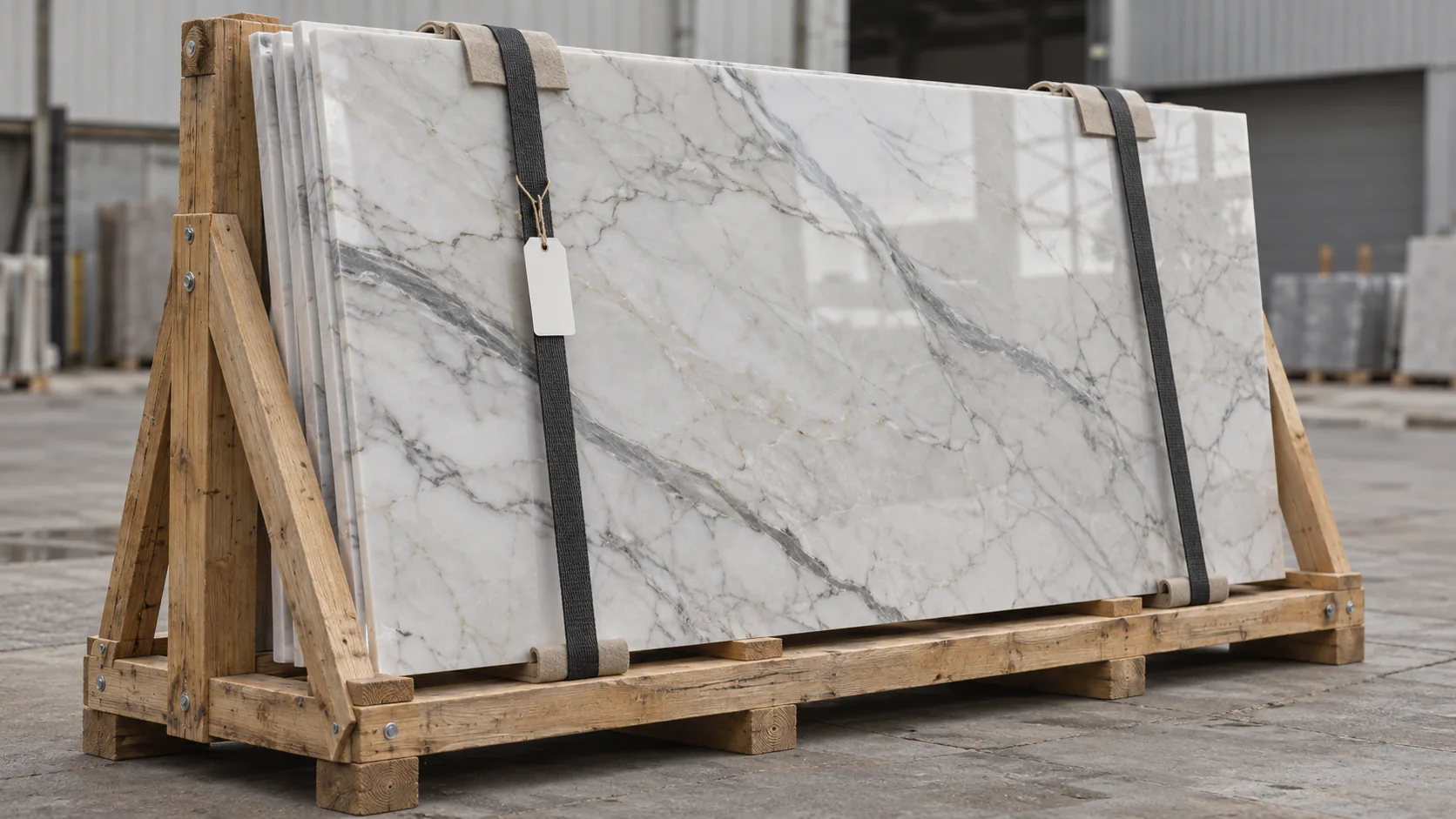
OSHA's bulletin gives a matching range: "Stone slabs can vary in weight from several hundred to several thousand pounds"11. A bundle multiplies the figures: seven of the granite slabs above have a dry mass of about 3.5 t before the timber and the frame.
The block weight calculator does the same arithmetic for blocks: volume × density, with the formula shown.
What the weight means in practice
Handling: A-frames, racks and lifters
OSHA's Safety and Health Information Bulletin SHIB 08-12-2008 reports that its Integrated Management Information System data for 1984–2006 record 46 fatalities in the US associated with handling and storing stone slabs, 11 of them reported by one regional office11. The main danger is the "fall shadow", "the area on both sides of the slab where the slab could land and topple if it were to fall"; "Standing in the fall shadow can result in a crushing injury or fatality should the slab tilt too far"11.
Weight matters for the equipment as much as for the people. OSHA found cases where "the A-frames were not designed properly to support the weight of the slabs", and notes that overloading a rack "can deform the base"11. The UK Health and Safety Executive states, in guidance updated on 4 April 2025, that traditional A-frame storage "is not suitable in this context unless modifications have been undertaken" to stop slabs toppling or slipping out, and that "No person should be within the hazard zone into which a slab might fall whilst it is being handled"12.
OSHA recommends to "Avoid manual lifting of stone slabs where possible" and to use mechanical aids such as slab dollies, suction lifts and scissor clamps11. A suction cup must be "rated to lift these types of finishes" when moving unpolished slabs, and clamps "should be used only on grade 'A' marble and other solid stones without flaws, open seams, or cracks"11. Every lifter and clamp has a rated capacity; the computed dry mass is a planning estimate to compare with it, using the density from your stone's test report, not the only test of whether the equipment suits the job.
Vehicles and containers
Stone fills a container by mass long before it fills it by volume. DSV, a forwarder, lists a maximum payload of 25,000 kg for a 20-foot dry container, and says capacities may vary with the container's manufacturer, age and owner14. Example: at 496 kg per slab, that payload is reached at about 50 of the 3.20 × 1.95 m granite slabs above; in square metres, 25 t is about 314 m² of 3 cm granite or 461 m² of 2 cm calcitic marble (our arithmetic). These are mass-only upper bounds before A-frames, packing and lashing, and before route and floor constraints; use the actual box and route limits. For full container planning, see the container load tool.
Cabinets and floors
A 3.10 × 1.00 m island top in 3 cm granite has a dry mass of about 246 kg (Example: 3.10 m² × 79.5 kg/m²). The Natural Stone Institute's design manual says that "sound varieties of granites and marbles falling within soundness classifications A or B can be used in thicknesses of 20 mm or greater without the use of a subtop"; that unsound veins, cracks or excessive fissuring mandate a subtop "regardless of thickness"; and that heavy loads such as cast-iron sinks may need a subtop or auxiliary framing13.
Whether a cabinet or floor can carry that is a question for the cabinet maker or structural engineer; the dry mass per square metre from the tables is the figure they need.
Frequently Asked Questions
How much does a granite slab weigh per square foot?
At an apparent density of 2,650 kg/m³3, a measured 2 cm granite slab weighs about 10.9 lb/ft² and a measured 3 cm slab about 16.3 lb/ft². Their nominal North American labels are 3/4 in and 1 1/4 in, which are not equal dimensions13. The cited granites range from 2,590 to 2,670 kg/m³3,17; a diabase sold as black granite reaches 18.9 lb/ft² at 3 cm7.
How much does a full slab of granite weigh?
Multiply its area by its dry mass per square metre. A 3.20 × 1.95 m slab of 3 cm granite at 2,650 kg/m³ weighs about 496 kg (1,094 lb); in 2 cm, about 331 kg (worked examples). OSHA says stone slabs "can vary in weight from several hundred to several thousand pounds"11. Add backing, frames and packing for a shipping weight.
Is marble heavier than granite?
How much does a quartz slab weigh?
Cambria lists approximate weights of 10 lb/ft² (48.82 kg/m²) for nominal 2 cm and 15 lb/ft² (73.24 kg/m²) for nominal 3 cm10. A 335 × 166 cm jumbo slab in 3 cm therefore weighs about 407 kg (our arithmetic). Other makers publish their own figures; use the data for the product in hand.
How do I calculate slab weight myself?
Dry mass in kg = length (m) × width (m) × thickness (m) × apparent density (kg/m³). Take the density from the stone's EN 1936 report8, or from an ASTM C97 report16, where bulk specific gravity × 1,000 gives kg/m³. For lb/ft², divide kg/m² by 4.8824289. Use the measured thickness: under EN 1469:2015, a nominal 20 mm cladding slab may be 18–22 mm15.
How heavy a slab can one person lift?
None of the slabs in this article is a one-person lift: even a 1 m² piece of 3 cm granite has a dry mass of 79.5 kg. OSHA recommends avoiding manual lifting of stone slabs where possible and using mechanical aids such as dollies, suction lifts and clamps11. Keep out of a slab's fall shadow while it is handled11,12.
How Noria Strata handles this
In Noria Strata, block weights are calculated from the material's density, and each slab has its own record with measured dimensions and thickness, so its dry mass can be worked out from the slab actually in the rack rather than a catalogue size. The free block weight calculator shows the volume × density formula with a worked example. More on slab inventory.
Sources
- Laskaridis, K., Arapakou, A. & Patronis, M. (2026). The timelessness of Thassos and Naxos heritage ornamental stones. Boletín Geológico y Minero 137(1), 004. DOI 10.21701/bolgeomin/137.1/004 bgm.revistas.csic.es/index.php/bgm/article/download/764/728?inline=1
- Hellenic Survey of Geology and Mineral Exploration. EuroLithos identity card «Thassos White» (apparent density 2,840 kg/m³, EN 1936) repository.europe-geology.eu/egdidocs/eurolithos/thassos_white.pdf
- Carvalho, J., Carvalho, C. & Lisboa, V. (2021). EuroLithos Atlas: Ornamental stone resources in Portugal. LNEG (apparent densities by EN 1936) repository.europe-geology.eu/egdidocs/eurolithos/eurolithos+atlas+portugal.pdf
- Lucarini, M. & Fumanti, F. (2021). EuroLithos Atlas: Ornamental stone resources in Italy. ISPRA (Travertino Romano, 2,247 kg/m³) repository.europe-geology.eu/egdidocs/eurolithos/eurolithos+atlas_italy.pdf
- Fernandes, T. M. G., Godoy, A. M. & Fernandes, N. H. (2003). Aspectos geológicos e tecnológicos dos quartzitos do centro produtor de São Thomé das Letras (MG). Geociências (UNESP) 22(2): 129–141 revistageociencias.com.br/geociencias-arquivos/22_2/3.pdf
- Buildwise (Belgian Building Research Institute). NIT 228 stone sheet «Schiste ardoisier» (Schiste d'Herbeumont, 2,731 kg/m³) buildwise.be/media/jsjihgk2/schiste-ardoisier-en.pdf
- Centro Tecnológico del Mármol (2023). Test report for Loimaan Kivi Oy, «Varpaisjärvi Black», diabase, 2023-06-07 (hosted by the Finnish Natural Stone Association) kivi.info/wp-content/uploads/2023/12/Varpaisjarvi-Black-Loimaan-Kivi-Oy-2023-EN.pdf
- CEN (2006). EN 1936:2006 Natural stone test methods – Determination of real density and apparent density, and of total and open porosity (catalogue page, NSAI) shop.standards.ie/en-ie/standards/en-1936-2006-346633_saig_cen_cen_792579
- NIST. Guide for the Use of the International System of Units (SP 811), Appendix B.9 (pound per square foot to kilogram per square metre: 4.882428) nist.gov/pml/special-publication-811/nist-guide-si-appendix-b-conversion-factors/nist-guide-si-appendix-b9
- Cambria (2024). Slab Product Information (manufacturer's sheet)
- OSHA (2008). Hazards of Transporting, Unloading, Storing and Handling Granite, Marble and Stone Slabs. Safety and Health Information Bulletin SHIB 08-12-2008 osha.gov/publications/shib081208
- Health and Safety Executive (UK). Handling and storage of large sheet stone slabs (updated 2025-04-04) hse.gov.uk/stonemasonry/handling-storage-slabs.htm
- Natural Stone Institute (2022). Dimension Stone Design Manual: Granite chapter, 5.1 (standard nominal thicknesses); Countertops chapter (17), 6.2 Subtops (copy hosted by a member company) lurveys.com/wp-content/uploads/NSI-Dimension-Stone-Design-Catalog.pdf
- DSV. Dry container dimensions (forwarder's page; 20' max payload 25,000 kg) dsv.com/en/our-solutions/modes-of-transport/sea-freight/shipping-container-dimensions/dry-container
- CEN (2015). EN 1469:2015 Natural stone products – Slabs for cladding – Requirements, 4.1.2 (preview pages of SIST EN 1469:2015) cdn.standards.iteh.ai/samples/34684/02005aadbe8a4ef4b70c107b6d0f12cc/SIST-EN-1469-2015.pdf
- ASTM International. C97/C97M-18 Standard Test Methods for Absorption and Bulk Specific Gravity of Dimension Stone (catalogue page; scope excludes slate) store.astm.org/c0097_c0097m-18.html
- Centro Tecnológico del Mármol (2023). Test report 232936PN004A for LT Granit Oy, «Baltic Brown», 2023-02-23 (hosted by the Finnish Natural Stone Association) kivi.info/wp-content/uploads/2023/12/Baltic-Brown-LT-Granit-Oy-2023-EN.pdf
- Papatrechas, C. (2011). Correlation of physicomechanical properties with grain size and mineralogical composition of the carbonate rocks of Eastern Macedonia (Greece). PhD thesis, Aristotle University of Thessaloniki didaktorika.gr/eadd/handle/10442/26663?locale=en
How to cite this article
Theodorakis, N. (2026). How much does a stone slab weigh? Weight per m² and ft² by stone. Noria Strata. https://www.noriastrata.com/en/blog/stone-slab-weight
The author
Nikos TheodorakisCOO, Noria Strata