At a glance
- By weight alone, a 20-foot container takes at most 81 slabs of 3.2 × 1.9 m (about 126 × 75 in) at 2 cm or 54 at 3 cm, in this article's example: 28,330 kg payload, 1.5 t of frames and securing, stone at an assumed 2,700 kg/m³2.
- ONE's specification lists a payload of 28,330 kg for its 20' dry container and 26,840 kg for its 40' dry; DSV's lists 25,000 kg and 27,600 kg1,2.
- Hapag-Lloyd's guideline for its wooden-floor containers allows 4.8 t per running metre of resting length in a 20' and 3 t in a 40'5.
- Under SOLAS, a packed container should not be loaded without a verified gross mass, and the shipper is responsible for it8,9.
Stone fills a container by weight, not by space
By weight alone, a 20-foot container takes at most 81 slabs of 3.2 × 1.9 m (about 126 × 75 in) at 2 cm or 54 at 3 cm, in this article's example: 28,330 kg payload, 1.5 t of frames and securing, stone at an assumed 2,700 kg/m³2. A container of stone is full by weight with most of its interior still empty. The payloads in the two published specifications used here run from 25,000 to 28,330 kg1,2; at an assumed 2,700 kg/m³, that is about 9.2 to 10.4 m³ of solid stone. The limits to check are the container's payload, the road at each end, and the floor.
Density varies by stone, from travertine to the dark stones sold as «black granite», as our article on density and specific weight of stone sets out. For a real load, use the apparent density on the test report for the material being shipped. Every mass in the examples below is a calculated dry stone mass, not a weighed one.
What a container can carry
Container sizes are standardised in ISO 668, which classifies Series 1 freight containers by external dimensions and sets their ratings3. Tare and payload still vary from box to box. DSV says capacities "may vary depending on the container manufacturer, the age of the container and the container owner"1, and ONE says individual containers "may have different specifications" from its list2.
The volumes are payload ÷ 2,700 kg/m³, rounded down; they describe solid stone only, not the space a packed load occupies.
The two specifications differ on the 40'. In ONE's, both boxes have the same gross rating of 30,480 kg, so the heavier 40' has 1,490 kg less payload than the 20'2. In DSV's, the 40' has 2,600 kg more payload than the 20'1. Neither is a rule. Check the actual unit, its plate and the booking. For stone, the length of a 40' matters mainly when long slabs or frames need it, or when a load has to be spread along the floor.
Solid stone at 2,700 kg/m³, before packing.
The road can set the limit before the box does
A container's payload is the most the box can carry. The truck that takes it to or from the port may be allowed to carry less.
In the EU, Directive 96/53/EC sets maximum weights for vehicles in international traffic. In the text as amended to 2019, a two-axle tractor with a three-axle semi-trailer, or a three-axle tractor with a two- or three-axle semi-trailer, may weigh 40 tonnes. A three-axle tractor with a two- or three-axle semi-trailer carrying containers up to 45 feet in total length "in intermodal transport operations" may weigh 44 tonnes. The driving axle of these vehicles may carry 11.5 tonnes6. These limits apply to the combinations named, in international traffic. National rules for domestic traffic can differ, and the Directive has been amended since; check the text in force and the rules of each country on the route.
In the US, federal limits on the Interstate system are 80,000 lb gross vehicle weight, 20,000 lb on a single axle and 34,000 lb on a tandem axle. The federal bridge formula "may require a lower gross vehicle weight" depending on the number and spacing of axles7.
Example. Each cargo ceiling below is the gross limit minus the tractor and trailer (or chassis) minus the container. The tractor-and-trailer tares are our assumptions, not published figures: ask your haulier for the real ones. The container tare is ONE's 2,150 kg for a 20'2. Results are rounded down, because they are ceilings.
- EU, 40 t combination: 40,000 − 15,000 (our assumption) − 2,150 (ONE) = 22,850 kg of cargo.
- EU, 44 t intermodal combination: 44,000 − 15,000 (our assumption) − 2,150 (ONE) = 26,850 kg of cargo.
- US, 80,000 lb = 36,287 kg (at 0.45359237 kg per lb): 36,287 − 12,500 (our assumption) − 2,150 (ONE) = 21,637 kg of cargo, before any permit.
In all three cases the road allows less than the box's own payload of 28,330 kg. A plan that checks only the container rating can produce a box that is within its rated payload but overweight on a road leg. Axle limits add a separate check: within the gross limit, a load concentrated at one end can still put an axle or tandem over its limit.
How much slab and block, by weight alone
Dry mass per square metre is thickness times density. At 2,700 kg/m³, a 2 cm slab weighs 54 kg/m² and a 3 cm slab 81 kg/m² (worked example). A slab of 3.2 × 1.9 m is 6.08 m², so it weighs 328.32 kg at 2 cm and 492.48 kg at 3 cm.
Packing counts against the limit. Under the IMO guidelines, gross mass includes "pallets, dunnage and other packing material and securing materials"9, so A-frames, timber, wedges and lashings are part of the load. The example assumes 1.5 t of them.
| Limit that binds | Cargo allowed (kg) | Stone (kg) | 2 cm: slabs (m²) | 3 cm: slabs (m²) | Same mass as block (m³) |
|---|---|---|---|---|---|
| 20' payload, ONE2 | 28,330 | 26,830 | at most 81 (492) | at most 54 (328) | 9.9 |
| EU road, 44 t intermodal6 | 26,850 | 25,350 | at most 77 (468) | at most 51 (310) | 9.3 |
| EU road, 40 t6 | 22,850 | 21,350 | at most 65 (395) | at most 43 (261) | 7.9 |
| US road, 80,000 lb7 | 21,637 | 20,137 | at most 61 (370) | at most 40 (243) | 7.4 |
The road rows use the tare assumptions stated above. These counts say only that the weight fits. Whether that many slabs can be framed, spread on the floor, secured and unloaded is a separate check, set out in the next section. A different density, slab size or packing allowance changes every figure; you can run your own figures in the container load calculator.
Blocks raise a different problem: one heavy object resting on a short length of floor. Example: a squared block of 2.8 × 1.5 × 1.4 m is 5.88 m³, a calculated dry mass of 15,876 kg at 2,700 kg/m³. That is inside every payload above. The floor is another matter.
Floor load and centre of gravity
Weight per running metre
A container floor has a limit per metre of length, not only a total. Hapag-Lloyd's guideline defines the maximum spread load as weight per running metre, so the cargo allowed "depends on the length that it rests on the container floor"5. For Hapag-Lloyd's wooden-floor containers, its table allows 4.8 t per metre of resting length in a 20' and 3 t per metre in a 40'; its steel-floor containers allow more5. Load may be spread with solid timber or steel beams, "but not more than 100 cm at each end of the load"5. These are one carrier's figures for its own fleet: for a booking, use the floor limits of the actual unit and the loading arrangement the carrier accepts.
Example, using Hapag-Lloyd's 20' wooden-floor figure: the 15,876 kg block needs at least 15,876 ÷ 4,800 = 3.31 m of effective resting length. On 3.0 m, the guideline allows 14.4 t5, which is not enough. The block would need bearers that spread it over a longer length within the carrier's rules, a unit with a higher floor rating, or other equipment. Hapag-Lloyd describes its flat racks as "designed for the transportation of heavier and more concentrated loads than standard containers"5. This is an illustration, not a loading instruction.
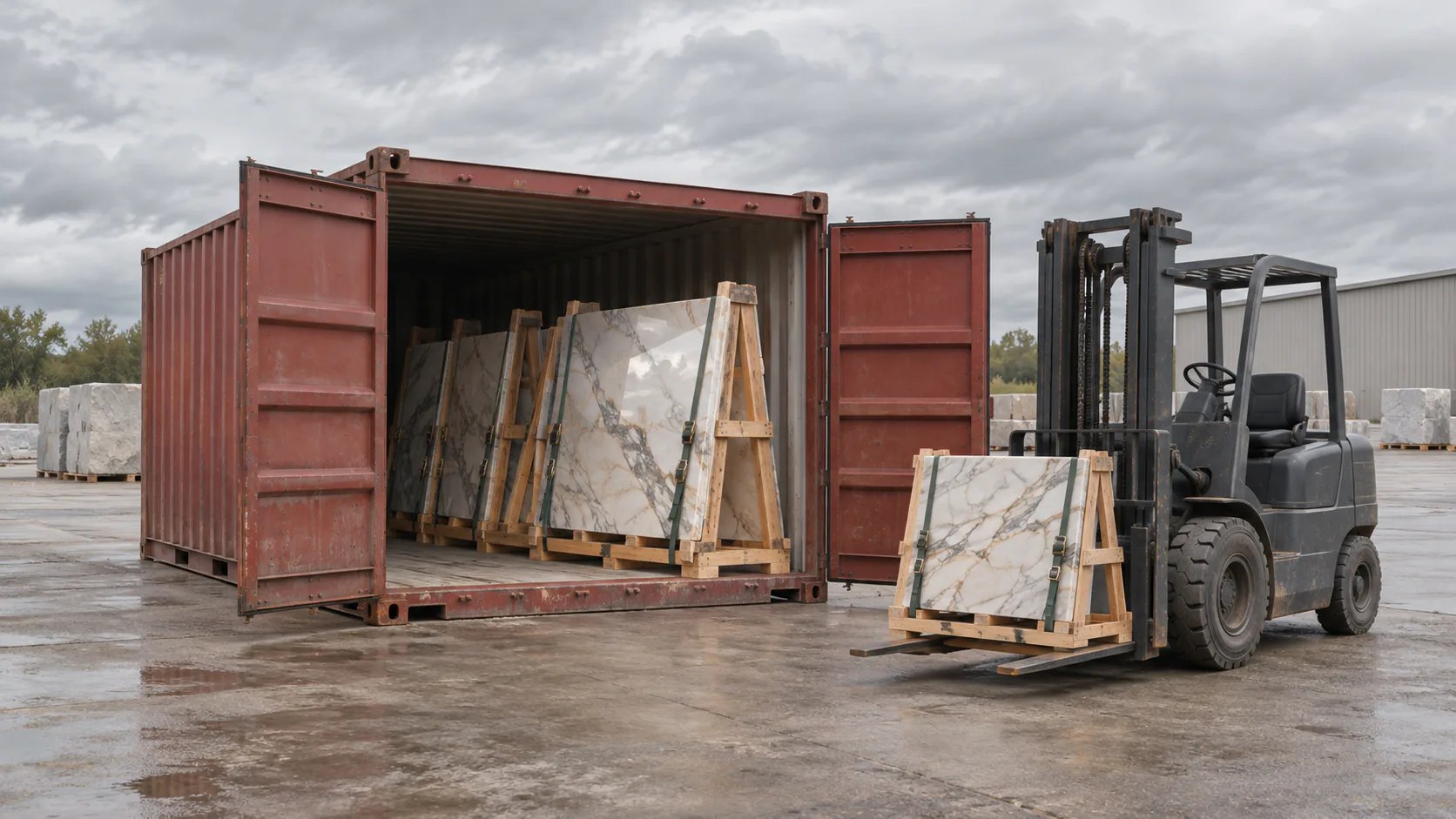
Slabs raise the same question. On the same 4.8 t per metre, a 25 t A-frame load would need at least 5.21 m of resting length (25 ÷ 4.8 = 5.208 m). A container packing handbook notes that "whether 1 or 2 frames are loaded per container depends on the mass of the cargo", and that A-frames can go in standard box or open-top containers11. Ask the carrier about open-top or other equipment when the floor limit, the door opening or lifting from above is the problem. For buyers arranging their own shipments, our guide to sourcing marble directly from a quarry covers the Incoterms® rule for containers and inspection before loading.
Keep the centre of gravity central
The IMO/ILO/UNECE Code of Practice for Packing of Cargo Transport Units (the CTU Code) is the reference for safe packing. IMO describes it as "a non-mandatory global code of practice", endorsed by the three bodies in 20144. Check the applicable carrier terms and national requirements separately.
On weight distribution, TT Club, the transport insurer, cites ISO 3874: when "60% of the cargo mass is distributed in 50% of the container length", the result is 5% eccentricity, which it calls "the industry standard for maximum eccentricity allowed"10. The same article reports research by ETS Consulting in which "17.2% of 20ft and 18.8% of 40ft containers had eccentric loading greater than 5%"; these were containers in general, not stone10. It adds that packing dense blocks without regard to distribution "can result in eccentricities of greater than 14%", and that poor distribution can reduce the effectiveness of brakes and steering on road vehicles10. A block or two A-frames against the front wall, or slabs added at the door end, move the centre of gravity at once.
Securing slabs and bundles
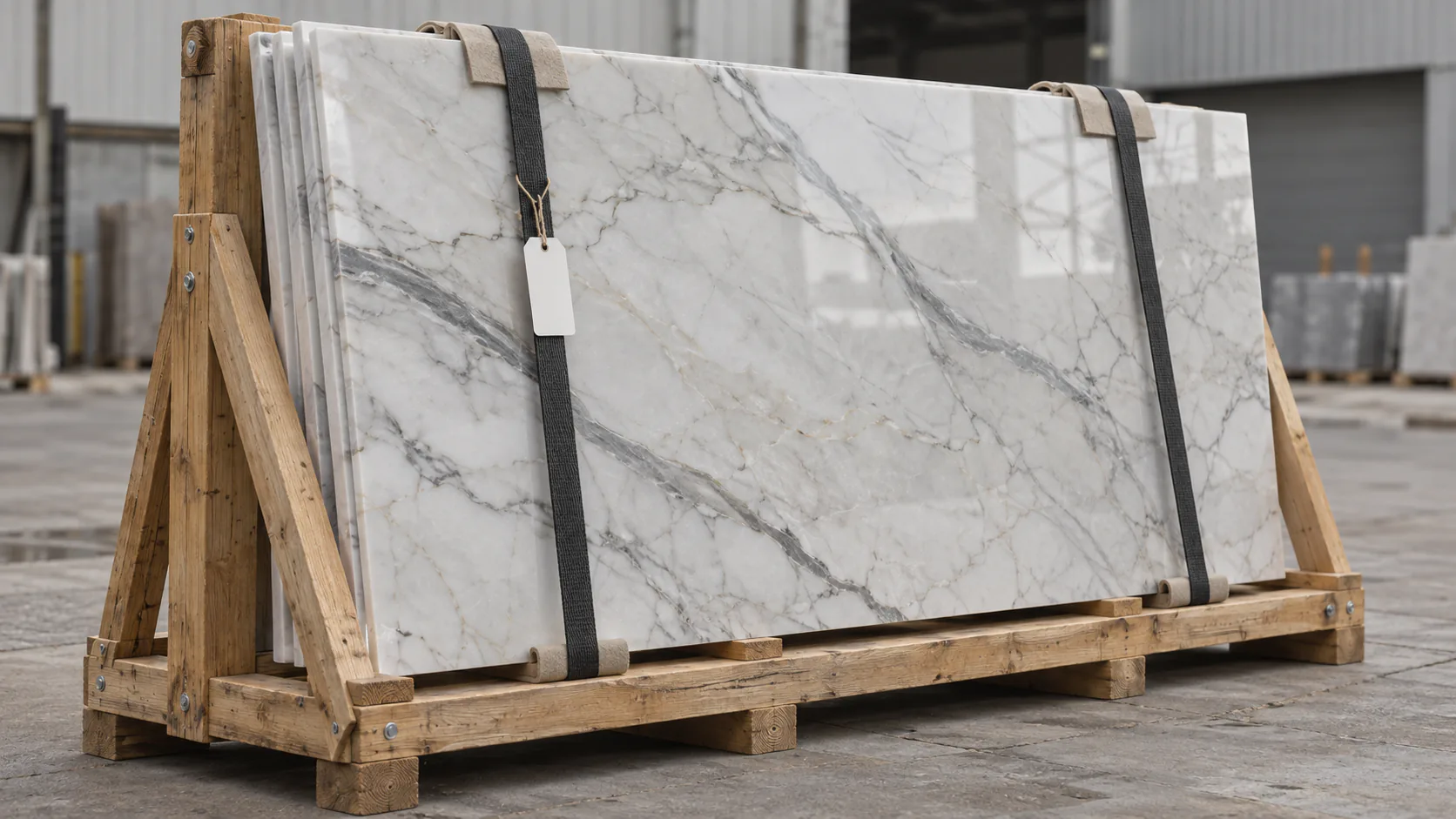
The same handbook describes slabs on A-frames. The slabs are strapped to the frames; in the container, "the frames are secured against lateral and longitudinal shifting with squared lumber"; shoring stops them rising or tipping; and direct lashing prevents lengthwise movement of the slabs11. Because slabs are fragile, "the lashings must be only slightly pretensioned"11.
Securing also protects the people who unload. A US OSHA safety bulletin reports that OSHA's records for 1984–2006 show 46 deaths in the US associated with the handling and storage of stone slabs, not only with containers12. It describes workers who "removed these supports when unloading and have become trapped or crushed" when slabs shifted inside containers12. Record the bundle positions and the agreed unloading and bracing-removal sequence for the consignee.
The verified gross mass: who is responsible
SOLAS chapter VI requires the gross mass of a packed container to be verified before it is loaded; in the UK the amendments "took effect from 1st July 2016"8. The IMO guidelines say "the responsibility for obtaining and documenting the verified gross mass of a packed container lies with the shipper", and that without it the container should not be loaded unless the master and the terminal obtain the mass by other means9.
There are two methods9:
- Method 1: weigh the packed and sealed container.
- Method 2: weigh all packages and cargo items, including pallets, dunnage and other packing and securing material, and add the container's tare, using a method certified and approved by the competent authority of the State where the container was packed and sealed.
A mass calculated from dimensions and an assumed density, or taken from a load plan, is a planning figure. It is not a verified gross mass. Method 2, as the guidelines describe it, weighs the items using a certified method9; check with your national authority what it accepts. In the UK, the Maritime and Coastguard Agency requires shippers using Method 2 to have their method approved, and sets an enforcement tolerance of ±5% or ±500 kg, whichever is greater, "for enforcer's guidance only"8. The tolerance is not extra payload. Elsewhere, how Method 2 is certified is "up to the State concerned"9.
Where planning software helps with stone
Software cannot make a container hold more than its limits allow. It helps with:
- Using the limit across mixed bundles: working through the ways an order of different stones, sizes and thicknesses can be split between containers, to bring each close to its limit without going over.
- Checking every limit at once: container payload, the road limit at each end, floor load and centre of gravity, showing which one binds.
- Positions: where each bundle sits sets the weight distribution, and gives the consignee the positions for planning unloading and bracing removal.
- Documents: the packing list and planned weights come from the same record as the plan. The VGM still comes from an accepted weighing method.
Example: assume the same all-in freight charge for either load. Raising the stone in a box from 20 t to 26 t carries 30% more stone and cuts freight per tonne by 23%.
Frequently Asked Questions
How many slabs fit in a 20-foot container?
By weight alone, the example in this article permits at most 81 slabs of 3.2 × 1.9 m at 2 cm (492 m²) or 54 at 3 cm, with a 28,330 kg payload2, 1.5 t of frames and securing and an assumed 2,700 kg/m³. Frame layout, floor loading, securing and road limits must also pass, and can each lower the count. Use your stone's tested density and your carrier's figures.
Does a 40-foot container always carry more stone than a 20-foot?
No. In ONE's specification both have a maximum gross of 30,480 kg, and the heavier 40' has less payload: 26,840 kg against 28,330 kg2. In DSV's, the 40' has 2,600 kg more payload than the 20'1. Either way, stone reaches the weight limit long before the space limit. Check the actual unit and booking.
How much does a loaded container of granite weigh?
Its gross mass is the container's tare plus the stone plus all packing and securing material9. A 20' at ONE's full payload reaches its 30,480 kg rating2. Whether that can travel by road depends on the vehicle and country: in EU international traffic, 40 t for the named combinations or 44 t for specified intermodal container combinations6; 80,000 lb on US Interstates7.
Who is responsible for the VGM of a stone container?
The shipper. The IMO guidelines place the responsibility for obtaining and documenting the verified gross mass on the shipper, using Method 1 (weighing the packed container) or Method 2 (weighing all contents and adding the tare by a certified method)9. A mass calculated from size and density is a planning figure, not a VGM.
Is the CTU Code mandatory?
IMO describes it as "a non-mandatory global code of practice" for packing cargo transport units, endorsed by IMO, ILO and UNECE in 2014, and notes it could serve as a reference for national regulations4. Check carrier terms and national rules separately. Road weight and axle limits are law in their own right6,7.
How Noria Strata handles this
Noria Strata's load planner places each item using its recorded dimensions and weight, and checks the weight distribution, the centre of gravity and the axle loads before the container is loaded. The weights come from the scan and the material's density. They serve the plan and can support the shipping documents; the shipper must still obtain the VGM by an accepted weighing method. See logistics, or try the container load calculator with your own stone and slab sizes.
Sources
- DSV (n.d.). Dry container dimensions (forwarder specification page) dsv.com/en/our-solutions/modes-of-transport/sea-freight/shipping-container-dimensions/dry-container
- Ocean Network Express (n.d.). Dry containers (carrier specification page) one-line.com/en/standard-page/dry-containers
- ISO (2020). ISO 668:2020 Series 1 freight containers – Classification, dimensions and ratings (BSI catalogue page) knowledge.bsigroup.com/products/series-1-freight-containers-classification-dimensions-and-ratings
- International Maritime Organization (n.d.). IMO/ILO/UNECE Code of Practice for Packing of Cargo Transport Units (CTU Code) imo.org/en/OurWork/Safety/Pages/CTU-Code.aspx
- Hapag-Lloyd (n.d.). Weight distribution guideline (carrier guideline) hapag-lloyd.com/content/dam/website/downloads/pdf/Weight_distribution_guideline_03.pdf
- Council Directive 96/53/EC of 25 July 1996, Annex I, revised version of 14 August 2019 (copy on legislation.gov.uk) legislation.gov.uk/eudr/1996/53/annexes
- US Federal Highway Administration (n.d.). Size and weight overview ops.fhwa.dot.gov/freight/sw/overview/index.htm
- Maritime and Coastguard Agency / GOV.UK (2016). Verified gross mass of containers gov.uk/government/publications/verified-gross-mass-of-containers
- International Maritime Organization (2014). MSC.1/Circ.1475, Guidelines regarding the verified gross mass of a container carrying cargo, 9 June 2014 wwwcdn.imo.org/localresources/en/OurWork/Safety/Documents/MSC.1%20Circ.1475.pdf
- TT Club (2014). TT Talk – Is weighing enough? ttclub.com/news-and-resources/news/article/tt-talk-is-weighing-enough
- Container Handbook (n.d.). 5.2.3.4 Granite and marble slabs on A-frames containerhandbuch.de/chb_e/stra/stra_05_02_03_04.html
- US Occupational Safety and Health Administration (2008). Hazards of Transporting, Unloading, Storing and Handling Granite, Marble and Stone Slabs, SHIB 08-12-2008 osha.gov/publications/shib081208
How to cite this article
Theodorakis, N. (2026). Loading stone in a container: slabs, bundles and blocks by weight. Noria Strata. https://www.noriastrata.com/en/blog/container-load-planning-savings
The author
Nikos TheodorakisCOO, Noria Strata